






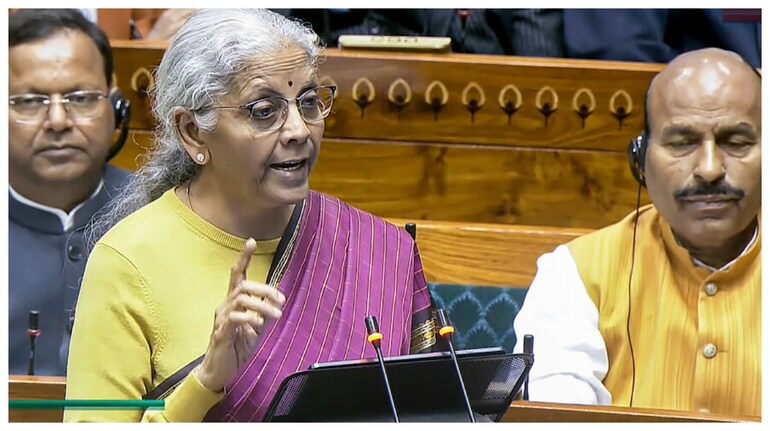
Finance Minister Nirmala Sitharaman on February 1 presented a budget that blended immediate concerns with long-term structural goals by focussing on the new economy sectors, mainstreaming artificial intelligence (AI), hi-tech, rare earths and data centres while staying firm on the fiscal consolidation path.
She laid out a new rural welfare framework —anchored by the VB GRAM G programme with an allocation of Rs 95,600 crore, which replaced the 22-year-old MGNREGA that had a budgetary allocation of Rs 88,000 crore in 2025-26.
“The Reform Express is well on its way and will maintain its momentum to help us fulfil our kartavya”, Sitharaman, who is the longest continuously serving finance minister of independent India, said.
The Budget raised the securities transaction tax (STT) and kept long-term capital gains tax (LTCG) unchanged.
The STT on futures has been raised to 0.05 percent from present 0.02 percent. STT on options premium and exercise of options are both proposed to be raised to 0.15 percent from the present rate of 0.1 percent and 0.125 percent respectively.
“We reformed the taxation landscape for corporates in 2019 by providing them a simplified regime with lower tax rate so that they could productively focus on business rather than on claim of deductions and exemptions,” the finance minister said.
“India will continue to take confident steps towards Viksit Bharat, balancing ambition with inclusion. As a growing economy with expanding trade and capital needs, India must also remain deeply integrated with global markets, exporting more and attracting stable long-term investment,” said Sitharaman, who, in a break from tradition, spoke extensively on what is referred to as Part B of the Budget speech that deals with taxation.
Fiscal primacy
Sitharaman was on track to meet the fiscal consolidation goals.
The minister pledged to keep the fiscal deficit — a measure of how much a government borrows to meet its expenses—at 4.3 percent of GDP in 2026-27 from 4.4 percent in 2025-26.
Last year’s budget announced the public debt-to-GDP ratio as the principal policy anchor, replacing traditional deficit markers. The budget reinforced the shift that comes into play this fiscal, with a target to lower the debt-to-GDP ratio to 50 percent by 2031.
The debt-to-GDP ratio is a widely accepted indicator of a country's fiscal health and the commitment to fiscal prudence with clearly defined medium-term goals.
To finance the deficit in 2026-27, the net market borrowings from dated securities are estimated at Rs 17.2 lakh crore, from a revised estimate of Rs 15.58 lakh crore in 2025-26.
The minister has banked on better revenue mobilisation to keep the deficit under check. For FY27, the net tax receipts are estimated at Rs 28,66,922 crore, up 7.2 percent from the previous year’s revised estimates of Rs 26,74,661 crore.
Heavy lifting on capex
The government will continue to do the heavy lifting on investment but at a more gradual pace. Sitharaman projected capital expenditure of Rs 12.2 lakh crore for the fiscal starting April 1, a 11.5 percent increase over the current year.
The government expects higher public spending on infrastructure projects to stimulate economic growth and create jobs.
The decision to increase capital expenditure — from Rs 7.5 lakh crore in 2022-23 to Rs 12.2 lakh crore in 2026-27 — is driven by the expectation of an economic multiplier effect.
Highways and ports are long-gestation projects but can create jobs, with cascading benefits on intermediate industries such as cement and steel.
The front-loading of capital expenditure is part of a well-crafted medium-term strategy to not only accelerate infrastructure development but also trigger a cycle of private investment, also described as the “crowding in” phenomenon.
Building AI
Sitharaman signalled the Modi government’s intent to make AI and hi-tech a central tower of India’s medium-term growth strategy.
She announced rare earths, data centres and bio-pharma as a principal components to leverage India’s talent and data, positioning the country as a global leader while simultaneously driving economic growth and addressing key socio-economic challenges
“Cutting-edge technologies, including AI applications, can serve as force multipliers for better governance,” she said.
As the world's fastest-growing major economy with the largest population, India has a significant and unique stake in the unfolding AI revolution, possessing both the talent pool and the immense data scale necessary to become a global leader.
A proactive and coordinated national approach to AI and rare earths development is crucial. This will not only position India at the forefront of this transformative technology but also ensure equitable access, foster responsible innovation, and address some of the nation's most pressing socio-economic challenges.
To enable critical infrastructure and boost investment in data centres, the finance minister announced a tax holiday till 2047 to any foreign company that provides cloud services to customers globally by using data centre services from India. It will, however, need to provide services to Indian customers through an Indian reseller entity.
To develop India as a global Biopharma manufacturing hub, the finance minister proposed the Biopharma SHAKTI with an outlay of Rs 10,000 crores over the next 5 years. This will build the ecosystem for domestic production of biologics and biosimilars.
She also announced the launch of Indian Semiconductor Mission (ISM) 2.0 “to produce equipment and materials, design full-stack Indian IP, and fortify supply chains. The Electronics Components Manufacturing Scheme, launched in April 2025 also got a higher outlay to Rs 40,000 crore to capitalise on the momentum.
A scheme for Rare Earth Permanent Magnets was launched in November 2025. “We now propose to support the mineral-rich States of Odisha, Kerala, Andhra Pradesh and Tamil Nadu to establish dedicated Rare Earth Corridors to promote mining, processing, research and manufacturing”, she said.

Discover the latest Business News, Sensex, and Nifty updates. Obtain Personal Finance insights, tax queries, and expert opinions on Moneycontrol or download the Moneycontrol App to stay updated!
Find the best of Al News in one place, specially curated for you every weekend.
Stay on top of the latest tech trends and biggest startup news.




