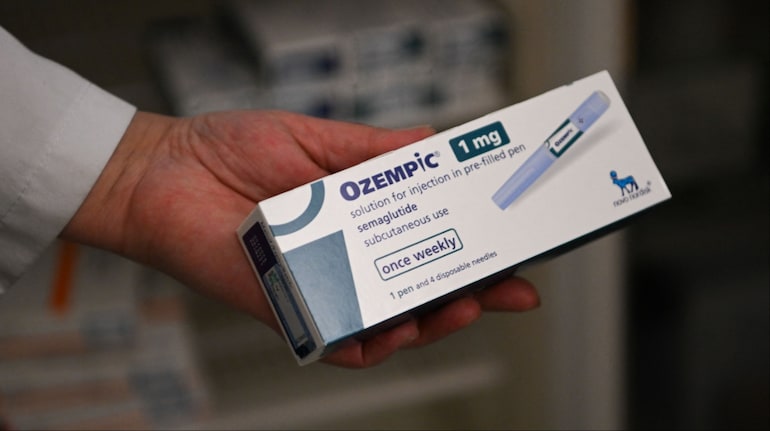

Semaglutide, the GLP‑1 blockbuster molecule behind Danish drugmaker Novo Nordisk's Ozempic, Wegovy, and Rybelsus — has gone off patent on March 20, opening the gates for dozens of branded generics to enter the market.
Come March 21, Indian pharma majors, Sun Pharma, Dr Reddy’s, Zydus, Lupin, Natco, and Mankind, will enter the market, which could lead to around fall 50–70 percent crop in prices, reshaping access for millions of diabetic and obese patients in India’s largely out‑of‑pocket healthcare system.
Moneycontrol explains what this means for patients, what do experts have to say and and how Novo Nordisk plans to defend its turf.
What Semaglutide generics mean for patients?
The key patent for Danish drugmaker Novo Nordisk's semaglutide (the active ingredient in Ozempic and Wegovy) in India expires March 20. This allows multiple Indian pharmaceutical companies to launch generic versions of the blockbuster diabetes and weight-loss drug from March 21. Some companies have marketing licences to sell only Ozempic for type 2 diabetes; others have approvals for both diabetes and weight loss.
The prices of the drug are expected to drop by 50 to 70 percent, which translates into monthly costs of Rs 3,000–Rs.5,000 per month.
What do medical experts have to say?
Semaglutide's development was inspired by a hormone found in the saliva of the Gila monster, a lizard species. Researchers discovered that a component in the venom, Exendin-4, mimiced human GLP-1, helping to regulate blood sugar but lasted much longer, which led to the creation of synthetic GLP-1 receptor agonists.
Experts say these drugs are disease‑modifying not just glucose‑lowering.
Endocrinologist Dr Shashank Joshi calls semaglutide a “game‑changing, disease‑modifying drug” because it works on glucose, weight and metabolic complications simultaneously. Semaglutide can reduce fat in the liver, pancreas and visceral tissues, potentially enabling diabetes remission when weight loss exceeds 10–15 percent. Cardiac and stroke protection is backed by strong trial data.
Cardiologist Dr Bhupen Desai points to the SUSTAIN‑6 trial, noting semaglutide reduces heart attack risk by 26 percent, reduces stroke risk by 39 percent and improves heart failure, kidney function and overall survival.
SUSTAIN-6 is phase-3 clinical trial sponsored by Novo Nordisk to assess the cardiovascular (CV) safety and efficacy of 0.5 mg or 1.0 mg semaglutide versus placebo in patients with type 2 diabetes and high cardiovascular risk. It had 3,297 patients followed over roughly two years.
“Up till now we were controlling diabetes. Now we are modulating the disease,” Desai said.
GLP‑1 drugs exploded globally because of an easy once‑weekly injection, strong weight‑loss outcomes, and improvements in sleep apnea, fatty liver disease and quality of life. These effects can reshape “economic behaviour and food chains,” Dr Joshi said, calling this period the “GLP‑1 generation".
Experts advise caution against misuse and side-effects
The drug, he said, is powerful precisely because it is a disease‑modifying biologic, not a cosmetic quick fix. Joshi warned that the growing culture of unsupervised use —fuelled by social‑media testimonials — could trigger preventable harm.
These are not "ordinary" drugs and should only be prescribed by endocrinologists, cardiologists, or specialist physicians, not even "ordinary doctors" should administer them, Joshi said.
"These are complex, once-weekly injections requiring strict nutritional adherence and expert oversight to prevent serious medical complications," he said.
Nausea is the most common side-effect, especially during dose escalation. Although rare, serious side effects can include pancreatitis, gallbladder problems, kidney issues, and severe allergic reactions.
Please read here on potential side-effects, misuse as cosmetic drug and aggresive marketing adopted by companies.
What does the data say?
Semaglutide is supported by one of the strongest evidence bases in metabolic medicine, with over 70 clinical studies involving more than 20,000 patients, including Indian participants, demonstrating its efficacy across blood glucose control, weight reduction and long‑term metabolic health outcomes.
Clinical trials consistently show substantial HbA1c reductions and 10–15 percent or more weight loss, levels high enough to enable diabetes remission in selected early‑stage patients, said Dr Joshi.
Beyond glycemic control, semaglutide’s multi‑organ benefits have been validated across dedicated trials - the SUSTAIN‑6 cardiovascular outcomes trial found a 26 percent reduction in heart attack risk and 39 percent reduction in stroke risk, while additional studies (including FLOW for kidney outcomes and ESSENCE for fatty liver disease) show protection across the heart, kidneys, liver and vascular system.
The FLOW trial is a major phase 3b study that found weekly 1.0 mg injections of semaglutide significantly protect kidney function and reduce cardiovascular deaths in patients with type 2 diabetes and chronic kidney disease (CKD). It showed a 24 percent lower risk of major kidney disease events and 18 percent lower cardiovascular risk. It had 3500 patients.
The ESSENCE trial is an ongoing Phase 3 study investigating the effectiveness of weekly 2.4 mg subcutaneous semaglutide on adults with metabolic dysfunction-associated steatohepatitis (MASH) and moderate-to-advanced fibrosis or liver disease..
These results make semaglutide a rare diabetes medicine with proven disease‑modifying potential rather than simple symptom control, explaining the intense clinical and commercial interest globally.
Semaglutide has also become one of the world’s fastest‑growing drug classes, contributing $26 billion to Novo Nordisk’s GLP‑1 revenues in 2024, underscoring its medical and commercial impact.
How is Novo Nordisk defending its turf?
Novo Nordisk's strategy involves defending its Indian market by combining its premium brand with local distribution strength and lowering prices — Wegovy prices were cut by up to 37 percent.
It has also used legal means to deter competition coming in before the patent expiry. Novo has also entered into collaborations aimed at increasing the market penetration through a "second brand" strategy. In November 2025, Emcure became the exclusive distributor for Poviztra, a second brand of Novo's weight-loss drug Wegovy (semaglutide 2.4 mg). Last month it has partnered with Abbott India to commercialise Extensior, a second brand of the diabetes drug Ozempic (semaglutide).
While Novo Nordisk continues to manufacture the product, Abbott uses its extensive distribution footprint to market. These collaborations allow Novo Nordisk to retain manufacturing control while utilizing local partners' established on-ground presence to compete with upcoming low-cost generic alternatives.
Are the generics the same as the original Ozempic/Wegovy?
Semaglutide is a recombinant biological peptide and not a simple chemical generic. Dr Parag Sheth, Regional Director-Regulatory & Medical at Abbott, said original is produced via recombinant DNA biotechnology, while many upcoming products use synthetic peptide processes that differ significantly. Even if bioequivalent, they may not be therapeutically equivalent, he said.
Synthetic versions may have impurities, different immunogenicity, and higher risk of reactions.
Novo and its partners also claim that they have India’s largest cold‑chain systems, ensuring stability throughout the product’s shelf life. The FlexTouch delivery pen (patented) is designed for high precision dosing, which could differ across manufacturers
But other in the generic industry says that isn't true. They say that generics offer the same benefits, regulators approve when generic manufacturers demonstrate their drugs have the same pharmacological effect and safety profile as the brand-name drug.

Discover the latest Business News, Sensex, and Nifty updates. Obtain Personal Finance insights, tax queries, and expert opinions on Moneycontrol or download the Moneycontrol App to stay updated!
Find the best of Al News in one place, specially curated for you every weekend.
Stay on top of the latest tech trends and biggest startup news.