Banking system liquidity in 2025 looked comfortable on paper but felt tight in the market. Even as numbers showed surplus conditions for much of the year, funding costs stayed high and bond yields moved up sharply after June. Large inflows and liquidity injections did not translate into easy money for banks and dealers, as liquidity was unevenly distributed and often absorbed by the Reserve Bank of India (RBI) through foreign exchange operations, weakening the impact of monetary easing.
“Although headline numbers in 2025 reflected a surplus, the effective liquidity available to the market was often far tighter, as seen in the sustained rise in yields post-June,” said Balasubramanian R, head of treasury at Dhanlaxmi Bank.
Explaining the RBI’s approach through the year, V. Ramachandra Reddy, DGM – head of treasury at Karur Vysya Bank, said, “During 2025, the RBI infused abundant liquidity through OMOs and buy/sell FX swaps, facilitating a transition from a relatively restrictive liquidity environment to an easing phase.”
This was supported by policy rate cuts starting February and continued liquidity injections to ensure smooth and faster transmission of monetary policy across the system.
Given the RBI’s stance of maintaining lower rates for a longer period, supported by benign inflation dynamics and strong FX interventions. Reddy expects liquidity conditions to remain supportive at least through the first half of the next financial year.
The RBI stepped in with fresh measures towards the end of the year. On December 23, it announced Rs 2 lakh crore of OMO purchases of government securities in four tranches and a USD/INR buy/sell swap auction of $10 billion for a three-year tenor. The move followed a turn to liquidity deficit in December due to heavy advance tax and goods and services tax (GST) outflows, with most of the liquidity infusion scheduled for January to ease conditions as the system moves into 2026.
 Banking system liquidity
Here is how liquidity panned in 2025:
Early 2025: Liquidity Stress and Active Management
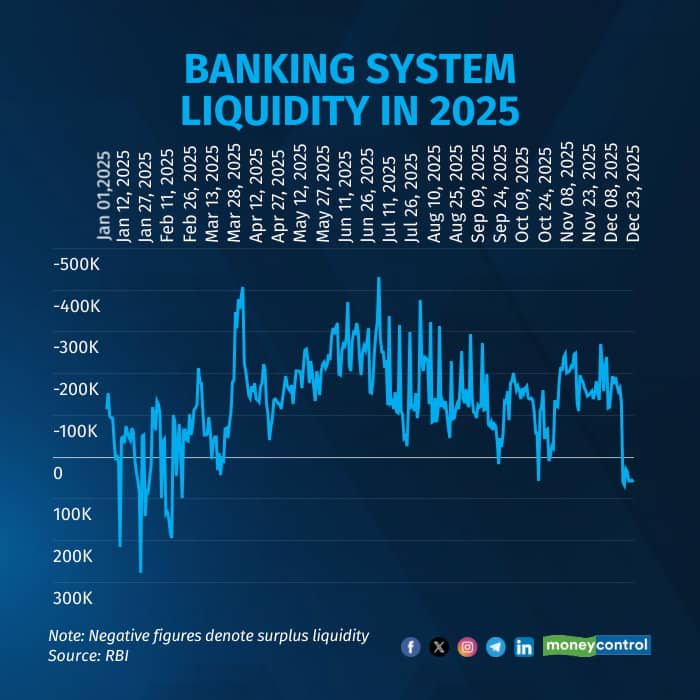
After remaining in surplus between July and November 2024 (between Rs 1-2 lakh crore) system liquidity slipped into deficit during December 2024 and January 2025 (Rs 1-2.5 lakh crore).The tightening was driven by advance tax outflows in December, sustained capital outflows, forex market operations, and a sharp rise in currency in circulation in January.
The deficit peaked in January, with net liquidity injection under the Liquidity Adjustment Facility (LAF) touching Rs 3.1 lakh crore on January 23, as per RBI’s data.
During this phase, the RBI stepped up short-term and durable liquidity support, which included daily Variable Rate Repo (VRR) auctions from mid-January, sizeable open market operation (OMO) purchases, and USD/INR Buy/Sell swaps.
The central bank also flagged concerns over banks’ reluctance to lend in the uncollateralised call money market, urging more active interbank participation to strengthen rate discovery through the weighted average call money rate (WACR).
February-March: Turning the Corner
Liquidity conditions improved steadily through February and March as the RBI injected close to Rs 6.9 lakh crore through a combination of OMOs, term VRRs and USD/INR buy-sell swaps, RBI data showed.
Government spending picked up sharply in the latter half of March, further easing conditions. As a result, system liquidity moved from deficit to surplus by March 29, and stood at around Rs 1.5 lakh crore in surplus in early April.
April-June: Durable Liquidity Takes Centre Stage
By mid-2025, the cumulative impact of RBI actions became evident. Since January, around Rs 9.5 lakh crore of durable liquidity had been injected into the banking system. Open market purchases accounted for over Rs 5.2 lakh crore, while term VRRs and forex swaps contributed roughly Rs 2.1 lakh crore and Rs 2.2 lakh crore, respectively.
Liquidity remained in surplus from end-March, reflected in tepid demand for VRR auctions and elevated balances parked under the Standing Deposit Facility (SDF), averaging about Rs 2 lakh crore during April–May. To further strengthen durable liquidity and lower banks’ funding costs, the RBI announced a staggered 100 basis points cut in the cash reserve ratio (CRR), to be implemented from September through November 2025, releasing an additional Rs 2.5 lakh crore by year-end.
August-October: Comfortable Surplus and Strong Transmission
Liquidity conditions continued to ease through the middle of the year. Average daily surplus under the LAF rose to about Rs 3 lakh crore between June and July, before moderating somewhat in August and September.
The phased CRR cuts by 100 basis points (bps) to 3.0 per cent of net demand and time liabilities (NDTL) and drawdown of government cash balances supported liquidity in the latter part of the year. This has helped to provide durable liquidity to the banking system.
“The cut in CRR release primary liquidity of about Rs 2.5 lakh crore to the banking system by December 2025. Besides providing durable liquidity, it will reduce the cost of funding of the banks, thereby helping in monetary policy transmission to the credit market. I would like to reiterate that we will continue to monitor the evolving liquidity and financial market conditions and proactively take further measures, as warranted,” RBI said in June policy.
Comfortable liquidity played a key role in reinforcing monetary transmission during the easing cycle. Money market rates, including the WACR, Treasury bill yields, certificates of deposit and commercial paper rates, declined broadly in line with or even more than the cumulative 100 basis points cut in the policy repo rate since February.
G-sec and corporate bond yields also softened, making Indian bonds among the better-performing assets globally during this period.
December: Sustained Surplus with Active Fine-Tuning
By December 2025, system liquidity averaged a surplus of about Rs 1.5 lakh crore, even as short-term absorption fluctuated due to transient factors. The RBI reiterated its commitment to ensuring adequate durable liquidity, announcing fresh OMO purchases of Rs 1 lakh crore and $5 billion in three-year USD/INR Buy/Sell swaps.
RBI Governor Sanjay Malhotra in December monetary policy said that injection (absorption) of liquidity through purchase (sale) of government securities under OMOs and that through operations under the LAF (VRR or VRRR) of short term duration serve very different purposes. While the objective of purchase (sale) under OMO is to provide (absorb) durable liquidity, the purpose of repo operations is to manage transient liquidity so as to align the operating target – the Weighted Average Call Rate (WACR) – to the policy repo rate. So, it is quite possible that we inject durable liquidity through purchase of government securities under OMO on the one hand while simultaneously withdrawing transient liquidity through a VRRR operation on the other hand.

Discover the latest Business News, Sensex, and Nifty updates. Obtain Personal Finance insights, tax queries, and expert opinions on Moneycontrol or download the Moneycontrol App to stay updated!
Find the best of Al News in one place, specially curated for you every weekend.
Stay on top of the latest tech trends and biggest startup news.