Specialized Investment Funds (SIFs), a new investment avenue recently introduced by the Securities and Exchange Board of India (SEBI), are poised to significantly impact the Indian investment landscape.
Positioned as a new category within the mutual fund regulations, Specialized Investment Funds (SIFs) are SEBI-approved investment vehicles designed to bridge the gap between Mutual Funds and AIFs/PMS. They combine the regulatory simplicity and taxation benefits of Mutual Funds with the flexibility and strategy innovation typical of PMS/AIF structures. In essence, SIFs are like a mutual fund in tax treatment, but with the freedom to run long–short or special-situation strategies like an AIF. Managed by AMCs through distinct SIF entities, these funds can operate 7 differentiated scheme categories across Equity, Debt & Hybrid asset classes.
A Sophisticated New Asset ClassThis new investment asset class is designed to offer sophisticated investment strategies that go beyond the typical scope of conventional mutual funds. They are intended for discerning investors who seek opportunities in niche areas and are comfortable with potentially higher risks and complexities. They allow investors to access differentiated strategies like long-short equity, hybrid allocators, and structured credit that can smooth volatility while retaining meaningful upside, customising risk and return intelligently.
The Role of SIFs in an investor's portfolioMost investors today rely on traditional equity and debt funds. SIFs open up a new layer of opportunities through tactical, risk-managed, and yield-enhancing strategies that help portfolios perform better across market cycles.
SIFs introduce a new dimension of diversification beyond traditional equity and debt assets by incorporating alternative strategies such as long–short positions, structured credit, and derivative overlays. These approaches help reduce dependence on conventional market cycles, offering investors a more balanced portfolio. They also enable greater risk–return customisation cushioning downside risks while still allowing meaningful participation in market upsides, thereby providing a middle ground between pure debt and full equity exposure. Additionally, SIFs can enhance fixed-income allocations by acting as a “fixed-income plus” tool, targeting higher yields than traditional bonds while maintaining relatively lower volatility than equities.
The ability to implement specialized and tactical strategies gives SIFs the potential to generate returns across both rising and falling markets. Their focus extends beyond absolute performance to enhancing the efficiency of returns, aiming to earn more per unit of risk taken.
At the end of the day, SIFs can effectively bridge the gap that previously existed between traditional mutual funds and PMS or AIFs by offering sophisticated investors access to specialized strategies with a potentially lower minimum investment compared to AIF categories. They will bring previously less accessible strategies like long-short and leverage within a regulated mutual fund framework and democratize such investment options.Most investors today rely on traditional equity and debt funds. SIFs open up a new layer of opportunities through tactical, risk-managed, and yield-enhancing strategies that help portfolios perform better across market cycles.
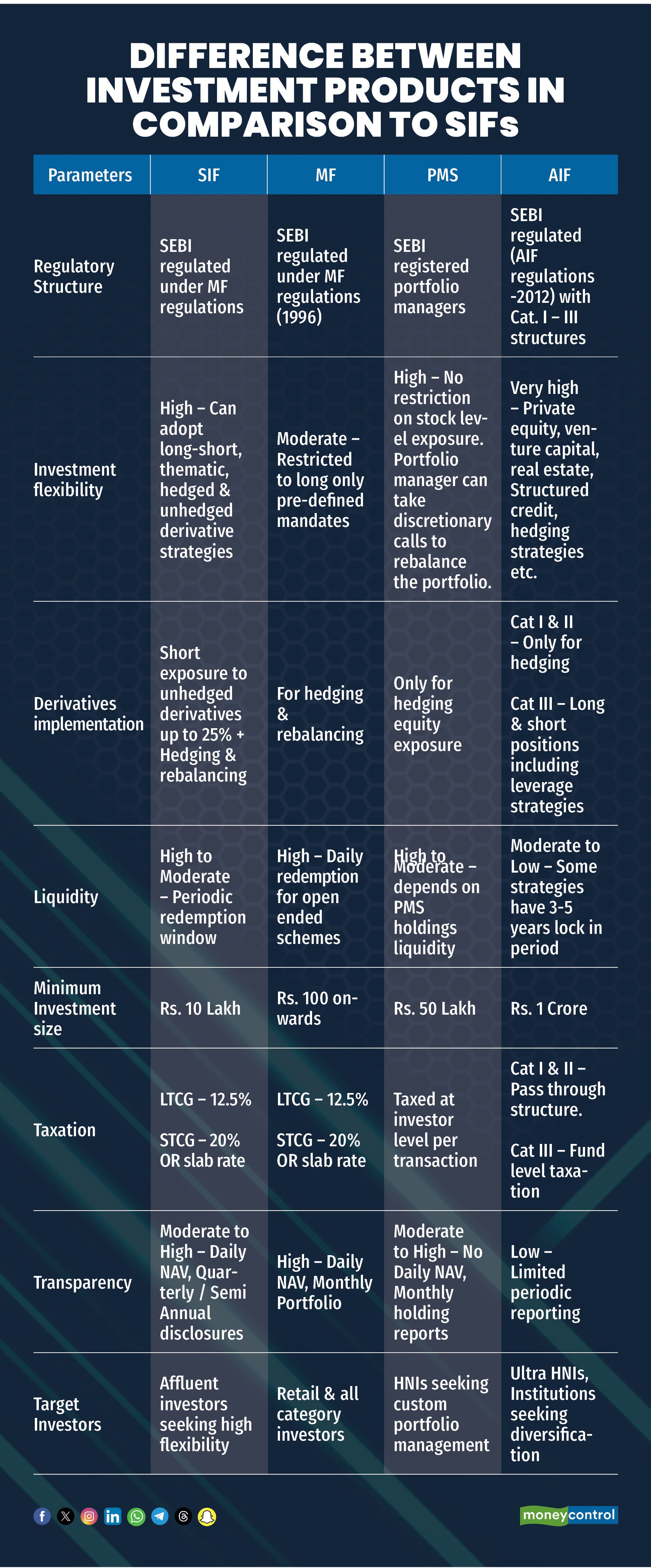
SIFs are primarily aimed at emerging affluent, high-net-worth individuals ( HNIs), accredited investors, and potentially institutional investors. The minimum investment threshold is set higher than that of a regular mutual fund and is currently 10 Lakhs at the PAN level across all SIF strategies of an AMC. While this is lower than the minimum ticket size of 50 lakhs needed for a single PMS investment of 1 Crore needed for an AIF, it will still make SIF accessible only to a specific segment of the investor population.
Also read | Retirement planning in your 30s: Start now, retire rich
Risks and ConsiderationsWhile promising, investors considering SIFs should also be mindful of a few things. The specialized strategies employed by SIFs, including the use of derivatives, inherently carry higher complexity and risks compared to traditional mutual funds. Also, depending on the SIF's strategy and structure, there might be lock-in periods or lower liquidity compared to open-ended mutual funds.
That being said, the success and long-term impact of SIFs will depend on various factors, including regulatory evolution, market acceptance, and the performance of the funds launched under this category. They certainly have the potential to be a significant game-changer by expanding the accessibility and range of sophisticated investment options available in India.
Key Takeaways● SIFs allow fund managers to deploy advanced techniques such as long-short equity, sector rotation, and tactical asset allocation—strategies typically reserved for PMS or AIF products. This flexibility helps them generate returns in rising, sideways & falling markets, unlike traditional mutual funds that usually rely only on long positions.
● Due to their active management approach and implementation of various derivative strategies, SIFs aim to deliver higher risk adjusted returns & hence higher alpha, or performance above benchmarks, by leveraging sophisticated market insights and dynamic rebalancing.
● SIFs offer the tax treatment of mutual funds but with the strategic flexibility of a PMS or AIF, making them appealing from both a compliance and efficiency standpoint. Investors get regulated oversight under SEBI while retaining flexibility in investment approaches.
● A minimum investment threshold of around ₹10 lakh makes SIFs accessible to high-net-worth individuals (HNIs) and mass affluent investors who may not meet the ₹50 lakh or ₹1 crore entry barriers typical of PMS or AIF products
The writer is Co-founder, Wealthy.in, a wealth management platformDisclaimer: The views expressed by experts on Moneycontrol are their own and not those of the website or its management. Moneycontrol advises users to check with certified experts before taking any investment decisions.Discover the latest Business News, Sensex, and Nifty updates. Obtain Personal Finance insights, tax queries, and expert opinions on Moneycontrol or download the Moneycontrol App to stay updated!
Find the best of Al News in one place, specially curated for you every weekend.
Stay on top of the latest tech trends and biggest startup news.