
Home loan rates have gone up marginally, thanks to the sixth increase in the Repo rate in the current financial year. But Ambuj Chandna, President – Consumer Assets, Kotak Mahindra Bank Ltd, tells Moneycontrol that the increase hasn’t affected the affordability of home loans and that demand continues to be strong.
Will there be an UBERisation of homes, where people rent places and move cities? Chandna doesn’t see a growing trend of people renting and sees more people buying homes for their own use. The changing mindset of borrowers — both on the home loan and credit card front — as interest rates stiffen and inflation eats into income, reveals how the credit scenario in India is evolving, he said in an interaction with Khyati Dharamsi.
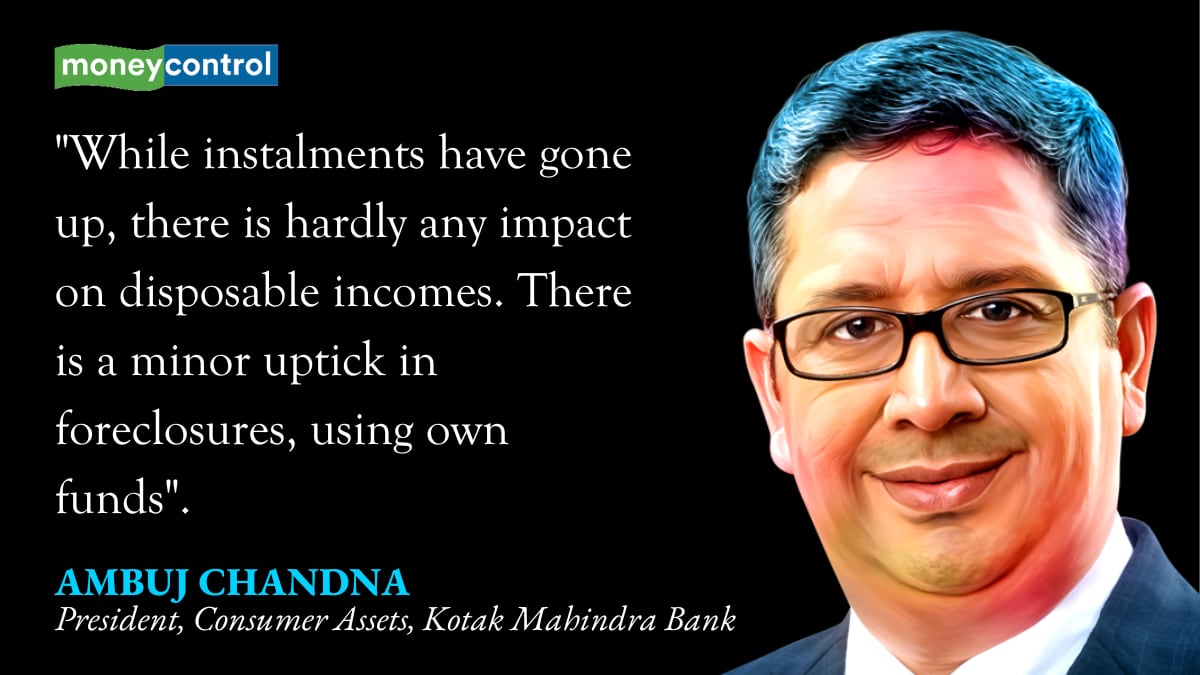
Home loan rates have risen over the past year. How are home borrowers reacting? Are you seeing a lot of restructuring of home loans?We haven’t seen too many restructuring requests, interestingly. The delinquency ratio has been at its best. There has been no impact on our bounce rates, which means that people are paying their equated monthly instalments (EMI) on time. This clearly tells you that while instalments have gone up, there is hardly any impact on disposable incomes. We don’t see any stress in the home loan portfolio.
There is a minor uptick in foreclosures. People are using their own funds and closing the loans as the interest rate has moved from 6.5-8-9%. Funds are being moved from liquid funds etc due to the low arbitrage and pre-closing loans.
No. The demand for new home loans continues. Industry data suggests that people are buying homes and that has not been impacted by rising home loan rates.
When existing home loan borrowers come to you to restructure their home loans, would you be willing to extend loans beyond the retirement age of 60 years? In case they want to opt for an increase in loan tenure?We consider the retirement age of 60 years while assessing the loan tenure only at the time of issuance. When interest rates rise, we aren’t alarmed if the tenure exceeds to 62-63 years of the borrower’s age, as over cycles, when the rates reduce, the overall tenure to retirement age comes down. Also, these are secured loans and the house serves as collateral for the loan.
While giving the loan, considering the affordability of the home loan, we ensure the tenure is restricted. Later the tenure is not in your control due to interest rate cycles.
The repo rate has not had much impact. The interest rate, where the credit card is used as a payment product (to repay dues), remains constant and there aren’t any changes.
Also, where the credit card is used as an interest product, where a customer uses the card for EMIs, it’s actually a zero-cost EMI structure, as the seller bears the cost as a transaction enabler and hence there is no direct impact on the 3-9 month EMI. In EMI products of a higher tenure, we have seen a small impact of 50-100 basis point (bps), which is borne by the seller (such as Samsung, Vijay Sales, Croma etc).
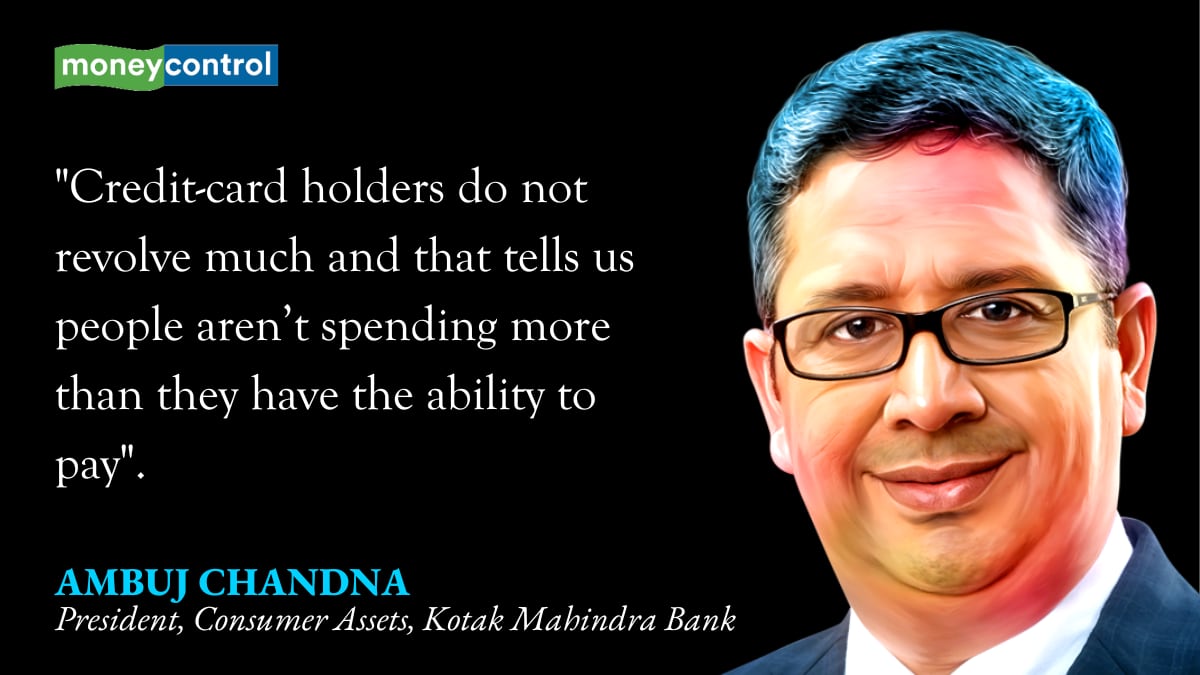
Post-COVID, at an industry level, the revolve rate (paying the minimum amount due and pushing the balance to the next month) has not seen much of a change. People do not revolve much and that tells us people aren’t spending more than they have the ability to pay. While there is inflation and interest rates, too, have risen, consumers in general haven’t seen much change in the rate at which they revolve credit.
How has credit card consumer behaviour changed?We haven’t seen any material impact on disposable income. The debt-to-income ratio is at a good standpoint.
The growth rate of people spending has been good and steady. In simple words, people are spending more. Our ability to underwrite more customers and issue more cards has gone up due to digitisation.
Do you see the ‘save and buy options’ being offered by fintech platforms dampening credit card usage or EMI-based products?‘Save and Buy’ has always been available. The question that consumers now ask, especially after the pandemic, is: what’s the point in delaying gratification when a zero-cost EMI is available. Also, by the time they save funds for a product, they realise its price has increased. So, I don’t see any impact of this.
Have the eligibility criteria for a home loan become stringent?A home loan is a standard product. As long as the overall debt is restricted to 60 percent of the take-home salary and the consumer can service the loan, we will offer a loan. It is supported by secured collateral.
In terms of evaluation, digitalisation has been a big change. We have gone live with a do-it-yourself home loan application, which can be completed by salaried consumers in 10 minutes, as compared to one week earlier. Hence, today 88 percent of our customers get a sanction letter in two days. Application cycles have become shorter and there is enhanced transparency in communication.
With faster-loan disbursal, how do you ensure a quick turnaround on the technical check?Due to significant use of technology, work that was laborious earlier has reduced. The empanelled evaluators quickly do the work based on the system-captured past data that we have in a similar area.
But we ensure that the collateral “legality” in terms of ownership is clear. We want the title to be pristine. Apart from Mumbai and Delhi, there is a large segment where plotting and house construction takes place, we need to do a safety due diligence there from the re-saleability perspective, based on a particular locality.
We still have a list of negative geographies; in other words, we do not give home loans for properties bought in such places.
Do borrowers have to purchase a mandatory insurance cover while opting for a home loan?If someone buys a home and takes out a loan, it is in our interest that the collateral (house) is protected from fire, damage... But we still don’t make home insurance mandatory.
But we ask the borrower to opt for a credit-life product, such that the principal taken by the borrower or the home loan outstanding doesn’t fall on the dependants later. This home loan insurance is a quality product and we recommend it in our home-loan sanction letter, but we do not make it mandatory.

Discover the latest Business News, Sensex, and Nifty updates. Obtain Personal Finance insights, tax queries, and expert opinions on Moneycontrol or download the Moneycontrol App to stay updated!
Find the best of Al News in one place, specially curated for you every weekend.
Stay on top of the latest tech trends and biggest startup news.