








Global financial markets were unsettled in the first half of calendar year (CY) 2025 following the US government's announcement of a series of tariff measures. The move triggered a sharp rise in global policy uncertainty, prompting investors to cut exposure to the US dollar and rotate towards traditional safe-haven assets, most notably gold.
According to the Economic Survey 2026, presented by Finance Minister Nirmala Sitharaman on January 29, global equity markets weakened and risk premiums widened across asset classes in April 2025. The spike in uncertainty led to heightened volatility across financial markets. However, conditions stabilised in the months that followed, as some of the US government’s policy announcements were rolled back and market volatility gradually returned to normal levels.
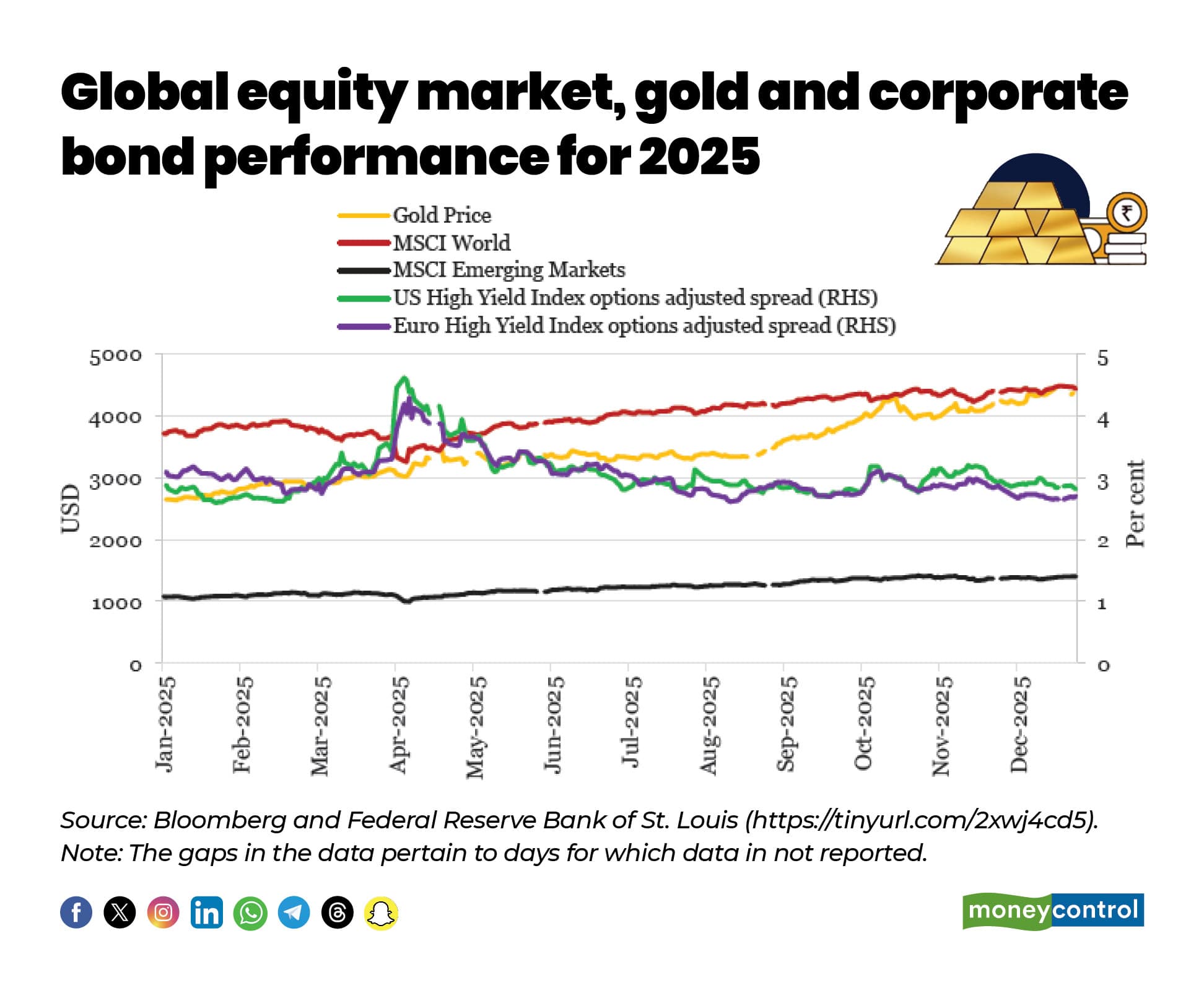
Against this backdrop, gold emerged as a clear outperformer. Prices surged from $2,607 per ounce to $4,315 per ounce during 2025, supported by a weakening US dollar, expectations of persistently negative real interest rates, and growing investor concerns around geopolitical and financial tail risks, per the economic survey.
By contrast, global equities, represented by the MSCI World index (premier stock market index), delivered modest gains. After an early March dip, equities recovered and trended higher, but at a slower pace than gold. The gap between gold and global equities widened notably after September, suggesting investors increasingly favoured defensive assets over growth-linked ones.
Emerging-market equities lagged even further, posting only gradual gains throughout the year.
Corporate bond markets tell a third part of the story. US and euro high-yield spreads spiked sharply around April, signalling stress and risk aversion. However, spreads narrowed steadily afterwards, indicating improving credit conditions and stabilising investor confidence. Even so, this improvement in bonds did not translate into stronger equity performance.
The economic survey stated, "Financial markets are typically the first to register and absorb the impact of an uncertainty shock. Much before agents across government, trade, and households adjust their choices, financial market participants tend to respond by pricing in uncertainty risk in real time. The year 2025 was marked by heightened uncertainty, which had a palpable impact on financial markets."
The survey also revealed that the impact of uncertainty on financial markets extends beyond just increased volatility and risk premiums. Research indicates that extended periods of uncertainty can influence the financial sector through at least three main channels. First, financial market participants tend to delay decisions when faced with uncertainty. Second, increased uncertainty can raise borrowing costs by widening credit spreads and financial intermediation expenses. Third, sustained uncertainty may lead to more significant market corrections across various asset classes.

Discover the latest Business News, Sensex, and Nifty updates. Obtain Personal Finance insights, tax queries, and expert opinions on Moneycontrol or download the Moneycontrol App to stay updated!
Find the best of Al News in one place, specially curated for you every weekend.
Stay on top of the latest tech trends and biggest startup news.





