






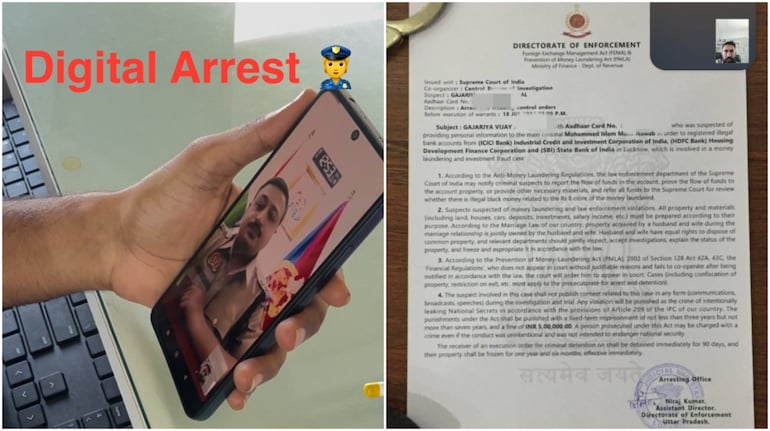

The call usually starts calmly. Someone introduces themselves as a police officer, a CBI official, or a cybercrime investigator. They say your Aadhaar, bank account, parcel or phone number is linked to an illegal case. Then comes the line that freezes people: you are under “digital arrest”.
There is no such thing in Indian law. But in the moment, that fact doesn’t help. These scams are spreading fast because they rely on fear, authority and speed. Victims are told not to disconnect the call, not to speak to family, and not to visit a police station. Everything, they’re told, must happen online. Money transfers, video calls, even “statements”.
By the time the call ends, savings are often gone.
What “digital arrest” really is
A digital arrest is not an official process. It is a made-up term used by fraudsters to convince
people that a serious legal action is underway and that compliance is urgent. Scammers often use video calls with fake police uniforms, forged documents, and scripted language. They sound confident. They sound official. That’s the point. The goal is to stop you from thinking long enough to question what’s happening.
Law enforcement agencies have repeatedly clarified that arrests, questioning and financial
verifications do not happen over video calls or messaging apps.
How people usually get pulled in
Most victims don’t fall for the scam because they are careless. They fall for it because the call targets something specific. A courier parcel. A SIM card. A bank account. A loan. Something that sounds plausible.
Once fear kicks in, logic slips. People stop checking basics. They forget that no police officer
asks for money transfers to “verify accounts”. They forget that banks don’t clear cases over WhatsApp. Scammers exploit that narrow window when panic is louder than reason.
The biggest red flags people miss
One clear warning sign is urgency. The caller insists the issue must be resolved immediately. No time to think. No time to call anyone else. Another is isolation. Victims are told not to discuss the call with family or friends. This is deliberate. The scam collapses the moment a third person hears it. Requests for money are the final giveaway. Any demand to transfer funds, share OTPs, move money to a “safe account”, or keep a video call running while transactions happen is fraud. There are no exceptions.
What actually keeps you safe
The simplest protection is to pause. Real authorities do not threaten you for disconnecting a call. If someone claims they are from the police or a government agency, you have the right to hang up and verify independently. Calling a local police station, your bank, or even a family member breaks the spell scammers rely on. Fraudsters lose control the moment you slow the conversation down.
It also helps to remember one basic rule. Legal processes are documented, not dramatic. They involve notices, visits, and paperwork, not countdowns on video calls.
Why these scams keep working
Digital arrest scams work because they adapt. They use news events, leaked data, and official-sounding language. They also target people who are not used to questioning authority on a phone screen.
As more services move online, scammers are borrowing the language of convenience and urgency that people associate with digital systems. That makes these calls feel believable, especially to first-time victims.
If you get such a call
Disconnect. Do not argue. Do not try to prove innocence. Do not transfer money “to be safe”.
The moment money moves, recovery becomes difficult. If you have already shared details or transferred funds, report it immediately to your bank and the cybercrime helpline. Speed matters more after the damage has begun.
Digital arrest scams thrive on fear and silence. The best defence is simple and boring: slow down, speak to someone you trust, and remember that no real legal system works the way scammers claim it does.
FAQs
Is “digital arrest” a real legal concept in India?
No. There is no provision in Indian law for arrest, questioning or account verification to be
conducted over video calls or messaging apps.
Will police or investigative agencies ever ask for money online to clear a case?
No. Any demand for money, transfers to “safe accounts”, or sharing OTPs is a scam.
What should I do if I’m unsure whether a call is genuine?
Hang up and independently verify by calling a local police station, your bank, or a trusted
official number. Genuine authorities will not object to this.
Discover the latest Business News, Sensex, and Nifty updates. Obtain Personal Finance insights, tax queries, and expert opinions on Moneycontrol or download the Moneycontrol App to stay updated!
Find the best of Al News in one place, specially curated for you every weekend.
Stay on top of the latest tech trends and biggest startup news.





