Dear Reader,
The Panorama newsletter is sent to Moneycontrol Pro subscribers on market days. It offers easy access to stories published on Moneycontrol Pro and gives a little extra by setting out a context or an event or trend that investors should keep track of.What made headlines in the last two days in Indian business media were Tesla’s surprise advertisements to hire people in key Indian cities.
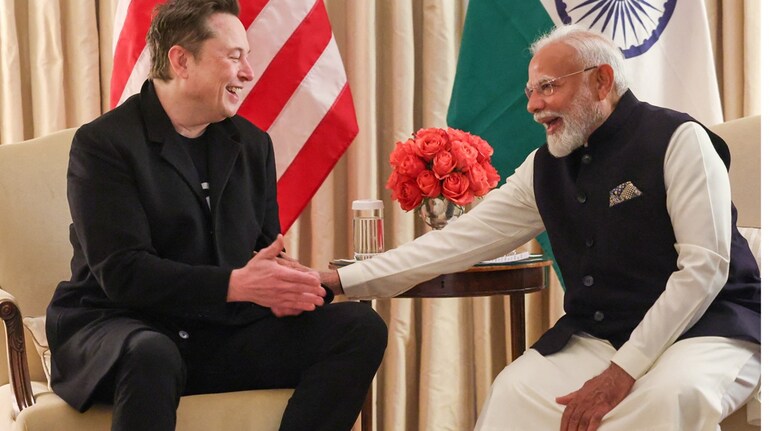
This comes after Prime Minister Narendra Modi’s recent meeting with Elon Musk in the US.
Musk may be dreaming big about India—This is a lucrative market of 140 crore ambitious consumers for any global seller. Indians, like people in any developing country, are drawn to shiny products that can be flaunted in the neighbourhood.
So, if Musk cracks the Indian consumer code (read: cheaper products), Tesla will mint money in this part of the world.
To begin with, Tesla’s decision to start hiring in India marks a critical shift in the country’s electric vehicle (EV) landscape. For years, the EV giant has engaged in a game of will-they-won’t-they with the Indian market, largely deterred by high import duties.
Now, with the Modi government’s recent tax cuts on high-end EVs, Musk’s company finally seems ready to take the plunge. But what does this really mean for India?
Behind Musk’s smiling face lie deepening worries in Tesla’s domestic market.
Whether Musk likes it or not, the fact is Tesla is at a crossroads globally.
For the first time in over a decade, the company has reported an annual drop in EV sales. China, its biggest growth market, is fiercely competitive, with local giants like BYD leading the charge. The US market is showing signs of saturation. Enter India—a nation with immense potential but where the EV market is still in its infancy.
Tesla’s hiring initiative in Mumbai and Delhi suggests the company is laying the groundwork for a local presence, likely starting with imports before considering a manufacturing base. This aligns with Musk’s pattern of cautious expansion, but it also raises questions.
Will Tesla commit to manufacturing in India, or will it merely use the country as a stopgap for sales recovery?
What does this mean for India?
Tesla’s arrival could be a double-edged sword.
On one hand, the move validates India’s growing appeal as an EV market and aligns with Modi’s push for a green transition. It could also spur much-needed competition, forcing domestic automakers like Tata Motors and Mahindra to accelerate their EV ambitions.
On the other hand, Tesla’s reliance on imports—at least in the short term—means its cars will remain out of reach for the average Indian buyer. Even with reduced import duties, Tesla’s prices are expected to stay well above the comfort zone of most consumers.
Unlike China, where Tesla set up a Gigafactory early on, India may not see the same level of commitment unless the government offers further incentives.
Challenges for Tesla
It won’t be a cakewalk for Musk either.
Tesla faces significant challenges in entering the Indian market. A key setback came in 2022 when it backed out after failing to secure lower import duties. While Tesla preferred to import Completely Knocked Down (CKD) units, the Indian government insisted on local manufacturing, creating a deadlock.
Additionally, India lacks a robust EV charging infrastructure compared to markets where Tesla has thrived. Road conditions, affordability-driven competition, and the dominance of well-established service and marketing networks further complicate Tesla’s entry.
On the positive side, India’s growing base of aspiring EV buyers presents an opportunity. Tesla’s financial strength, cutting-edge technology, and proven success with electric vehicles give it an edge. Its presence could accelerate EV adoption in India, pushing the ecosystem forward. However, whether Tesla will establish R&D operations in India remains uncertain, depending on how deeply it commits to the market.
Modi-Musk Meet
Musk’s India push comes against the backdrop of his growing alignment with political powerhouses. Given Musk’s role in Trump’s Cabinet and his increasing involvement in geopolitical deals (such as SpaceX’s recent talks with the Italian government), the Tesla-India move cannot be seen in isolation.
Is this purely a business decision, or does it signal deeper strategic interests tied to US-India relations?
Tesla’s entry into India is undoubtedly significant, but its long-term impact depends on whether it transitions from an import-heavy model to serious local manufacturing. If Musk commits to a Gigafactory in India, the country’s EV industry could experience a major boost—not just in sales, but in infrastructure, supply chains, and technology transfer. If not, Tesla’s entry may remain symbolic rather than transformative.
Either way, Tesla’s move signals that India is no longer an afterthought in the global EV race. The question is whether India can seize this moment to push for deeper investment and technological collaboration or whether Tesla’s presence will simply cater to the ultra-rich while domestic automakers do the heavy lifting of electrifying India’s roads.
Also, read today’s Chart of the Day that shows how NBFC credit growth moderated in the third quarter while gold loans remained as an outlier. That apart, Vivek Kelkar’s piece that explains how Trump’s policies could make the EU a contested geopolitical space is a good read.
Investing insights from our research team CDSL – Should investors consider this stock in a wobbly market?Cholamandalam Investment: Best long-term play among asset financiersSJS Enterprises: Decent Q3 FY25, positive outlook, comfortable valuation What else are we reading? Amerika Uber AlliesAre lock-in expiries in IPOs scary?How to make the nuclear tilt in the energy mix work?Economic Survey reveals some risks in the financial system, but glosses over many othersBYD’s strategy shift is bad news for global automakers (republished from the FT)
Europe wakes up to a tectonic shift in the continent’s geopolitics
Climate Action: Rethinking finance, technology, and policy for a sustainable future
India's Path to AI Leadership: Building a global talent hub
Markets Arbitrage funds catch investor fancy as flows touch Rs 4,300 crore in January
Tech and Startups DPDP Rules: MeitY open to tweaks, clarifications on children's data, govt access provisions
Technical Picks: UPL, HFCL, NETWEB, WIPRO.
Dinesh Unnikrishnan Moneycontrol Pro

Discover the latest Business News, Sensex, and Nifty updates. Obtain Personal Finance insights, tax queries, and expert opinions on Moneycontrol or download the Moneycontrol App to stay updated!
Find the best of Al News in one place, specially curated for you every weekend.
Stay on top of the latest tech trends and biggest startup news.