




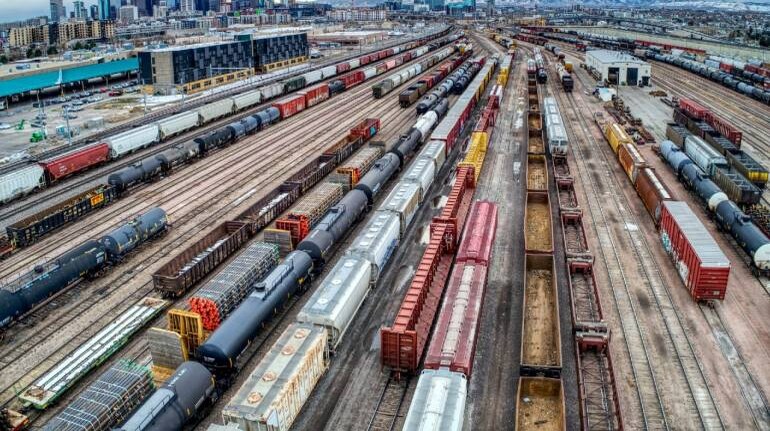
The Union Cabinet on September 7 revised its policy on leasing railway land, by lowering the annual rental on leased land and extending the period of leases.
The railway land lease fee has been cut to 1.5 percent of the market value of land per acre from the existing 6 percent. The lease period has been extended from the present five years to 35 years.
The decision is not only expected to bring in more investment in the Indian Railways' infrastructure facilities, including cargo terminals and public utilities but is also expected to expedite the divestment of the government's stake in Container Corporation of India (CONCOR).
But how will the new land leasing policy help in the divestment of CONCOR?
The new land leasing policy will address the biggest concern the industry had in buying the government's stake in the public sector utility (PSU).
Prem Kishan Gupta the chairman and managing director of Gateway Distriparks had in August said that his company was interested in bidding for the government’s stake in CONCOR till last year but due to a lack of clarity around the government tweaking the railways’ land use policy and the land licensing fee, they were no longer interested.
The government is hoping to attract back private players which to buy its 30.8 percent stake in CONCOR for around Rs 8,000 crore.
Many industry players are expecting the new land leasing policy to not only help reduce CONCOR's land leasing fees but will also provide clarity on the company's inland container depots (ICDs).
"The biggest issue with CONCOR was that it was closing its ICDs to reduce its land payment to the Indian Railways. Some of CONCORs biggest ICDs are located on land owned by the railways. The new policy will help CONCOR continue operations of its ICDs," a senior official at a potential buyer said.
Another official at a company who had expressed interest in the government's stake in CONCOR said that the new land leasing policy will not only help reduce the outgo of CONCOR but will also help the company invest more to expand its existing ICDs.
"With the new land leasing policy, any expansion of CONCOR's ICDS on railway land will also be cost-effective in the future," the second official said.
Last year, Karan Adani, CEO of Adani Ports and Special Economic Zone said the company was creating a war chest to acquire CONCOR once there was clarity on the government's land leasing policy.
“Rationalising the railway land lease policy will accelerate investment in the sector and reverse the decades-long modal shift to the road. It will bring in higher quality infrastructure to steadily reduce India’s logistics costs and make our manufacturers more competitive globally,” said Ajit Pai, strategy lead partner, Government and Public Sector, EY India.
Brokerages were also positive that the changes in land leasing policy will benefit CONCOR.
"The new land leasing will help CONCOR save Rs 286.77 crore annually in land licensing if it switches to the new regime," Anand Rathi Equity Research said.
While some brokerages were skeptical about changes to CONCOR's land licensing fee due to the new policy, they said that more clarity on the new policy will help investors come up with a valuation for CONCOR.
Edelweiss, Nomura India, and JM Financial said there is no clarity about the recovery of the investments that the incumbent operator has made in the infrastructure at its existing terminals.
Shares of Concor had risen around 12 percent on September 7 after the government announced changes to land license policy.
In 2021, CONCOR signed a new leasing deal with the Indian Railways for land on which it has built 24 of its 64 ICDs by paying upfront 99 percent of the market value of the land in development.
CONCOR had paid as much as Rs 3,500 crore upfront for the long-term lease of the land parcel and was required to pay only a nominal annual lease fee of about Rs 1,000 a year to the Railways, according to an agreement.
Industry participants were unhappy with the new deal signed by CONCOR in 2021 as it jacked up CONCOR's pay-out on this count to Rs 590 crore in 2020-21 from Rs 140 crore in 2019-20, even after surrendering some 16 terminals built on railway land to reduce its outgo.
A majority of Concor terminals are rail-linked, with rail as the main carrier for haulage. As rail is price-competitive over long distances, the price advantage can be passed on to clients, thus allowing for flexible and competitive pricing.
The rail link also plays a major role in decongesting ports and the road corridors that lead to these ports.
Discover the latest Business News, Sensex, and Nifty updates. Obtain Personal Finance insights, tax queries, and expert opinions on Moneycontrol or download the Moneycontrol App to stay updated!

Find the best of Al News in one place, specially curated for you every weekend.
Stay on top of the latest tech trends and biggest startup news.




