It has been more than six decades since Goa was liberated from Portugal’s colonial rule, yet the international dimensions of that episode continue to resonate. With Russian President Vladimir Putin visiting India, attention has once again turned to the little-remembered role played by Moscow in supporting New Delhi during the 1961 crisis.
After India won Independence in 1947, it was widely assumed that the remaining European colonial powers would soon withdraw from the subcontinent. Britain departed swiftly, and France later transferred Pondicherry, Karaikal, Mahé, Yanam and Chandernagore. Portugal, however, refused to relinquish Goa, Daman and Diu. It was only on December 19, 1961, that Goa was finally freed.
Portuguese roots in India
The Portuguese presence in India began with the voyage of explorer Vasco da Gama, who opened the sea route from Europe to Asia via the Cape of Good Hope. Goa was seized in 1510 by Afonso de Albuquerque and became Portugal’s first Asian outpost. Over time, Portuguese settlers intermarried with locals, creating a large Eurasian community.
During the 16th century, Goa enjoyed a golden age, rivaling Lisbon in terms of wealth and influence. The arrival of the Dutch, however, marked the start of a long decline. Portuguese power weakened steadily, and by the 18th century, Goa had lost much of its former prominence.
Goa after Indian independence
When India became independent in 1947, Portugal refused to vacate Goa, claiming that Goan Catholics would be unsafe—despite Hindus forming the majority and millions of Catholics living peacefully elsewhere in India. Tensions rose quickly. In 1946, a liberation march saw protesters, including women, arrested, baton-charged and threatened.
In 1955, when Indian volunteers entered Goa during a satyagraha, Portuguese forces opened fire, killing nearly two dozen people. Prime Minister Jawaharlal Nehru responded with an economic blockade but initially stopped short of military action. Portugal, having joined North Atlantic Treaty Organisation in 1949, sought backing from the United States and Britain.
‘India’s patience was exhausted’
By 1960, Portugal ignored a United Nations resolution on decolonisation. Border clashes intensified through 1961, with the Portuguese claiming they repulsed Indian attacks on Anjediv Island and Indian fishing boats reportedly coming under fire.
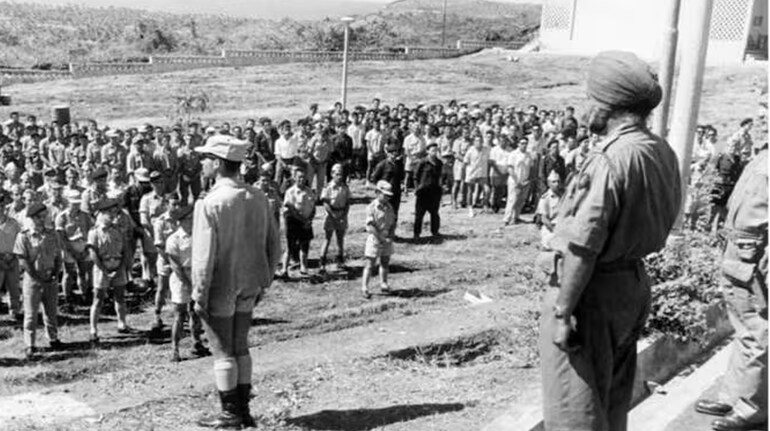
In December, Nehru announced that “India’s patience was exhausted” and declared that Goa would join India “either with full peace or with full use of force.” Despite appeals from Western leaders including John F Kennedy, Harold Macmillan and UN Secretary-General U Thant, India launched Operation Vijay on December 18 and 19.
Portuguese resistance was minimal. The Governor-General, Manuel António Vassalo e Silva, signed the surrender on December 19, ending more than 450 years of Portuguese rule.
Western backlash and the UN battle
India’s military action triggered sharp condemnation across the West. The US, UK, Canada, Australia, New Zealand, France, the Netherlands, Spain and West Germany criticised India for abandoning its professed commitment to non-violence.
Britain’s Commonwealth Relations Secretary Duncan Sandys told the House of Commons: “Her Majesty’s Government deeply deplore the decision of the Government of India to use military force to attain its political objectives.” He added: “We are particularly concerned about the wider repercussions which the action taken by the Indian Government may have upon other problems that face the world today.”
At the United Nations, the US, UK and France backed a Portuguese resolution demanding that India withdraw and that “the positions prevailing before 17 December 1961” be restored.
How the Soviet Union stepped in
At this critical moment, the Union of Soviet Socialist Republics intervened decisively by vetoing the resolution. The Soviet permanent representative, Valerian Zorin, condemned Western “double standards”, declaring: “When Portugal exterminates tens and hundreds of thousands of Angola citizens, the United States and the United Kingdom do not condemn it…”
He also said Goa and India were inseparable “both by reason of its geographical position and by its history, culture, language and traditions”.
Soviet leader Leonid Brezhnev, who was then on a state visit to India, declared Moscow’s “complete sympathy for the Indian people’s desire to liberate Goa, Daman, and Diu from Portuguese colonialism.” He urged India to ignore “…those who are accustomed to strangle the people’s striving for independence… and from those who enrich themselves from colonialist plunder.”
Another message of support came from Nikita Khrushchev, who told Nehru that “the resolute actions of the Government of India to do away with outposts of colonialism in its territory were absolutely lawful and justified”, adding that the Soviet people “unanimously approve of these actions”.
As historian SR Sharma later wrote in India–USSR Relations – Volume 1, “The (Russian) veto saved India from a very awkward situation as the West was determined to get a ceasefire and withdrawal resolution passed in the Security Council.”
Recognition came much later
Portugal formally recognised Goa as part of India only after the fall of its dictatorship. A treaty signed on December 31, 1974, finally settled the matter. Today, as India and Russia reaffirm close diplomatic ties, the Soviet veto remains one of the most significant—and often forgotten—moments of international support in India’s post-Independence history.
(With inputs from agencies)
Discover the latest Business News, Sensex, and Nifty updates. Obtain Personal Finance insights, tax queries, and expert opinions on Moneycontrol or download the Moneycontrol App to stay updated!
Find the best of Al News in one place, specially curated for you every weekend.
Stay on top of the latest tech trends and biggest startup news.