






For nearly four decades, India’s most widely tracked equity index has moved broadly in step with the country’s economic expansion.
Since its launch in 1986, the BSE Sensex has delivered an annualised return of 13.4 percent, closely matching India’s nominal GDP growth of 12.97 percent over the same period. BSE data shows that, over long horizons, the benchmark’s returns have largely reflected the pace of the underlying economy rather than diverging meaningfully from it.
From 549 to 85,000
The Sensex was introduced at a time when India’s economy was still largely closed, capital availability was limited and equity market participation remained narrow. On January 2, 1986, the index was set at 549. By December 2025, it had risen to nearly 85,000, spanning economic liberalisation, multiple market cycles and successive shifts in the structure of corporate India.
Over this 39-year period, the Sensex’s returns have broadly tracked the expansion of India’s nominal economic output. This alignment holds not just over the full period, but also across rolling 10, 15, 20 and 25-year windows, suggesting that the index’s long-term behaviour has remained relatively stable despite sharp swings in shorter periods.
In its earlier decades, the Sensex was marked by sharper drawdowns and larger single-day moves, reflecting low liquidity, limited institutional participation and a market ecosystem that was still evolving.
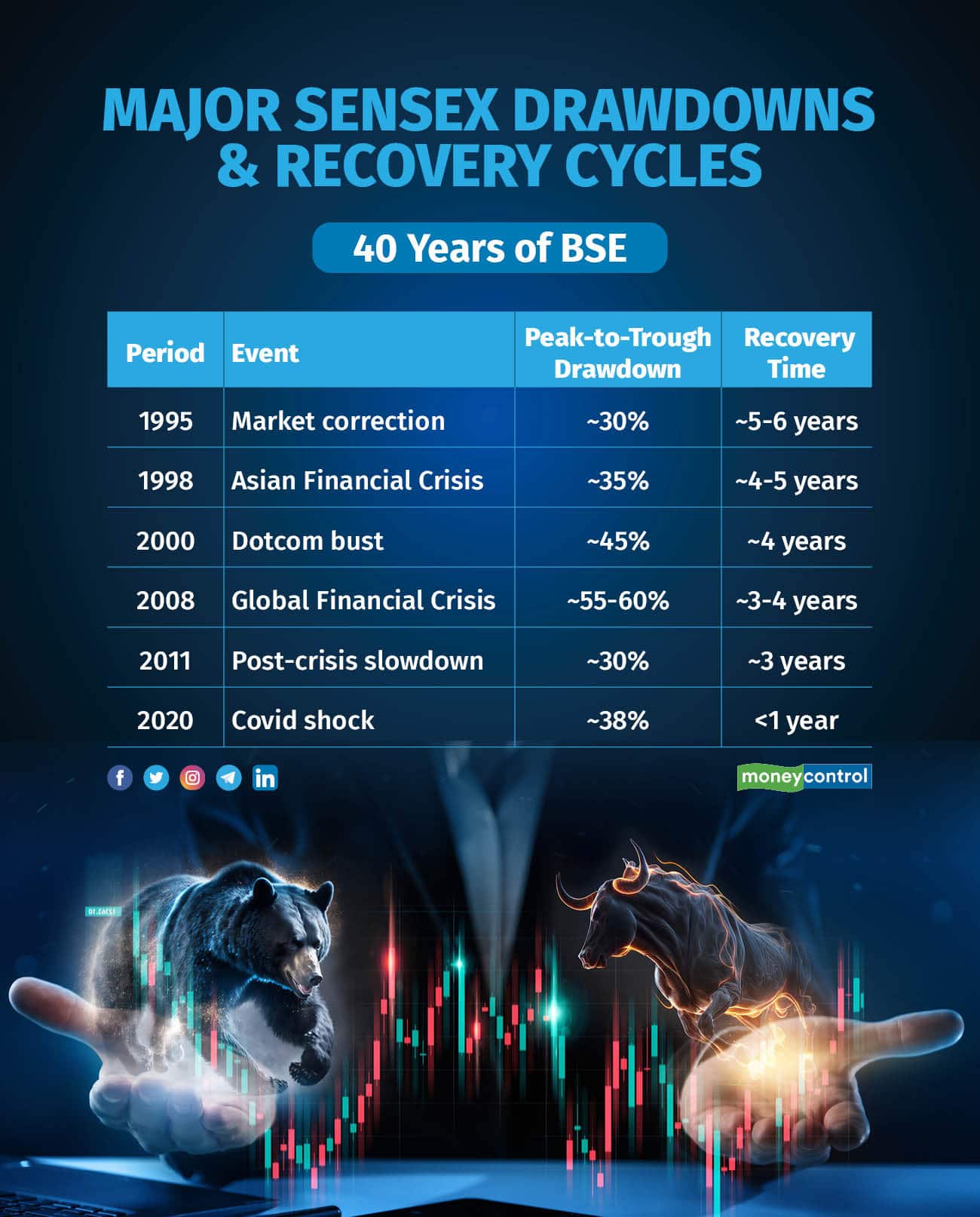
Peak-to-trough declines of over 30%
Several years — including 1995, 1998, 2000, 2008 and 2011 — stand out as periods of pronounced stress. The index saw multiple peak-to-trough declines of over 30 percent, with the steepest fall occurring during the global financial crisis of 2008.
What has changed over time is not the occurrence of market declines, but the speed with which losses have been recovered. Since the early 2000s, most major drawdowns have been recouped within 3-5 years, compared with longer recovery periods in earlier cycles. BSE Research links this shift to deeper liquidity, electronic trading, dematerialisation of securities and a broader investor base.
This structural deepening is also reflected in participation metrics. India’s demat accounts have expanded from fewer than 5 million in the early 2000s to well over 150 million today, while daily market turnover has risen several-fold. The growing presence of domestic institutional investors and retail investors has helped absorb shocks more quickly than in earlier decades.
Despite frequent volatility, calendar-year outcomes have skewed positive over time. The Sensex delivered positive price returns in roughly three out of four calendar years. When dividends are included, the Total Return Index recorded gains nearly 80 percent of the time, overall.
Returns, however, have not been evenly distributed. The weakest years were often followed by sharp rebounds, leading to a clustering of returns around market turning points rather than steady accrual over time. This pattern helps explain why short-term performance can appear erratic even as long-term outcomes remain stable.
Over longer holding periods, variability narrows significantly. BSE data shows that the rolling 10-year returns for the Sensex have remained positive throughout its history, despite encompassing multiple crises, drawdowns and leadership changes. The smoothing effect has come not from the absence of volatility, but from the cumulative impact of recoveries, earnings growth and reinvested dividends.
Only a handful of original companies now
One reason the Sensex has remained aligned with economic growth is its ability to evolve internally. While the index has retained its role as India’s primary equity benchmark, it has undergone substantial churn at the constituent level. Only a handful of companies from the original 1986 index remain today, with the majority having been replaced as the economy, corporate scale and earnings mix changed.
This churn has allowed the index to capture successive phases of India’s growth — from manufacturing-led expansion to financials, consumption and services — without altering its core structure. At any given point, a relatively small group of stocks has driven index movements, but the identity of these leaders has changed repeatedly across decades.
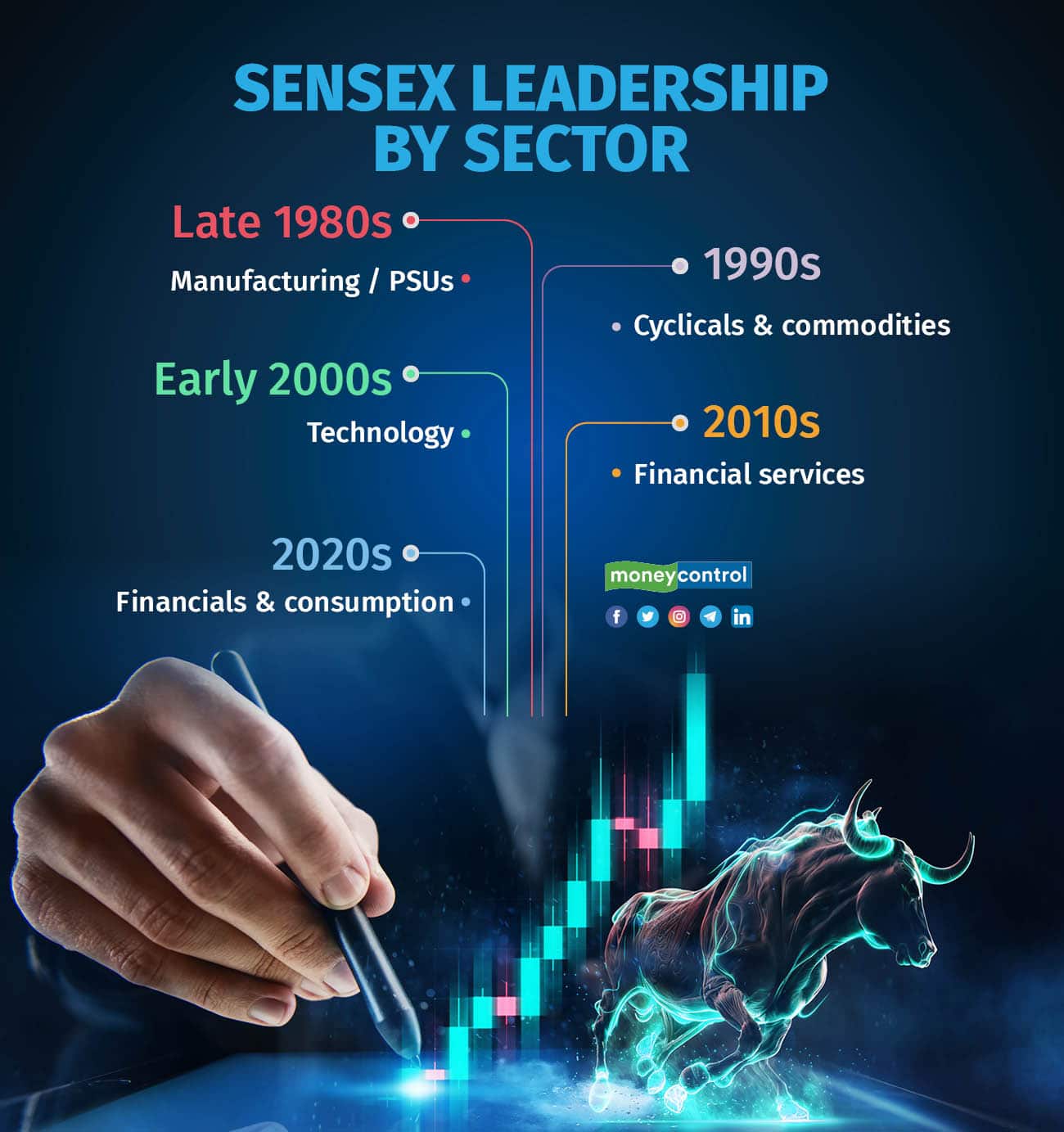
Sector weights illustrate this evolution. Financial services, which accounted for roughly 22 percent of the index in 2005, now represent close to 40 percent, reflecting deeper credit penetration and the growing role of financial intermediaries.
Consumer discretionary stocks have gained share, while commodities and traditional manufacturing now occupy a smaller portion of the index. Information technology, which dominated the Sensex during the early 2000s, today holds a more moderate weight as earnings contributions have broadened.
The introduction of the Sensex Total Return Index in 1996 highlights another dimension of long-term performance. Over the past 25 years, the Sensex TRI has compounded at 14.3 percent, exceeding price-only returns by more than a percentage point annually. Dividends and their reinvestment have accounted for a meaningful share of long-term gains, particularly during periods when price appreciation was muted.
Across cycles, reforms and shifts in market participation, one pattern has remained consistent: over extended periods, the Sensex’s returns have stayed broadly aligned with India’s nominal economic growth. The index has neither persistently outpaced nor lagged the economy, instead reflecting changes in scale, earnings capacity and corporate composition over time.
Disclaimer: The views and investment tips expressed by experts on Moneycontrol.com are their own and not those of the website or its management. Moneycontrol.com advises users to check with certified experts before taking any investment decisions.-Discover the latest Business News, Sensex, and Nifty updates. Obtain Personal Finance insights, tax queries, and expert opinions on Moneycontrol or download the Moneycontrol App to stay updated!
Find the best of Al News in one place, specially curated for you every weekend.
Stay on top of the latest tech trends and biggest startup news.




