








After a muted 2025, investment bankers expect qualified institutional placements (QIPs) to recover gradually in 2026, driven by visible capex pipelines and strong domestic institutional liquidity.
While some bankers believe that the market is unlikely to return to peak issuances seen in 2024, they say conditions are aligning for a selective, issuer-led revival marked by fewer but larger and better-prepared transactions.
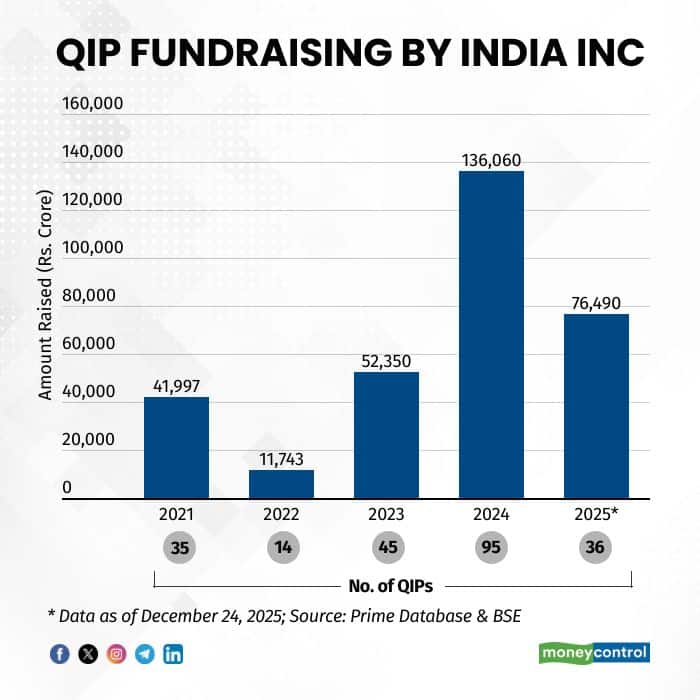
According to data from primary market tracker Prime Database and BSE, in 2025, 36 companies launched QIPs, as of December 24, to raise Rs 76,490 crore, compared to a record fundraising of Rs 1,36,060 crore by 95 companies in 2024.
The slowdown was less about lack of capital demand and more about valuation comfort and secondary-market volatility, experts said. With earnings visibility improving and domestic flows continuing to support markets, 2026 is expected to see normalisation of QIP volumes, particularly among largecap and high-quality midcap companies with clear capital deployment plans.
“Companies have raised more than $26 billion through QIP in the last two years either for capex, growth or deleveraging,” said Kaushal Shah, managing director and head of equity capital markets at Kotak Mahindra Capital Company.
“While there have been periods of volatility, the overall environment in India has been positive and expect tailwinds to continue. Robust domestic inflows have also allowed DIIs and supported by FIIs to back the companies requiring capital.”
With no major negative triggers, strong domestic liquidity and an improving investment cycle, QIP activity is expected to improve in the coming year, Shah said.
2025 slowdown: fewer issuers, valuation friction
The cautious optimism for 2026 comes after a sharp moderation in QIP activity this year.
In 2025, issuances saw a drop in both value and number of deals compared, even as the country's initial public offering (IPO) market delivered a record year.
While 2024 was an exceptional year with the highest-ever fundraising, 2025 still saw around $10 billion raised through QIPs, compared with $17 billion in 2024, Shah said.
That QIP fundraising in 2025 was still 50 percent higher than in 2023 and significantly above 2021 and 2022, he said. The average ticket size also rose, with the per-QIP fundraise in 2025 being about 1.45 times that of 2024.
Some market participants, however, say that the headline numbers mask a narrower issuance base.
Anand Rathi Advisors CEO Samir Bahl said QIP activity in 2025 was notably subdued against an exceptional 2024.
“While more than 90 QIPs in 2024 raised over Rs 1.37 lakh crore, only 36 issuances were completed in 2025, mobilising around Rs 76,000 crore,” Bahl said. A large part of the total was supported by Swiggy’s roughly Rs 10,000-crore QIP, and if that is excluded, fundraising by end-November stood closer to Rs 60,000 crore.
Bahl attributed the slowdown largely to valuation concerns in an uncertain market environment.
Unlike IPOs, QIPs are priced based on SEBI-mandated formulas linked to recent market averages, which often resulted in unattractive issuance levels amid volatility, geopolitical uncertainty and sustained foreign investor outflows. It led to promoters and boards choosing to defer equity-dilution decisions.
Gaurav Sood, managing director and head of equity capital markets at Avendus Capital, shared similar views. QIP issuance was concentrated in a handful of large transactions such as SBI and Swiggy, unlike 2024 which saw broader participation, he said.
“The slowdown was driven by market volatility and valuation sensitivity led to a moderation in Nifty P/E multiples relative to CY24, and a clear softening in institutional risk appetite for follow-on issuances,” Sood said. Promoters were reluctant to dilute equity at prices they did not view as reflective of intrinsic value, he added.
Sectoral outlook
QIP issuance in 2026 will likely be driven by capital-intensive sectors and companies with visible growth requirements, bankers said.
Shah said one of the highlights of QIPs over the past two years has been the diversity of issuers, across both new-age and traditional sectors.
“We expect the same to continue, especially led by industrials, financials, real estate and infra/energy,” he said. REITs and InvITs raised more than $2.6 billion over the last two years, accounting for over 12 percent of QIP fundraising and the momentum is expected to intensify, Shah said.
Sood expects PSU banks, power, renewables, infrastructure and select industrial companies to dominate in 2026.
Private banks, he said, may tap the market opportunistically to maintain growth buffers rather than due to stress-driven capital needs, given that most remain well capitalised. He also pointed to a parallel trend within BFSI of capital being raised through preferential and strategic issuances, which offer faster execution and greater pricing certainty than marketed QIPs.
Bahl sees banks and NBFCs as key participants, as they seek to support credit expansion and regulatory buffers. Renewables, utilities, industrial manufacturing, specialty chemicals and healthcare companies will raise capital for expansion and to meet working capital needs.
Use of proceeds: debt reduction still relevant
Despite improving balance sheets, bankers do not expect debt repayment to disappear as a key use of QIP proceeds.
Debt repayment accounted for 38 percent of QIP raises over the last two years, rising to 55 percent for non-financial companies, Shah said.
“We expect that debt repayment will continue to be a relevant use case going forward as well,” he said. Debt remains a critical financing tool for both acquisitions and capex, which is often refinanced through equity raises including QIPs.
Debt reduction will continue to coexist as a relevant use case alongside growth funding, Bahl said.
Avendus’ Sood said with leverage levels healthier, QIPs can gradually shift towards funding capacity expansion and growth, including selective inorganic opportunities.
“Companies can choose a mix of debt and equity for funding their plans, and the portion of equity allocated will be a function of expected dilution, current valuation, and attractiveness of the sector for public market investors,” Sood added.
Discover the latest Business News, Sensex, and Nifty updates. Obtain Personal Finance insights, tax queries, and expert opinions on Moneycontrol or download the Moneycontrol App to stay updated!
Find the best of Al News in one place, specially curated for you every weekend.
Stay on top of the latest tech trends and biggest startup news.





