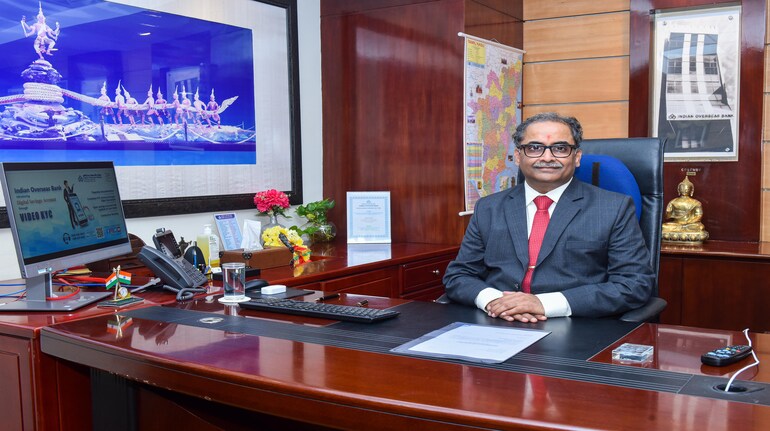

Indian Overseas Bank is unlikely to meet the minimum public shareholding (MPS) norms by August 1 and make seek more time from the government, managing director and chief executive officer Ajay Kumar Srivastava has told Moneycontrol in an interview.
Srivastava was talking to Moneycontrol after the state-run bank’s Q3 results in which the lender reported its highest every quarterly profit at Rs 1,365 crore.
The bank is planning to raise Rs 4,000 crore through a qualified institutional placement in the fourth quarter, which is expected to dilute the government’s over 90 percent stake by about 4 percent, he said, adding but even after QIP, the compliance with the 25 percent public float requirement will remain challenging, Srivastava said. Edited excerpts of the interview:
The December quarter profit at Rs 1,365 crore is strong. Is this the highest-ever quarterly profit for the bank?
Yes. The previous highest quarterly profit was Rs 1,226 crore and this quarter’s Rs 1,365 crore is the highest so far. Every quarter, we are breaking our own record and creating a new benchmark.
It has worked both ways. First, our income has increased. Credit growth is around 20–24 percent year-on-year, which has boosted interest income. Second, we are maintaining CASA at around 41 percent, which is a low-cost deposit base, helping us control interest expenses.
Third, non-interest income has grown by around 18 percent year-on-year. This includes recovery from technically written-off accounts, PSLC sales, processing fees and other income streams.
The combined effect of higher interest earned and controlled interest paid has resulted in an operating profit growth of around 50 percent.
This profit was achieved despite Expected Credit Loss (ECL) provisioning. Can you explain that?
Yes. This quarter’s profit of Rs 1,365 crore is despite making an ECL provision of Rs 1,500 crore. This is the first time we have made ECL provisioning.
If this provision had not been made, the profit would have been around Rs 2,800-2,900 crore.
Gross NPAs have declined sharply to around 1 percent over the past four quarters. What has driven this improvement?
A one percent drop may look sharp but it is the outcome of sustained efforts. There are multiple recovery channels — cash recovery, upgradation, sale to ARCs, SARFAESI, DRT and IBC. All accounts are run through these channels.
We have also created 16 exclusive ARNB branches across India dedicated solely to recovery. Aggressive use of all these channels has helped bring down NPAs.
Additionally, the denominator, credit outstanding, has increased. So, recovery on one side and credit growth on the other have together reduced the gross NPA ratio.
Around 323 accounts were transferred to ARCs during the quarter. Were these corporate or retail accounts?
These were mainly MSME accounts and small-value accounts.
On the QIP front, what is the status of the Rs 4,000-crore issue?
The process is ongoing. Post the Rs 4,000-crore QIP, the government of India’s shareholding will come down by around 4 percent.
All approvals, from the government, RBI and exchanges, are in place. The appointment of merchant bankers is part of the ongoing process.
Will the bank meet the minimum public shareholding norms by August 1?
It will be difficult to comply by August 1, 2026. After completing this QIP, we may explore additional options in the next financial year but it will still be challenging. If required, we can approach the government for an extension.
What is the recovery plan for Q4, especially through asset reconstruction companies (ARCs)?
We had planned recoveries of around Rs 4,500 crore and are currently at about Rs 2,600 crore. We are budgeting around Rs 1,900 crore more.
All channels, including ARC sales, are being used aggressively. We conduct open auctions, create pools of accounts and invite ARCs to bid.
Recovery is a continuous process. Many OTS (one-time settlement) cases sanctioned earlier have repayment timelines of six to nine months, so recoveries sanctioned in Q3 may come through in Q4. We are confident of achieving the Rs 4,500 crore recovery target.
CASA ratio has declined year-on-year despite quarterly improvement. What is happening there?
CASA percentage depends on CASA balances and retail term deposits. Our savings deposits grew by around 11 percent, adding nearly Rs 10,000 crore year-on-year. Quarter-on-quarter, CASA grew by Rs 5,300 crore.
However, retail term deposits grew by 16 percent, or about Rs 25,000 crore. So, while CASA has grown in absolute terms, the faster growth in retail term deposits has impacted the percentage.
Percentages can sometimes be misleading. In absolute terms, CASA has increased significantly.
What CASA levels are you comfortable maintaining?
Only three banks in the system have CASA above 40 percent, and we are one of them. We have consistently maintained CASA at around 40-41 percent and intend to continue at these levels.
Growing CASA beyond this becomes difficult, as current accounts pay no interest and savings accounts pay only 2.5-3 percent. Maintaining 40-41 percent is a very decent level.
Credit growth is strong, but deposit growth is lagging. How challenging is this environment?
There is a challenge. Credit demand is strong, while deposit growth is relatively slower. The domestic CD ratio is around 81-82 percent, which is still a tolerable level.
However, if credit grows at 24 percent and deposits at 14-15 percent, challenges will arise. We will have to find newer ways to grow deposits.
How much rate-cut transmission has happened, so far, and what is the impact on margins?
Repo rate cuts have an immediate impact on about 50 percent of our credit portfolio, mainly retail and MSME loans. With 125 basis points of RBI cuts already delivered, interest income on half of the portfolio has reduced by that extent.
On the deposit side, we have reduced rates by only 40–50 basis points, as aggressive cuts would hurt deposit mobilisation. It is a delicate balance.
Despite this, margins have not been impacted. NIMs are growing, and yield on advances is above 9 percent. We are finding ways to manage these challenges.
What NIM levels are you targeting for the full year?
For the full year, NIM should be around 3.3 to 3.4 percent. We are comfortable within this range.
Even if further rate cuts happen, we believe we will be able to protect NIM at around 3.3 percent.
Did you participate in RBI's recent OMO purchase auctions?
The RBI announced liquidity measures under OMO for Rs 2 lakh crore on December 23, with 4 tranches of Rs 50,000 crore each. Bank has participated in all the three tranches of OMO for the tune of Rs 1,495 crore. Bank could not get any allotment in OMO due to undercutting from market level.

Discover the latest Business News, Sensex, and Nifty updates. Obtain Personal Finance insights, tax queries, and expert opinions on Moneycontrol or download the Moneycontrol App to stay updated!
Find the best of Al News in one place, specially curated for you every weekend.
Stay on top of the latest tech trends and biggest startup news.