






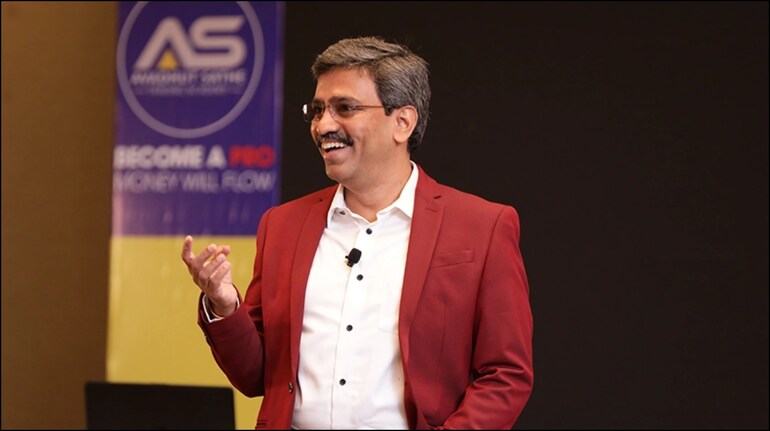
The Securities Appellate Tribunal (SAT) on Monday reserved its order in the case involving Avadhut Sathe and his trading academy after hearing detailed arguments from both sides over the course of the day. The matter relates to SEBI’s interim order against Sathe and the conduct of trading-related educational programmes by his academy.
Appearing for the Securities and Exchange Board of India (SEBI), Senior Advocate Chetan Kapadia argued that Sathe and his trading academy were engaged in providing stock tips and trading recommendations to students without being registered as research analyst or investment adviser, as mandated under SEBI regulations. Kapadia submitted that several institutions, including the National Institute of Securities Markets (NISM), exchange-led training institutions and Mumbai University, teach capital markets in an academic manner, but none indulge in practices such as using market data to provide trading tips to participants.
SEBI contended that on several occasions Sathe advised specific trades to students while not taking positions himself. It was further argued that at times students were encouraged to break their fixed deposits and deploy the funds in trading, without any risk profiling or assessment of their income and financial background. According to SEBI, such conduct was particularly concerning given the high-risk nature of derivatives trading and the vulnerability of retail participants.
Kapadia cited SEBI’s September 2024 press release on retail participation in the equity and futures and options segments, highlighting that nine out of ten individual traders continue to incur losses. Over the three-year period from FY2022 to FY2024, the cumulative losses of individual traders crossed Rs 1.8 lakh crore. SEBI argued that activities permitted only for registered intermediaries cannot be carried out under the guise of educational programmes, particularly when they involve real-time market interpretation and trade calls.
SEBI also pointed out that Sathe and his academy had failed to disclose details of their assets despite directions issued under the interim order. Kapadia justified SEBI’s action, stating that the order was based on detailed research, evidence and material collected during search operations. SEBI further highlighted that despite a warning letter issued in March 2024 and the subsequent interim order of December 2025, the allegedly misleading testimonials had not been removed from public platforms.
During the hearing, SEBI played select portions of videos used by the academy, including charts and commentary, to demonstrate how the training sessions were conducted. These clips were relied upon to support SEBI’s allegation that the programmes went beyond theoretical education and entered the domain of regulated advisory activity.
In his concluding submissions, Kapadia defended SEBI’s order and said, “They have till date not brought down the testimonials and not complied with orders. They have till date not filed an affidavit disclosing their assets and in my respectful submission therefore, in the facts of the present case, the entire order is justified in fact and law”.
Sathe denies allegations
Representing Avadhut Sathe, Senior Advocate Janak Dwarkadas strongly refuted SEBI’s allegations. He argued that SEBI relied on selective WhatsApp chats to build its case and sought to counter the claim that live market data was used in violation of regulatory norms. Dwarkadas maintained that historical data, which is publicly available on multiple platforms, was used for teaching purposes to identify patterns, and denied that the charts were prepared by Sathe or his academy.
Dwarkadas also opposed the allegation that Sathe was providing stock tips, asserting that the chats and commentary relied upon by SEBI were selective and taken out of context. He compared the academy’s training methods to the practical training imparted to surgeons, arguing that theoretical knowledge alone is insufficient without real-world exposure. He stated, “without even getting into the details that each of them has an explanation, each of them has an answer and I will provide an answer to SEBI when I get an opportunity”.
On the issue of allegedly misleading testimonials, Dwarkadas produced chartered accountant-certified statements to show that certain participants had made profits, contrary to SEBI’s claim of widespread losses. He further argued that SEBI had wrongly linked independent trades carried out by students to the present proceedings.
Dwarkadas strongly questioned the impounding order of Rs 546 crore, stating that no such funds were lying in bank accounts as the money had been spent on establishing and running the academy, paying taxes and statutory levies, and on welfare activities such as corporate social responsibility. He said, “On the one hand, I am being told to bring Rs 546 crores and put it into a no-lien account. On the other hand, my bank account is frozen. I have been prevented from selling, buying or dealing in securities. I have been told to stay away from the market. Where do I produce Rs 546 crores from? There is no answer”.
Concluding his arguments, Dwarkadas submitted that the interim order deserved to be stayed, stating, “This appeal requires this order to be stayed not because of anything else but because it is first of all impossible to perform”. Referring to SEBI’s action, he added that “it gives final directions at the stage of interim, ex parte”. After hearing arguments for almost the entire day, the Tribunal reserved its order.
Discover the latest Business News, Sensex, and Nifty updates. Obtain Personal Finance insights, tax queries, and expert opinions on Moneycontrol or download the Moneycontrol App to stay updated!
Find the best of Al News in one place, specially curated for you every weekend.
Stay on top of the latest tech trends and biggest startup news.




