






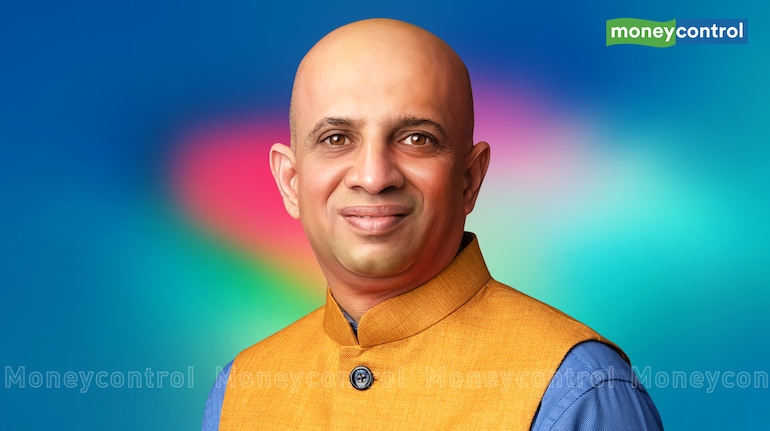
As ICICI Prudential Asset Management Company prepares to tap the capital markets, CEO Nimesh Shah says sustained growth in the mutual fund business is driven by consistent investor outcomes rather than short-term market cycles. “Whether it’s 1, 3, 5, 10 or 50 years — the only real driver in this business is customer experience,” Shah told Moneycontrol, pointing to digital onboarding and SIP-led flows as key enablers of the AMC’s expansion.
Edited excerpts
What would you attribute the stellar growth at ICICI Prudential to?
The first credit for the industry’s growth goes to the regulator. SEBI has created regulations that make the product pure and transparent for the final investor. We can debate margins, but never whether the product is good for investors. SEBI deserves that credit.
Because of these regulations, the investor experience has been good. In mutual funds, you only get money if your scheme does well. Even with the best marketing, if a scheme hasn’t performed, it won’t get flows. Customers are smart; they look at past performance and decide accordingly.
Digital access has completely changed in the last few years — KYC, onboarding, everything is easier, including availability in smaller towns. The “Mutual Fund Sahi Hai” campaign also played a big role: from 1 crore customers in 2018 to 5.5 crore today.
As the economy develops, people move away from traditional, low-return products towards capital markets. Intermediation evolves and money naturally shifts to mutual funds. This is globally true. Ten years ago, the MF industry was only 12–13% of bank deposits; today it's nearly 28.7%, and both are still growing. Ultimately, good customer experience has driven the growth.
Anything specific to ICICI Prudential?
At the cost of sounding like I’m bragging, one thing we’ve done well is ensuring a good investor experience even as we scaled. Our products moved from Rs 2,000 crore to Rs 20,000 crore to Rs 50,000 crore, and investor experience stayed strong. For example, ICICI Prudential Large Cap Fund is now one of the top performers in the category, and it’s Rs 75,000 crore in size.
Managing scale while delivering good risk-adjusted returns has been key. We also understand that customers are almost always pro-cyclical, whereas returns require counter-cyclical behaviour. So we created products that do that for investors — the dynamic asset allocation category. Over the last 15 years, the Balanced Advantage Fund’s performance relative to the risk it takes has been outstanding. Providing a consistent, good experience leads to continued growth.
Looking ahead, what will be the big drivers of growth over the next 1–3 years?
Drivers won’t change. Whether 1, 3, 5, 10 or 50 years — the only real driver in this business is customer experience. If the customer has had a good experience and made good returns, he reinvests. Everything else is secondary. The factors that supported the industry over the last five years will continue. India is a great market; if you deliver a good, fairly priced product to the middle class, the market is infinite.
On product design, where do you see big opportunities? Beyond thematics, you’ve already covered most equity categories.
We have a very wide product suite, managed by fund managers with very different styles — value, contra, concentrated, growth, quality. We match managers to products accordingly. Over the years, we’ve built a suite that is scalable.
Our asset allocation products — Balanced Advantage, Multi-Asset, Asset Allocator — have no capacity constraints. When investors sell, the fund buys; when markets fall, equity allocation rises; when markets rise, the fund trims exposure. This category has been scalable for us. Our market share in asset allocation products is over 25%.
Large caps also offer opportunities. Market views change over cycles. For the last year and a half, we’ve advocated large caps because they offered better risk-adjusted returns than mid and small caps. We continue to see room there. Flexi-cap, multi-cap, growth and asset allocation products all have opportunities.
Quant strategies will also have a role. SEBI has introduced SIFs, and we already use derivatives extensively.
Active funds charge more; passives have to charge less. How do you look at scaling from a business perspective?
I don’t “scale” anything personally — the market decides. Funds may appear to be push products, but I believe we only offer our investment views. For example, when mid and small caps ran hard in 2024, we advised large caps. Our views evolve with markets, not with product economics.
On quant, it must be used with judgment. We use quant everywhere — we have mathematicians in the investment team — but pure quant beyond the top 100 names can throw up uncomfortable results. We’ve run models, and some names that appear attractive on pure quant screens don’t meet softer parameters like capital allocation quality. So quant works best with guardrails of judgment. We follow that approach in our alternate space too.
On passive, as long as my active funds generate alpha, I would advise customers to invest in them. ICICI Prudential Large Cap has consistently beaten its benchmark. Retail passive participation hasn’t grown meaningfully because active funds have delivered. The day active stops beating passive, investors will shift. Investors will decide where the growth comes from.
What proportion of your active AUM beats the market? Because at the industry level, the picture isn’t very inspiring — nearly 70% of funds end up underperforming.
You can look at the data — more than 90% of my AUM across various time periods beats the benchmark.
How are you viewing the SIF category?
There’s a lot of potential. It will take time; I don’t expect anything dramatic in 6–12 months. We create products, manage them well, and once customers see 1- and 3-year performance, flows typically accelerate. Most of our funds have similar curves — initial growth, followed by a sharp pickup once customers gain confidence.
We’ve received three SIF permissions, and you’ll see launches over the next six months. We’ll manage the funds well, and as customers see value, the category will grow.
How much do you expect to collect? What size can this category reach for you?
I genuinely don’t know. In the last 3–5 years, my NFOs have collected Rs 10,000 crore and also Rs 1,000 crore. The effort is the same; the market decides. The target segment and market buoyancy matter. There’s no realistic way to predict a number.
Will this category cannibalise PMS/AIF assets? There is concern that SIF might kill the PMS industry.
If you add value in India, the market is infinite. If performance is strong, customers will stay — whether in PMS, AIF or SIF. We also have a reasonably large PMS business built over the last 4–5 years. I don’t view movement between products as a threat. We are in the MF business, the SIF business, the PMS business, the AIF business and the ETF business. This is a supermarket. If customers shift across vehicles, that’s an opportunity, not a threat.
There is room for every product. India still has huge pools of traditional money. SIF is an additional vehicle, not a replacement.
On your overall market share — it's around 13% for the first half of FY26. How do you see incremental gains?
Our approach has been consistent. Our equity products and our dynamic asset allocation products have done well, and together they’ve steadily pushed up our market share. Nothing dramatic — just year-after-year steady growth. As of 31 March FY25, we had about 13.6% share in equity. We also have long-only PMS and AIF money. We are comfortable with the growth trajectory.
Direct plans have grown sharply. How do you see this trend going forward? What impact has this had on your realized yields? At what margin threshold does compression become material?
We don’t analyse it that way. The customer is God, and he has multiple routes — digital, branch walk-ins, IFAs, banks, national distributors. He chooses the route; we welcome him through all of them. Margins differ by channel, and direct margins are lower, but that’s fine. Our gates are open everywhere.
But customers coming through direct reduce your profitability, and markets care about that more than you might.
How does it matter? The customer decides. SEBI has provided multiple routes; I can’t dictate which one he uses.
But the direct trend is strong now. What does that mean for profitability?
Profitability depends on volume and margin. We don’t worry about margins much — SEBI regulations clearly specify them. As size increases, charges naturally decrease. That’s good for our ability to beat the benchmark, and good for customers.
India is a volume game. Lower margin leads to higher profitability. Our margins have dropped over the last three years, yet profits have grown strongly. A buoyant market helps flows, but even in flat markets, lower costs make us more competitive. In a low-return environment, charges become more sensitive. Charging less becomes an advantage.
Ultimately, customers choose the route. Our job is to make all our platforms — digital or otherwise — equally strong. They can come through any.
What percentage of your growth is coming from SIP? Is a larger portion of the business coming from SIP?
SIP is fundamental. I’ve done over 100 roadshows worldwide and every discussion touches SIP. Psychologically, SIP replaces recurring deposits — people save monthly for predictable future needs like a child’s education. That behaviour is ingrained. SIPs keep growing and are a healthy trend. Even in corrections, SIPs held up; when markets fell in past cycles, more money flowed in. A lot of credit for recent market resilience goes to SIPs.
In the last 2–3 years your AUM has grown, yet operating margins have been flat or shrinking. Why, and can this margin level be sustained?
It’s a volume business. Despite falling margins, profits have grown because sales volumes are strong — look at net sales in 2024–25 and the first seven months of this year. SIP maturity shows up: when markets correct, flows often increase. Lower charges raise the probability of meeting benchmarks, making the business more sustainable. Margins can be maintained because our revenue mix spans multiple products — liquid funds, overnight, equity, hybrid — each with different margins. What you see as an aggregate margin is a cocktail of these businesses.
There’s no way to predict market direction in the next year; CEOs and boards make assumptions on how liquid, equity and other segments will grow. We plan for profitable growth across each business; the outcome is the result, not a simple top-down guarantee.
Your ROE is far above peers — around 89% — driven by distribution scale. Is there a formal distribution or payout policy as a public company?
We focus on operating profit, not PAT, because PAT is sensitive to net worth and other income. Operating profit is the right metric in this business. We hold ~20% share of industry operating profit while top-line market share is ~13.6% — a healthy balance.
On payout, our RHP commits to a minimum dividend policy (we will endeavour to pay at least 60% when feasible). Historically, we’ve paid more than 80%. The business doesn’t require large net worth; the resource is expertise and people, not a big balance sheet.
What about the SEBI consultation on TER/brokerage caps? What’s the likely impact?
SEBI created a transparent product that helped industry growth. We’re in ongoing consultations with SEBI over the proposals. We’re not worried; if there is an impact, we know how to manage it.
Can you provide any assurance that promoters will not sell at current levels, given concerns around future supply overhang and its impact on the stock?
During the roadshow, we attracted high-quality foreign investors and domestic mutual funds with deep existing exposure to Indian markets. Capital markets have ample appetite. The mutual fund industry is about Rs 50 lakh crore, yet only Rs 1,000 crore was allocated to them in the anchor book—making 12.5% relatively insignificant given the scale.
Global investors manage trillion-dollar funds; allocations of Rs 40–50 crore ($4–5 million) to them were small by comparison, underscoring strong long-term demand. The anchor and pre-IPO books comprised institutions with deep pockets and long-term intent, including large pension funds with allocations of around Rs 45 crore.
Lastly, how much money might have been left on the table in this IPO?
I won’t speculate. Look at operating profit and its growth; analysts can form their view. My perspective would be biased — I’ll leave it to the market and analysts to judge.
Disclaimer: The views and investment tips expressed by experts on Moneycontrol.com are their own and not those of the website or its management. Moneycontrol.com advises users to check with certified experts before taking any investment decisions.
Discover the latest Business News, Sensex, and Nifty updates. Obtain Personal Finance insights, tax queries, and expert opinions on Moneycontrol or download the Moneycontrol App to stay updated!
Find the best of Al News in one place, specially curated for you every weekend.
Stay on top of the latest tech trends and biggest startup news.




