






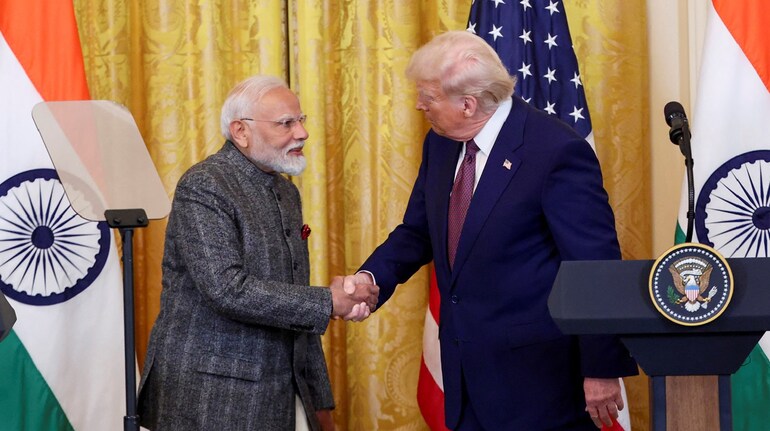

The India-US trade deal has delivered a sharp overnight jolt to market sentiment with Nifty and Sensex opening in green, about 2.7% higher (as of 9:30 am). While foreign investors remain heavily positioned on the short side, rollover behaviour and key technical levels indicate that traders are waiting for confirmation before committing to a sustained trend.
According to NSE data, foreign institutional investors (FIIs) hold nearly 80 to 90% of their open interest in Nifty and Bank Nifty index futures on the short side, with net short positions around 201,567 contracts. The long-short ratio is close to 14%, indicating that for every 100 index futures positions, only about 14 are longs. This reflects deeply bearish positioning carried into February, even before the trade deal.
“The first one hour will be crucial,” said Mithin Doshi, senior derivatives analyst at Centrum Broking, noting that early price action will determine whether shorts are forced to unwind abruptly or allowed to exit gradually.
Short covering risk high — but conditional
If early gains hold, the derivatives setup could turn constructive quickly. “Heavy FII short positions and a low long–short ratio mean the market is primed for short covering, which can accelerate upside moves in Nifty and Bank Nifty futures,” Doshi said.
Traders will watch futures open interest rising alongside prices, which signals fresh long build-up rather than only short covering. In the options market, call writers covering positions and put writing shifting to higher strikes would indicate growing confidence in the move.
However, traders caution that this will hinge on follow-through buying rather than just a gap-up open.
Dhupesh Patel, derivatives analyst at Samco Securities, said FIIs have remained in an oversold zone for nearly a month, but the extent of short covering remains uncertain, particularly given ongoing adjustments to the STT framework.
“Some short covering is possible, but it is difficult to estimate how much of the short book will be unwound. The major trend reversal depends on price confirmation, not just how oversold the market is,” he said. A sustained close above 25,500 on Nifty would be required to confirm a meaningful trend shift. Until then, market moves are likely to remain sharp and reactive, driven by positioning adjustments rather than clear directional conviction.
According to Patel, a sustained close above 25,500 on the Nifty would be required to confirm a major trend reversal. Until then, the market may continue to see sharp moves driven by positioning adjustments rather than a clean directional shift.
Rollover bands emerge as key decision zones
February rollovers, compiled before the trade deal, indicate traders entered the month with restraint. Doshi said Nifty futures rollovers were concentrated in the 25,250 to 25,200 zone, while Bank Nifty rollovers clustered around 59,200 to 59,100.
“Nifty is currently trading below its rollover band, and if this zone continues to act as resistance, downside pressure cannot be ruled out,” he said. A sustained move above 25,200 for a few sessions would be required to validate further strength, while failure to hold above this level could result in a false breakout.
Bank Nifty, by contrast, is hovering near its rollover range, where a sustained hold could preserve a mild upward bias, making banking stocks a key swing factor. Nifty rollovers moderated to 70.75% from 72.29% in January, below the three-month average of 72.28%, signalling gradual loss of momentum. Bank Nifty rollovers fell to 71.15% from 77.46%, below the three-month average of 75.82%, showing traders were cautious about carrying aggressive positions despite elevated bearish bets.
Sector-specific impact from the trade deal
Sudeep Shah, Head of Technical and Derivatives Research at SBI Securities, said the trade deal’s effect is likely to be visible first in sectors that faced heavy short-selling in recent weeks.
“A lot of short positions were built in IT stocks, which saw significant pressure. Select auto-ancillary and chemical stocks also had aggressive selling,” Shah said. “In sectors with concentrated selling, we could see a decent bout of recovery.”
Shah added that the long-short ratio had improved from about 7.5 to 11 post-Budget, suggesting many negatives were already priced in. With the Budget behind and concerns around transaction costs fading, traders can now shift focus to crowded shorts and sector-specific recovery opportunities, rather than broader macro overhangs.
STT impact likely limited to futures
Regarding higher transaction costs post-Budget, Shah said volumes may fluctuate in the short term but are unlikely to collapse. “Most of the negatives were already priced in. The Budget noise is fading, and the trade deal has emerged as a dominant trigger,” he said.
Shah noted that options, which account for 95% of F&O volumes, are largely unaffected, as higher STT adds only a marginal cost. Futures, which make up 5% of volumes, may see reduced participation due to rising margins, but this is expected to be gradual.
“Earlier, STT and Budget concerns drove hesitation. Now, with a positive global trigger, traders are focusing on where shorts are crowded and where recovery can play out,” Shah said.
Disclaimer: The views and investment tips expressed by experts on Moneycontrol.com are their own and not those of the website or its management. Moneycontrol.com advises users to check with certified experts before taking any investment decisions.Discover the latest Business News, Sensex, and Nifty updates. Obtain Personal Finance insights, tax queries, and expert opinions on Moneycontrol or download the Moneycontrol App to stay updated!
Find the best of Al News in one place, specially curated for you every weekend.
Stay on top of the latest tech trends and biggest startup news.





