







The market was almost entirely dominated by bears in the week ended March 6, falling nearly 3 percent, reacting to the crude oil shocks amid the US-Israel-Iran war-led geopolitical tensions in the Middle East. Brent crude oil prices skyrocketed to nearly $95 a barrel. A sustained rise in oil prices could weigh on investor sentiment and adversely affect India’s twin deficits, inflation trajectory, and the RBI’s monetary stance, while a 4.8 percent weekly uptick in the US 10 year bond yield to a level of 4.14 percent and a stronger dollar have prompted FIIs to adopt a risk off approach toward domestic equities. The impact was also seen in the global peers with Dow Jones declining 3 percent, and Shanghai down nearly 1 percent.
The selling was broad-based, while defense gained some ground with the Nifty India Defence Index rising 4.9 percent due to the evolving geopolitical landscape and increased budget outlay. The sharp spike in India VIX increased uncertainty and risk aversion among market participants.
In the week ahead starting from March 9, the benchmark indices are expected to weaken further if the Iran war intensifies and the blockade continues in the Strait of Hormuz with the Nifty bears eyeing psychological 24,000 zone. Apart from developments in West Asia and their impact on global energy supply, oil prices and rupee, the focus will also be on the inflation data (from the US, India and China), and US Q4 GDP numbers & jobs data.
The Nifty 50 plunged 728 points (2.89 percent, the biggest weekly loss since February 2025) to close at 24,450, and the BSE Sensex tumbled 2,368 points (2.91 percent) to 78,919, while the Nifty Midcap and Smallcap 100 indices were down 2.91 percent and 2.54 percent, respectively.
"Markets have partially priced the geopolitical shock, but not the full macro impact. The initial Hormuz disruption triggered a fear premium in oil and a sell-off in risk assets — that knee-jerk move may be largely behind us," Rahul Bhutoria, the Director and Co-Founder of Valtrust said.
He feels what hasn't been fully priced in is the sustained economic consequence if disruption persists: a potential widening in India's current account deficit, rupee pressure, and the inflationary pass-through from elevated crude.
According to Vinod Nair, Head of Research at Geojit Investments, investors are moving towards traditional safe-haven assets and adopting a cautious stance, awaiting greater clarity.
He expects that reassurance over control of the Strait of Hormuz will help stabilize market sentiment. He advises avoiding a panic sell-off and adopting a disciplined, long-term perspective and exercising patience over the next several weeks, as current price levels may offer a strategic entry point for medium- to long-term investors.
Here are 10 key factors to watch:
US-Iran War
Globally, participants across asset classes will continue to keep an eye on the highly sensitive factor - the geopolitical developments in the West Asia that entered into the second week, as this has not only disturbed the life of lakhs of people, killed more than 1,500 people and destroyed civilian structures in the Iran and other nations like Lebanon in the Middle East but also impacted economies directly or indirectly, ultimately signalling the global growth concerns.
Gulf war seems to be unending soon. Iran President Pezeshkian on Saturday said sorry and promised not to hit regional allies in the Middle East but later immediately he faced criticism from Iranian leaders. Iran -- the main target of United States and Israel forces -- continued to attack neighbouring countries like UAE, Saudi Arabia, Qatar, Bahrain, and Kuwait, especially the US bases, in retaliation for ongoing strikes by US and Israeli forces. On Sunday, various drone and missile attacks were reported in United Arab Emirates, Bahrain, Saudi Arabia, and Kuwait from Iran, while their defenses also responded to a missile threat from Iran.
Further, Israel struck several fuel storage complexes belonging to the Iranian Revolutionary Guard Corps, damaging the military infrastructure of the Iranian terrorist regime.
Iran security officials said the US President Trump must pay the price for the war, while the United States President stick to its comments saying their forces will hit the Tehran hard and asking unconditional surrender from Iran. In between, the new leader has been appointed in Iran, replacing Supreme Leader Ayatollah Ali Khamenei, who was killed in the beginning of the war. CNBC and CNN reported.
Strait of Hormuz and Oil Prices
All this ultimately impacts the crude oil prices as the supply worries come to the fore especially after reports of closure of Strait of Hormuz, a narrow 33-kilometre waterway (which Iran claims that the Strait lies within its territorial waters), which quietly carries nearly 20 million barrels of oil per day, accounting for about one-fifth of global oil trade. Later Iran confirmed that the Strait is open but warned that it will target vessels of US and Israel, while the reports indicated that Iran forces allowed two vessels carrying Indian flag over the weekend.
Further, the impact was also seen in Kuwait as Kuwait Petroleum Corporation either stopped or reduced operations at its major refineries following the Strait blockade and Iranian threats.
Brent crude oil spiked to 94.64 a barrel on Friday (the highest level since September 2023) before closing the week 27.5 percent higher at $93.33 a barrel after gap-up opening on Monday, while the US crude oil prices narrowed the gap with Brent crude oil prices, rising 35.29 percent during the week to $91.08 a barrel due to rising demand.
Oil importing nations like India is expected to hit hard by the rising crude prices which will impact earnings and economic growth, rupee, increase inflation concerns, and widen the fiscal deficit. India imports roughly 5 million barrels of crude oil every day, and nearly 50-52 percent of these imports pass through the Strait of Hormuz i.e. more than half of the energy that powers the Indian economy.
According to experts, if oil averages $90+ for an extended period, the combination of fiscal pressure and the limited room for further monetary easing could trim 25–30 bps from economic growth.
Sectors with high crude-derivative content in their input baskets — paints, chemicals, FMCG packaging, logistics — will see cost-push pressure, Rahul Bhutoria, the Director and Co-Founder of Valtrust said, adding India's LNG-dependent sectors, including fertilisers, city gas distribution, and industrial users, face a parallel supply and cost risk that the market has not yet fully reflected.
US GDP, Inflation
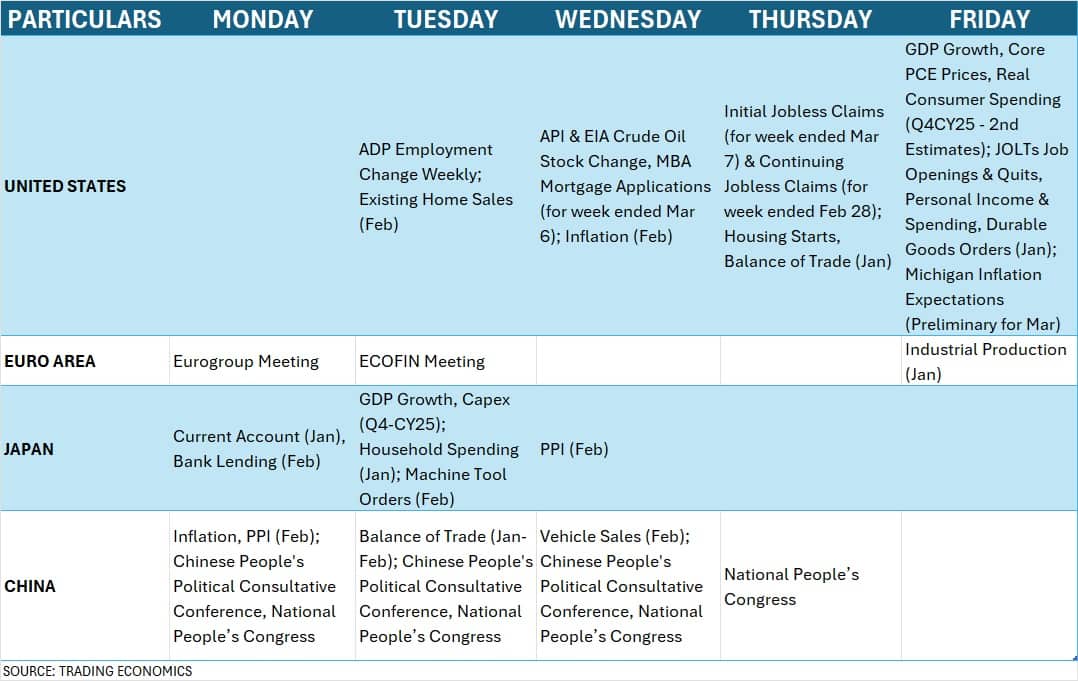
Apart from Iran war and oil prices, the economic releases from the United States like GDP growth, Core PCE prices, and real consumer spending (2nd estimates - Q4CY25); February inflation; and January JOLTs Job openings & quits, personal income & spending, and durable goods orders will also be watched as all these data points could influence expectations for Federal Reserve policy.
According to preliminary estimates, the US GDP growth declined to 1.4 percent in October-December 2025 period against 4.4 percent growth in previous quarter, with slowing consumer spending, declining exports, and contraction in government investment & expenditure, while most economists expect the inflation for February to be around similar lines of previous month (i.e. 2.4 percent).
Global Economic Data
Besides US economic releases, the focus will also be on the China's inflation and Two Sessions' meeting. Further, Q4CY25 GDP growth, capital expenditure, and private consumption, as well as January month's household spending from Japan.
Domestic Economic Data
Back home, the market participants will focus on the monthly retail inflation scheduled on March 12, which according to economists is expected to inch upward in February from 2.13 percent in January. This is one of the important factors for considering the interest rate decision by the Reserve Bank of India but the numbers for current and following months (if crude oil prices remain above $90 a barrel) will be closely track by the central bank. Also, the next month's monetary policy meeting is also important to watch amid Iran war.
The bank loan and deposit growth for fortnight ended February 28, and foreign exchange reserves for week ended March 6 due March 13 will also be watched. Forex reserves jumped to all-time high of $728.49 billion in the last week of February from $723.61 billion in previous week.
The Foreign Institutional Investors' (FII) money flow to Indian equities will also be watched next week as the flow (considering the February numbers) was about to improve given the expected further recovery in earnings and healthy economic growth but the US-Iran war-driven Middle East concerns and spike in oil prices raised concerns over the earnings and growth along with weakening rupee.
The dollar index surged 1.24 percent to 98.85 after a month of consolidation, while the Indian rupee maintained depreciation for third consecutive week and hit fresh low of 92.3 against the US dollar before ending at all-time closing low of 91.91, weakening 0.97 percent amid concerns of rising import bills on elevated oil prices. Experts expect further weakness in the currency if the oil prices keep rising.
FIIs net bought Rs 21,800 crore worth shares during the first week of March against Rs 6,600 crore outflow in previous entire month, however, Domestic Institutional Investors (DIIs) continued to fully compensate the FII outflow by buying nearly Rs 32,800 crore worth shares in the recent week in addition to Rs 38,400 crore of buying in previous month, as per provisional updates.
"FPIs are unlikely to return to the market as buyers until there is some clarity on the outcome of the conflict and decline in the price of crude. Brent crude trading above $90 a barrel is bad news for the Indian economy and markets," VK Vijayakumar, Chief Investment Strategist at Geojit Investments said.
The flow of IPOs suggest that the primary market action has not impacted yet, though the equity market hammered by the US-Iran tensions. Four initial public offerings (IPOs) worth more than Rs 6,600 crore are set to hit Dalal Street next week with three from the mainboard and one from the SME segment.
Rajputana Stainless will be first IPO worth Rs 255 crore from the mainboard segment opening on March 9, followed by Innovision offer amounting to Rs 323 crore. Raajmarg Infra Investment Trust will open its Rs 6,000-crore initial share sale for public subscription on March 11.
Apsis Aerocom is the only SME IPO opening on March 11. It is raising Rs 35.77 crore via public issue, while Elfin Agro India closed its maiden public issue on March 9, followed by Srinibas Pradhan Constructions on March 10.
On the listing front, four new companies - Sedemac Mechatronics, Acetech E-Commerce, Elfin Agro India, and Srinibas Pradhan Constructions - will be available for trading on the bourses
Technical View
Technically, the Nifty 50 remains subdued with bearish crossovers in momentum indicators and the index itself trading well below the long term moving averages (100 and 200-day EMA). In fact, currently the index is more than 3 percent below its 200-day EMA (25,225), while all these key moving averages trended down. Hence, the chances of index breaking 25,300, the previous week's low, is expected to be very high in the coming week as sustaining below it can open door for the 24,050-24,000 zone, however, on the higher side, the 24,700 is expected to be immediate hurdle followed by 24,850-25,000 levels.
F&O Cues, India VIX
The weekly options data indicated that the Nifty 50 is expected to trade in the 23,800-25,000 range in the short term as breaking either side can give next direction to the market i.e 23,500 on the lower side and 25,500 on the higher side.
Meanwhile, the fear gauge, India Volatility Index (India VIX) spiked 45.08 percent (the highest weekly rally since April 2025) during the recent week to 19.88, the highest closing level since May 2025, signalling the major discomfort and increasing risk for bulls. Bulls may not find comfort unless the VIX falls and sustains below 13-12 levels.
Corporate Action
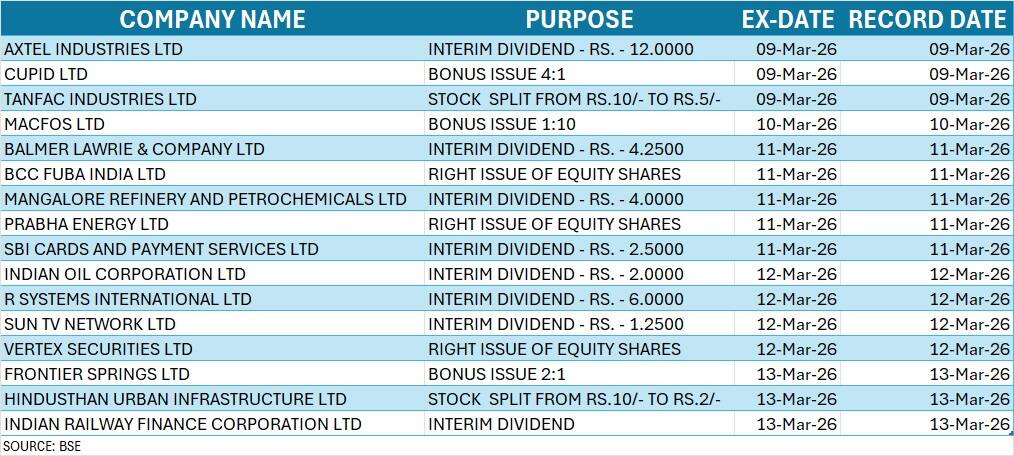
Here are key corporate actions taking place in the coming week:
Discover the latest Business News, Sensex, and Nifty updates. Obtain Personal Finance insights, tax queries, and expert opinions on Moneycontrol or download the Moneycontrol App to stay updated!
Find the best of Al News in one place, specially curated for you every weekend.
Stay on top of the latest tech trends and biggest startup news.





