






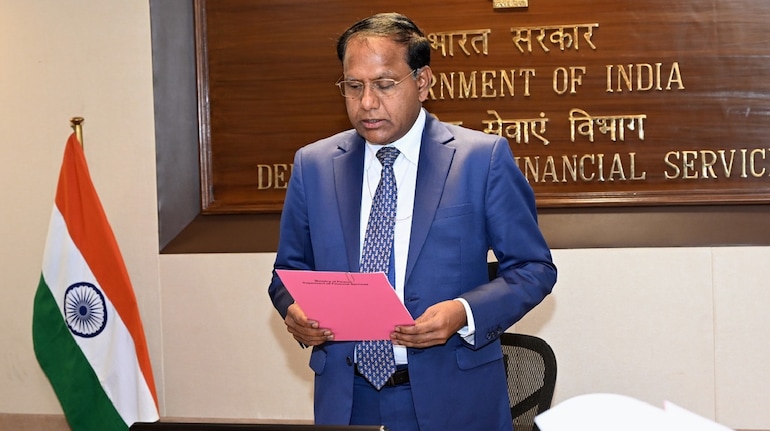

The government plans to revamp the Stand-Up India scheme to offer larger loans and widen its reach, Department of Financial Services (DFS) Secretary M Nagaraju said on January 13, as part of a broader push to deepen financial inclusion and back small entrepreneurs.
Speaking at the Global Inclusive Finance Summit, Nagaraju said the government is “trying to revise the Stand-Up India scheme” and wants to “provide larger loans to more people from the SC, ST beneficiaries”. He noted that women’s participation under the scheme is higher than men’s. “Even in the Stand-Up India scheme, women's participation is higher compared to men. In fact, among the SC, ST, the aspiration for women is higher compared to the men,” he said.
Since April 2016, 2.75 lakh loans worth Rs 62,000 crore have been sanctioned under the scheme, according to data cited by Nagaraju. Stand-Up India is aimed at promoting entrepreneurship among women and the Scheduled Caste and Scheduled Tribe communities by facilitating bank loans.
Under the current framework, banks can provide loans ranging from Rs 10 lakh to Rs 1 crore to eligible entrepreneurs from the Scheduled Caste, Scheduled Tribe, or women categories to set up greenfield enterprises in manufacturing, services, trading or allied sectors.
Fintech’s global access via trade deals
In a separate initiative, the DFS is working to help Indian fintech companies access overseas markets. Nagaraju said the department is “trying to provide fintechs access to the ecosystem through trade deals with other countries”.
India, he said, is particularly focused on East Asia as it looks to expand UPI and the broader digital payments ecosystem abroad, while ensuring Indian firms are not shut out of global markets.
Banking reach at 99.9%
Nagaraju said 99.9 percent of villages are now covered by banking touchpoints, with the remaining gaps in difficult terrain such as parts of Arunachal Pradesh.
“We are trying to design some new things there. I hope by the end of this year, we will be having a touch point even in those remotest places within 5 kilometres,” he said, referring to a cluster-based approach for the Northeast.
Banking correspondents, he added, have been central to the expansion. “Imagine 60 lakh BCs going around in the villages, mohallas, trying to bring people, first opening their accounts and then providing banking services,” he said.
Cleaning up accounts, tackling risks
The government has also launched drives to clean up the system. Nagaraju said a recent campaign weeded out inactive accounts and added more than 3 crore new accounts over the past three months. “Currently we have about 57 crores… accounts,” he said.
Going forward, he said financial inclusion must translate into financial literacy and then financial security, built on three pillars: “credit, risk coverage and pension”. He also flagged that micro-units need support to scale up, as “the graduation of micro-units into medium and large enterprises is actually not happening in the country”.
Financial inclusion as a growth engine
Nagaraju said financial inclusion has become a key driver of economic growth and poverty reduction. “Financial inclusion is a key driver of economic growth, poverty alleviation,” he said, adding that it has had a “multiplier effect on economic growth”.
Calling the launch of the Pradhan Mantri Jan Dhan Yojana (PMJDY) on August 20, 2014, “one of the most transformative days in India’s history”, he said the programme has reshaped India’s financial landscape. “Now…….over 50 crore people have bank accounts in India. And most of them are poor, from the rural areas and marginalised sections,” he said.
He added that the gender gap in account ownership has almost closed, with women increasingly seeing themselves as “equal stakeholders in economic development of the family”.

Discover the latest Business News, Sensex, and Nifty updates. Obtain Personal Finance insights, tax queries, and expert opinions on Moneycontrol or download the Moneycontrol App to stay updated!
Find the best of Al News in one place, specially curated for you every weekend.
Stay on top of the latest tech trends and biggest startup news.





