






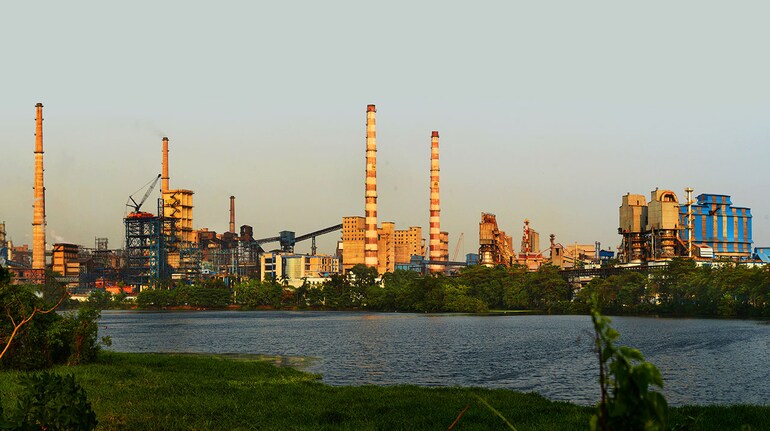

Metals firm Tata Steel's CEO and managing director T.V. Narendran and executive director and chief financial officer Koushik Chatterjee said in an interaction with Moneycontrol that the safeguard duty re-imposed by the government on certain grades of flat steel at the end of December 2025 will help the industry in India with cash flows, making it primed for large-scale expansion projects.
The management said that the company plans to make more investments towards downstream facilities in India, as it plans to expand its market share in its new India-first strategy. Overseas, especially in Europe, Tata Steel said that the Carbon Border Adjustment Mechanism (CBAM), a non-tariff measure by the European Union to keep out "carbon-intensive" products, protects its significant exposure to EU.
Edited excerpts:
How does the US trade agreement indirectly or directly impact Tata Steel?
T.V Narendran: The US trade agreement doesn't impact us directly. But anything good for the country is good for the steel industry. Many of our customers like the auto component sector export to the US, so they will get the benefit from it.
US is also a source of coking coal which doesn't help us in our Indian operations much because we use a technology in our coke ovens called Stamp Charge technology. So, the US coals are not great for that technology, but some of our peers use other technologies and so they have an optionality to import coking coals.
How does the EU-India trade deal and the continuity of CBAM improve the outlook for Tata Steel’s European business?
Narendran: As far as the EU is concerned, from a sentiment point of view, it's positive and again it helps many sectors, some of whom may be our customers.
From Tata Steel's point of view, the fact that the CBAM stays helps us in Europe because CBAM is actually an equalization tax. It's not so much a trade issue, it is a carbon tax issue. I think the whole philosophy of CBAM is if any steel producer in Europe is paying a carbon tax, any steel supplier into Europe should pay the same carbon tax. The fact that CBAM stays helps us for European operation and we don't export so much steel from India to Europe as Tata Steel.
Chatterjee: (On the US tariffs on India) There are two parts to it. One was there were certain exclusions to Section 232 which actually lasted till September 25, because (of) exclusions, our effective tariff was lower than 50%, but post September 25 those exclusions moved away. The EU is just now at about 50% for the steel that they export to the US, so it’s increased.
Mr Narendran, last year you had said muted prices were holding back large capex decisions across the steel industry. With the new safeguard duty now in place, does that change the incentive for Tata Steel, and should we expect a pickup in capex?
Narendran: It is important for the country that the Indian steel industry is healthy.. so that the industry, including Tata Steel, can continue to invest in new projects,
In the beginning of this year, the safeguard duty came in, maybe less than what we had asked for, but it was still good enough. In December we got the guidance that it is being extended for another two years as was originally planned. So that allows us comfort. We are at a much better place now. Going forward, we expect prices to improve across geographies, and that bodes well for our cash flows and balance sheet. It sets us up well for the investments that we plan to make.
What are the future growth plans for Tata Steel?
Narendran: We are focusing not just on the upstream growth, it's not just more steel capacity, but investing in downstream value-added products, making sure we have a high market share in the more profitable segments.
What is Tata Steel’s response to the CCI investigation into steel pricing?
Narendran: We will respond to it when we get all the documents, the DG (director general) has looked at it and submitted some report and CCI has a process whereby people like us who are allegedly doing what they said we are doing, can respond.
We will respond to the allegations. But the larger point we are making is steel prices go up and down. It is based on international prices. It doesn't depend on Tata Steel deciding in isolation that we will increase prices or things like that. Steel prices are published every day. There is a Mandi Gobindgarh price, a Raipur price, and daily publications that track steel prices. It is a very transparent market with hundreds of players.
The investigation is focused on reinforcing steel, where the large players account for only about 30–40% of the market. Most of the market consists of a large number of smaller players, and there needs to be a deeper understanding of how steel prices move within this market structure.
Steel prices will also go up when coal prices go up like it is going up now, so there are multiple issues which impact steel prices. We are just saying that please look at all these things and don't conclude that the steel prices go up because everyone is colluding.
We will make our submissions to the CCI and submit our arguments. It's a bit unfortunate that we've all been named but we will follow due process.
How is Tata Steel progressing on its UK restructuring and green transition plans in the UK and the Netherlands?
Narendran: In the UK, we’ve already signed an agreement with the government, and the government is committing about £500 million. We've done a lot of the restructuring. We've closed the blast furnaces. We (have) placed the orders for the electric arc furnace, and we are in the process of setting it up. It was supposed to come up by the end of next year. We are having some discussions with the National Grid who is supposed to supply the power. They're running a bit slower on their project than they promised. So, we need to get all those things in place, but directionally we know where we are headed and I think we are making good progress.
Netherlands is more about transitioning into a greener process route. But there the conversation is with the government. We signed a non-binding letter of intent in September last year. In September this year, we are supposed to conclude the discussions and address the conditions precedence which are there for both sides.
So, we're working on that and recently there are some claims on us in Netherlands , which is more to do with some of the societal issues we are dealing with. Again, there we will go through due process and explain our point of view to the authorities and hopefully we'll come out of it, you know, in a positive way.
We are currently opening our markets with trade deals with the UK, EU, and another is being concluded with the US. In that context, some could say that the safeguard duty goes against the spirit of the FTAs. How do you respond to that?
If you look at the steel industry, traditionally it has operated with 5% import duty and zero import duty on imports from Japan and Korea. I can't think of too many industries in India which operate at 0% import duty and 5% import duty and still are competitive and still are able to spend billions of dollars building new capacity.
The Indian steel industry, I think has done a pretty good job in building large capacities over a period of time. The fact that it is a tough industry is reflected in the fact that you can count there are more people who died than who have survived in the last 30 years.
If it was such an easy industry, then you would have so many players. But most people who come in have struggled to survive because it's a tough industry. So, I think that is a reflection of the fact that this is an industry which is competitive. Anyone can build a steel plant in India.
What we are saying is India is the second largest market for steel...If anyone wants to participate in the steel consumption in India, they should build a steel plant in India. India allows you to own 100% of the steel plant. Very few countries allow that. When you want to buy a steel plant in US or if you go to buy a steel plant in Japan or Korea or China, you won't get 100% ownership.
In India, the government allows anyone from anywhere in the world to come and set up a plant. So, if you want to participate in the Indian steel industry, build a steel plant in India. You will get the iron ore. But that is important to create jobs in India. If India has an iron ore market, why wouldn't you want people to build steel plants in India and create jobs in India?
But if you say that I will build a steel plant anywhere in the world and ship to India at zero duty. Then how does it help India? And that is where our point is. And safeguard duties are only when there is damage.
What are the success stories of manufacturing in India, right? The first name which comes to mind is auto industry. What did we do in auto industry? We allowed anyone who wanted to set up an auto plant to build in India. We helped people build an auto industry, auto component industry and today we have world-class auto companies, world-class auto component companies, because there are costs in India of doing business beyond the factory gate.
We can be competitive inside the factory gate, but the cost of logistics, cost of capital, time taken to acquire land, time taken to deal with many of the local issues that we face when you want to acquire land. All those costs add 50 to $100 to the cost of steel. You can build a steel plant in Vietnam or somewhere else and not incur those costs, and ship to India.
I think one needs to think about it a little bit more strategically to say, do you want an industry or not? If you say I don't want steel industry, I'm happy to import steel, then it's fine. Then it doesn't matter...Then I will also import. Why should I invest tens of thousands of crores in Odisha and Jharkhand and build steel plants if I can import steel to Mumbai from wherever and use it to convert into finished products?
I think that's a question to ask. So that's where we feel safeguard duty is not an unreasonable ask.
Koushik Chatterjee: In most of the OECD countries, the steel capacity is more than their domestic requirement. To keep those plants running and employment going, they keep producing the steel.
Their consumption levels are lower, so they go to the country which is growing the fastest, with 8 percent growth, which is equivalent to somewhere around 12 million tons of steel every year.
Do you have further room to raise prices in the coming quarters? You did it earlier in the year after Safeguard duty was announced...
Till November, steel prices in India were at a discount to import landed prices, which is unusual. Normally steel prices in any country will be higher than import landed prices. That was a reflection of supply side growing faster than demand, but I think there's a better balance now and so that's why you see steel prices matching import landed prices, and maybe slightly better going forward.
There are two factors which will drive up the price. One is the sentiment in the domestic market, the demand, etc.
Imports are not so much of an issue, but the other factor which will maybe put pressure on prices are coking coal prices, because that has gone up by $50 in the last six weeks and that is 40% of the cost for any steel producer. If coking coal prices stays at this level or keeps going up, then there will be pressure from a cost point of view to push up the prices. So that remains to be seen how where the coking coal prices will settle.
Currently, how do you source coking coal and do you plan to diversify?
...For India, we largely import from Australia. We buy from North America for our Netherlands operations, and a little bit from Africa, Indonesia, etc. We will stick to this because I know there was a question around coking coal from US for India, but those coking coals are not suitable for our technology. We use what's called stamp charging technology, which is ideal for Indian coals and for Australian coals. We buy some volumes from the US, around 1 million tonnes, more for some of our top charging battteries but largely we will stick to the current mix of 70-80% Australian coal.
Discover the latest Business News, Sensex, and Nifty updates. Obtain Personal Finance insights, tax queries, and expert opinions on Moneycontrol or download the Moneycontrol App to stay updated!
Find the best of Al News in one place, specially curated for you every weekend.
Stay on top of the latest tech trends and biggest startup news.





