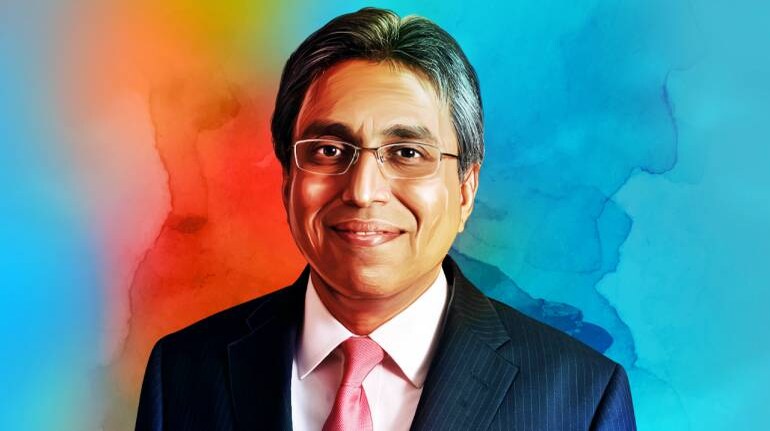
With the Mahindra Group's main auto business now back on track, the conglomerate is shifting its focus to new growth opportunities. Anish Shah, Managing Director of Mahindra Group, discusses the strategic themes influencing each of the conglomerate's core businesses in an interview. Shah expects a considerable increase in the net worth of these businesses and lists out the key factors that will shape their growth trajectory. Edited experts:
Do you see signs of a rebound in private capital spending? How is the Mahindra group placed in this?We see that (private capex) is picking up now because capacity utilization is starting to hit 75%. In our case, capacity utilization in the auto business is close to 100%. And we continue to put in more capacity. So, we have been slightly ahead of others on the capex front. But across the industry, we see companies stepping up and really ramping up private capex as well.
Several large corporate groups are aggressively tapping external capital. Will you also raise more capital?The good thing is that only businesses that are doing well need capital. In some ways, we are open to external capital - but only from investors who can help us grow the business. For instance, we have raised private equity funding for Mahindra Last Mile Mobility and Mahindra Susten. In both cases, it was not only about capital per se; it was about having the right set of partners who could help us grow these businesses. We have sufficient internal accruals and enough cash on our books, so we continue to remain very judicious in terms of how we raise capital from outside. Our focus will be to execute well and grow our businesses; if you do that, plenty of capital is available.
What exit options are available for investors who have already invested in group businesses?The exit path for many of them will be through a public listing. If we look at the Susten Invit, there is already an exit option for investors. Look at MEAL (electric vehicles business) and Last Mile Mobility, the three-wheeler business; we will look at listing them over time when they reach a significant scale. As we look at some of our other private growth gems, we will look at listing those as well. So, the paths will be through a public listing. Our focus is to drive the core engine of the business to deliver growth. And if we do that well, the market will reward us.
We recently saw Tata Motors announcing the demerger of its businesses. At some point, will you evaluate a similar value-unlocking opportunity for the auto business?That's not something we're looking at right now. See, for us, it is very important to create value in all our businesses. In fact, we see a much greater value from synergies across our businesses… If you look at a farm business, it has margins that are far greater than the industry. One would say that's expected because we've got a market share that's far greater than anyone else. But if you look at the auto business, while we are number one in the SUV segment, we are not number one in the passenger vehicle industry. Despite that, we have the best margins, and that's driven by a lot of the synergies that we have with other businesses. We are, in fact, strengthening those synergies now as well. So, the approach we have is if we can create far greater value for shareholders by leveraging synergies across businesses than by having the businesses separate. However, if we can harness more value by separating the business, we may consider that in the future, but, like I said, we are not considering that now.
How are things shaping up at Mahindra Finance?If you look at the recent results, the concerns on asset quality have been solved. For us, credit costs were never an issue. As we see it, the business has undergone a full transformation. The business has gone through a very significant transformation on the technology side. A number of tech programmes have been launched, and these are doing very well for us. And we expect that in the next one and a half years, we should come out much, much stronger.
How do you view the recent regulatory actions in the NBFC space?One needs to have very strong processes, strong controls, and a strong risk framework. RBI, in fact, has always been very disciplined in asking for that, and that's the right thing to do. Even if you take for a minute that there was no regulation in this industry, the Mahindra Group would want to make sure that all possible risks are contained and that that business operates with a tight set of controls. So, the recent RBI actions will have a positive impact on the NBFC sector. We see this as consistent with what the standard has always been… Our financial services sector must be run well with the right set of controls around it and the right risk framework.
Does the current situation present an opportunity for Mahindra Finance?You could say in some form that there is. But if there is credit being given in the market at high risk, we are not going to go in and do the same…. But for sure, the financial services industry offers huge growth potential over the next decade or maybe even longer.
Competition has always been a good thing for us; we have become better because of intense competition over the years. We have had global auto players in India for a long time, and we have been competing with the best in the world. And we have actually been able to show tremendous success competing against most of them. We are launching six new electric SUVs soon – and these are designed to meet the loftiest expectations of our customers. So, it's good to have more players come in and participate in 'Make in India.'
What are your plans for EV battery cell manufacturing?We have been looking at it for a while. Our approach to it is that it's an adjacency for us and not a necessity. Therefore, we continue to evaluate if it is better for us to build or continue to buy. If there is a supply available, then we don't need to build it ourselves. Only if there is any level of uncertainty that we may see in supply down the road, then we could look at it and say, do we want to make it ourselves? We haven't made that final decision yet. Right now, we have secured supply for the foreseeable future. Our Volkswagen partnership is really based on that.
Some argue that Indian climatic conditions are different from where most EV cells originate, so we need to manufacture cells locally.Our products are designed for the Indian market. And that is a big difference. In terms of how you do the packaging and how you put the cells together, all of those things are again designed for India. So, from our standpoint, our vehicles are designed for local conditions. All our EVs have been tested for the last four months. And one of them, I think, or a couple of them, has driven for 44,000 km already. So, we are testing all conditions in India, including serious snow conditions. So, for us, our cars will be designed in India for Indian conditions, with the cells that we bring in and the batteries that we customize for Indian conditions. So, we are not really concerned about any of the issues on that front.
Let's talk about your role as the FICCI President. What are your immediate priorities?We have four priorities: 'Make In India', women-led development, farm prosperity & sustainability.
What specific actions are needed in this regard?So we started by saying what is required to meet the goal of having a $30 trillion economy with a per capita income of $17,500 by 2047. That means manufacturing has to go from 18 percent of the economy to 25 percent of the economy – effectively growing 16 times from current levels over the next 23 years. We need to be competitive across the world because it's not just the Indian market we should serve; we should be able to 'Make in India – for India and the world'. For manufacturing to reach this level, exports have to grow 11x. We need Indian companies, or foreign companies who have invested in India, to be able to make products here that are the most competitive in the world.
We need lower logistics and infrastructure costs that come with that ease of doing business. Similarly, for women-led development, how can corporate India play a much bigger role. How can we improve skills for women and give them more opportunities from a job standpoint. What are the kinds of numbers we need to achieve for women participation in the labour force? So, these are some good examples of things that we are driving right now.
What do you make of the China-plus-one strategy, which is often cited as a growth lever?India is setting up its policies for itself. So, I don't think there is a need to emulate anyone on that front. So, I feel that the China plus one argument is flawed because we are not a 'plus one'.
Talent retention is one of the big challenges that companies face. How are you navigating this?We have been fortunate to attract the best talent for many years. And I do feel that the values of the group are the key drivers for attracting that talent. We have now taken that to a much further level by planning career paths for all our key leaders and having what we call marquee development programmes. We have introduced a leadership programme – Future Shapers - which is a one-year programme that includes spending one week at Harvard. We have also started the Mahindra Accelerated Leadership Track (MALT) for mid-to-senior level employees. It is also a one-year programme offered by Carnegie Mellon University. There are a number of other interventions that take place as well, where we prepare people for bigger roles. Also, a fair amount of job rotation is taking place now. That helps broaden people's horizons and gives them a set of experiences that will help them from a career standpoint and prepare them for bigger roles in the company.
Are you looking at entering new businesses or planning to acquire one?We may look at one new business at some point in time. We feel that all our core businesses are operating at a very, very strong trajectory, and therefore, we are not actively looking at anything new right now. We may look at acquisitions, but more importantly, we will only make the right acquisitions when we decide to do so.
Discover the latest Business News, Sensex, and Nifty updates. Obtain Personal Finance insights, tax queries, and expert opinions on Moneycontrol or download the Moneycontrol App to stay updated!
Find the best of Al News in one place, specially curated for you every weekend.
Stay on top of the latest tech trends and biggest startup news.