






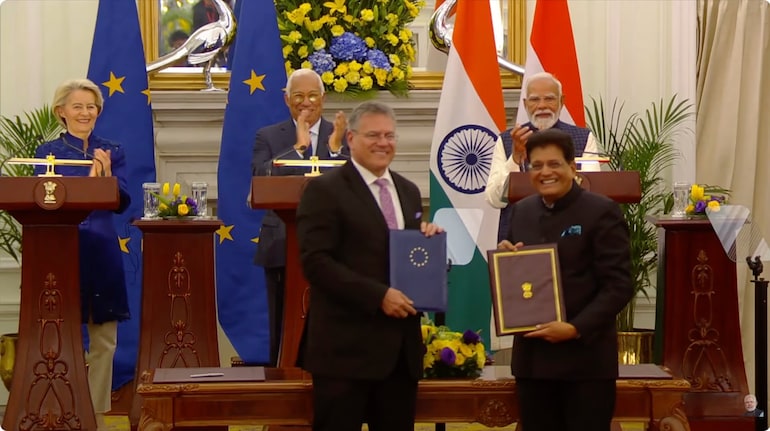

India and the 27-nation European Union concluded talks for a free trade agreement on January 27 granting greater market access to both sides once the deal kicks in.
India will eventually gain $75 billion in exports under the free trade agreement, with preferential access on over 99 percent of goods, while the EU is expected to double its outbound shipments to by 2032 due to tariff cuts or eliminations.
To be sure, the benefits from tariff reductions or eliminations will materialise once the FTA is implemented, which may take at least a year after the deal is signed.
Both sides have described the pact as the world’s largest bilateral trade agreement, reflecting its scale across goods, services and sustainability.
India’s bilateral trade in goods with the European Union reached about $136.5 billion in 2024-25 with Indian exports worth $75.85 billion and imports of $60.68 billion, making the bloc South Asian nation’s largest trading partner.
 .
.
India’s gains
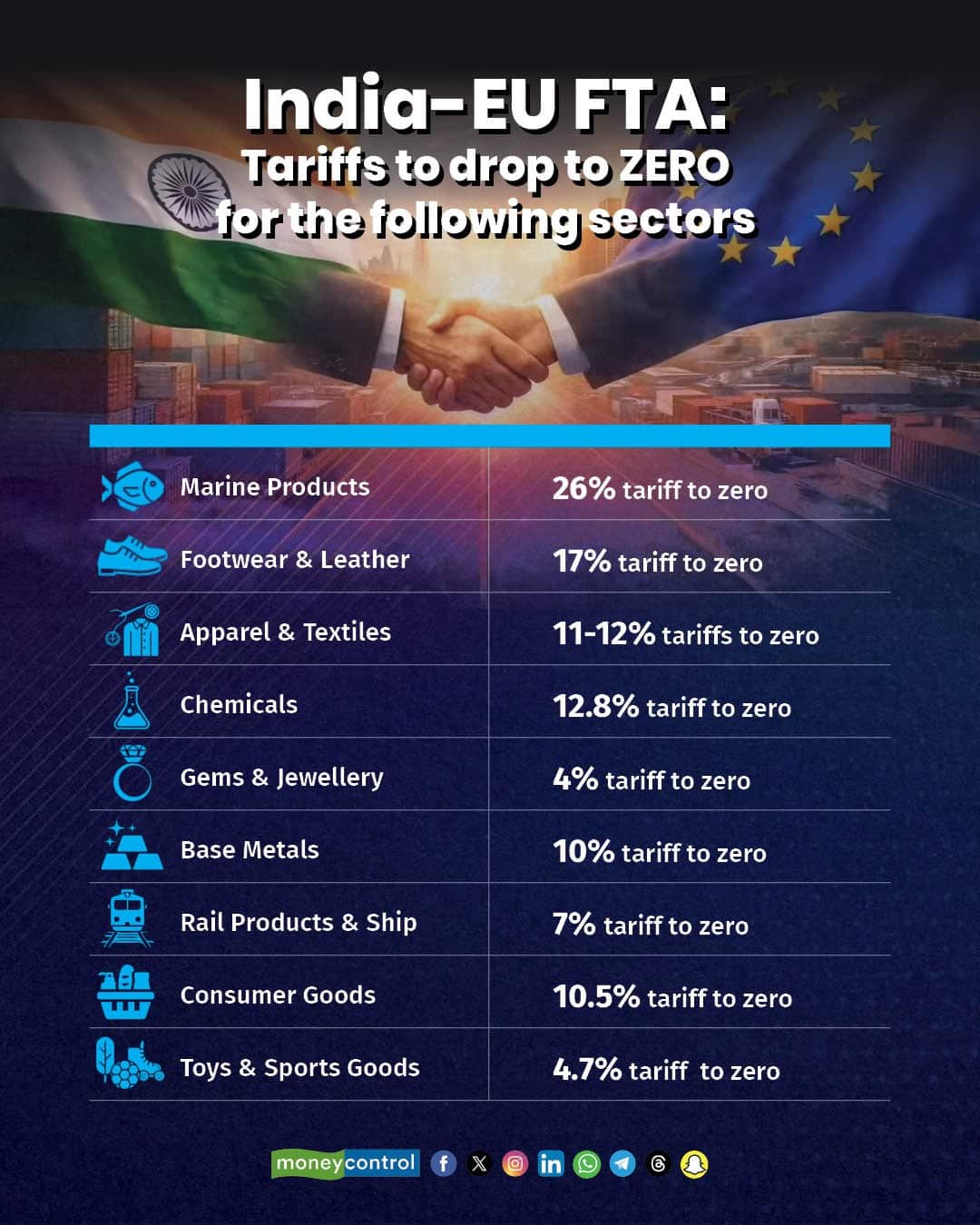
For India, the FTA provides immediate duty elimination for 70.4 percent of tariff lines covering 90.7 percent of India’s exports, including key labour-intensive sectors such as textiles, leather and footwear, tea, coffee, spices, sports goods, toys, gems and jewellery, and certain marine products.
Another 20.3 percent of tariff lines, covering 2.9 percent of exports, will see zero duty over 3–5 years for certain marine products, processed foods, and arms and ammunition, while 6.1 percent of lines, covering 6 percent of exports, will receive preferential access through tariff reductions or quotas for cars, steel, and select seafood.
Key labour-intensive sectors stand to benefit the most.
Textiles, apparel, marine, leather, footwear, chemicals, plastics, sports goods, toys, gems, and jewellery, accounting for around $33 billion of exports currently subject to EU duties between 4 and 26 percent, will enter zero duty from the FTA’s entry into force.
Sectoral snapshot
It opens the door for India to access the $263.5 billion EU textile import market, where current exports by the bloc from the South Asian nation are only $7.2 billion.
Key beneficiaries include Tiruppur (Tamil Nadu), Ichalkaranji (Maharashtra), Surat (Gujarat), Ludhiana (Punjab), and Hyderabad–Warangal (Telangana), where easier access to the EU market could lead to larger orders and more factory jobs across spinning, weaving, processing, and stitching.
Zero duty on leather and footwear, down from 17 percent can help win new EU orders in both mass and mid-premium segments, supporting MSMEs and formal jobs, giving better access to clusters like Vellore–Ambur (TN), Kanpur and Agra (UP) to EU’s $100 billion import market in this segment.
Electronics tariffs will fall from 14 percent to zero on 99.6 percent of exports, boosting finished products, components, sub-assemblies, and industrial electronics, while elimination of EU duties on gems and jewellery from 4 percent will lead to gains for manufacturers in Mumbai, Surat, Jaipur.
Chemicals tariffs fall from 12.8 percent to zero on 97.5 percent of exports in this category, pharmaceuticals and medical devices will gain preferential access to the bloc’s market, while engineering goods benefit from tariff reductions.
Agriculture and marine exports will gain from lower tariffs, supporting farm and coastal incomes, including tea and spices from Assam, pepper and cardamom from Kerala, and marine products from Andhra Pradesh, Gujarat, Kerala, and West Bengal. Handicrafts, furniture, and sports goods will also get better access.
Beyond tariffs, the FTA is expected to strengthen mobility, giving India preferential access to 144 EU sub-sectors, including key professional and technical services, while India opens 102 sub-sectors for EU firms.
The agreement also includes uncapped student mobility from the EU and limited post-study work visa commitments, helping Indian students gain international exposure.
 .
.
EU’s gains
In return, India has agreed to progressively liberalise tariffs on European goods.
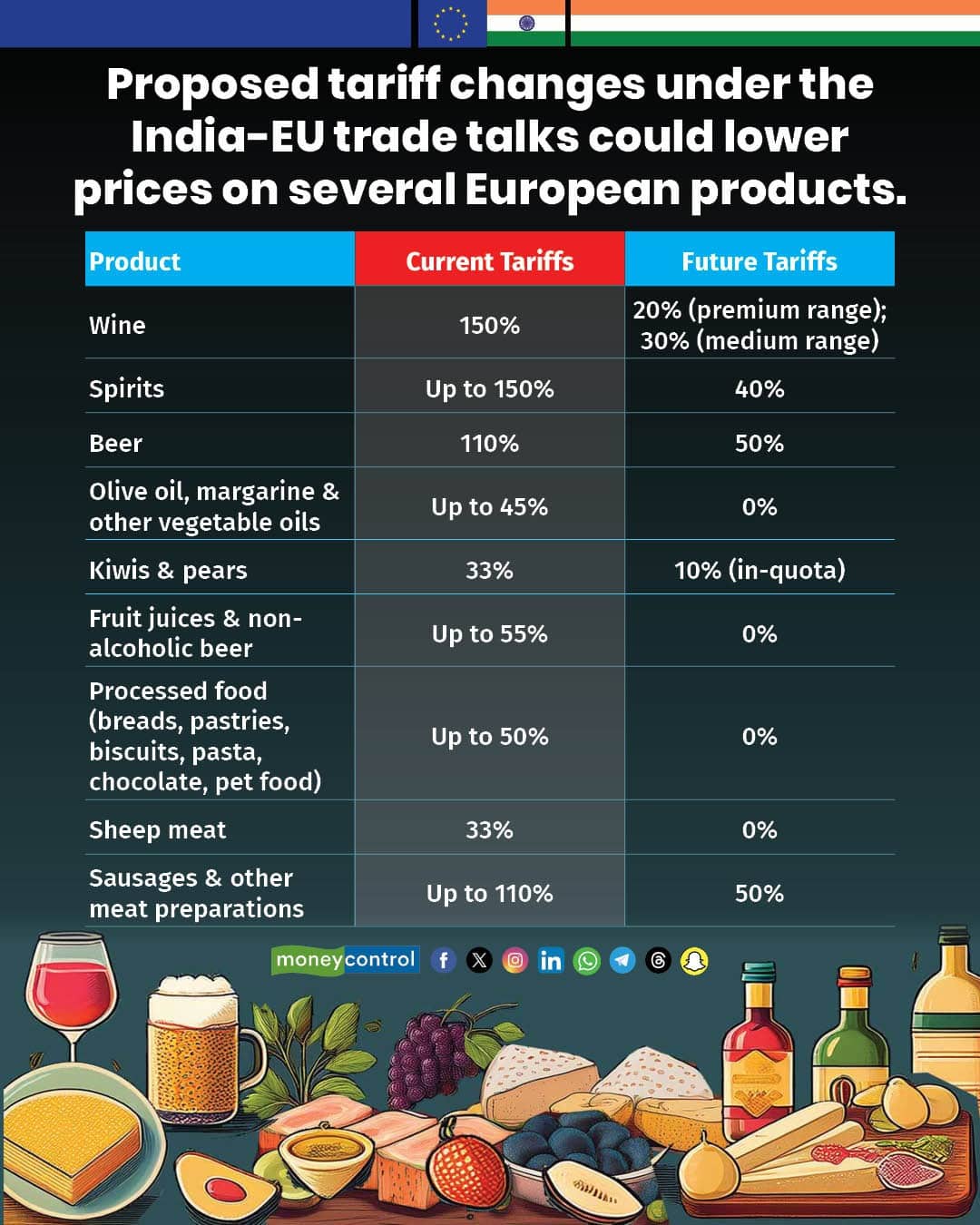
India has offered concessions on 92.1 percent of EU’s tariff lines offered, covering 97.5 percent of EU exports, including high-tech goods, fruits like apples, pears, peaches, and kiwi, and other industrial and consumer products.
Immediate and phased duty cuts will reduce costs for EU exporters, diversify supply chains, and open new opportunities for integrating Indian suppliers into global markets.
European exporters of machinery, chemicals, pharmaceuticals, medical devices, aircraft, plastics, iron and steel are set to benefit from steep tariff cuts, many of which currently range between 11 percent and 44 percent.
The deal will also provide tariff cuts on EU’s wines and spirits under a quota system, while chocolates and other processed food items will see significant duty reductions, boosting exports from countries such as France, Italy, Spain and Belgium.
It also provides better market access for the bloc’s consumer products such as chocolates, processed foods and high-end cosmetics, largely through tariff reductions and quotas.
Cars, steel and climate carve-outs
Automobiles were among the most sensitive areas.
EU cars priced below €15,000 are excluded from the agreement, while higher-priced vehicles have been divided into three segments with quotas.
Tariffs will fall to around 30–35 percent at implementation and be phased down to 10 percent over five years. Electric vehicle quotas will apply from the fifth year, with no duty cuts beyond quotas and no concessions for completely knocked down units.
India will also receive a vehicle export quota to the EU that is 2.5 times larger than the quota it has granted European automakers.
Steel access will be shaped by the EU’s new WTO-notified regulation, under which overall import quotas have been cut by 47 percent.
India is seeking preferential treatment as an FTA partner, with the final outcome expected once the regulation takes effect.
On climate rules, no exemption was secured from the EU’s carbon border adjustment mechanism, which applies uniformly across countries.
However, India will benefit from any flexibility extended to other nations and from technical assistance to help firms meet carbon-compliance requirements.
Discover the latest Business News, Sensex, and Nifty updates. Obtain Personal Finance insights, tax queries, and expert opinions on Moneycontrol or download the Moneycontrol App to stay updated!
Find the best of Al News in one place, specially curated for you every weekend.
Stay on top of the latest tech trends and biggest startup news.





