






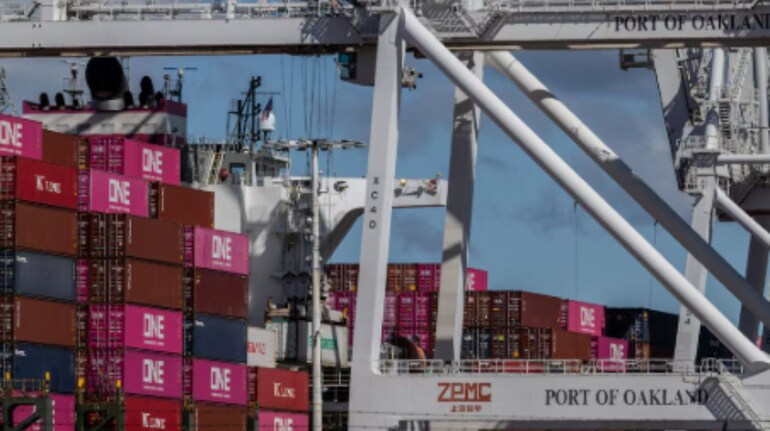
The India–Oman trade deal could help India leverage Omani ports to expand petroleum exports to Europe, Africa, and Turkey, while also diversifying outbound shipments to mitigate the impact of steeper tariffs.
With transshipment facilities at ports such as Sohar and Duqm, Indian crude and refined products can be efficiently re-exported, as the trade deal helps lower customs barriers.
Most of India’s petroleum shipments are not destined directly for Gulf nations and include significant transshipment volumes. At several ports, cargo is transferred from one vessel to another, and in such cases, the movement is classified as transportation rather than a direct export, an industry source told Moneycontrol.
The source added that ports in Oman can be used as transit hubs to supply oil onward to Europe, as well as to countries such as Sudan and Turkey, which could potentially expand India’s petroleum exports. The trade deal could also help make this process easier.
This is crucial given that the European Union is set to prohibit the import of refined petroleum products into the bloc from January if they are derived from crude oil originating in Russia, even if processed in a third country.
Both the European Union and the United States have been tightening sanctions on Russia in response to the war in Ukraine.
A significant portion of India’s petroleum refining still relies on Russian crude, with Moscow supplying around 34 percent of India’s total oil requirements, up from just 0.2 percent before the Ukraine war began in 2022.
This is why alternative routes, such as using hubs like Oman and non-traditional payment or barter mechanisms, to move fuel refined in India to destinations where sanctions are less restrictive, such as Turkey and Sudan, are becoming increasingly important as Western sanctions intensify.
While petroleum product exports from India to Oman were already tariff-free even without a trade agreement, the deal is expected to ease regulatory compliance and procedural requirements, thereby helping to further boost these exports.
Of the total $4.1 billion in exports to Oman in 2024-25, India’s petroleum products accounted for the largest share at $1.4 billion.
Diversification Drive
Experts say the free trade agreement also allows Indian exporters to diversify goods at a time when many face steeper US tariffs, positioning Oman as a strategic link to the Gulf and African markets.
The Federation of Indian Export Organisations (FIEO) President S C Ralhan noted that Oman’s strategic location makes it a vital gateway to the Gulf and Africa, and that the trade deal will enable Indian exporters to integrate more effectively into regional value chains, diversify markets, and expand India’s export footprint.
Pankaj Chadha, Chairman, EEPC India, also agrees that “being the key gateway to the Middle East and Africa, the trade pact with Oman promises a lot of business opportunities, especially for micro, small, and medium enterprises (MSMEs).”
The Comprehensive Economic Partnership Agreement (CEPA) between India and Oman, signed on December 18, provides duty-free access for over 99 percent of Indian exports, particularly labour-intensive goods such as textiles that face tariffs of over 50 percent from the US.
The Confederation of Indian Textile Industry (CITI) Chairman Ashwin Chandran said that the CEPA with Oman, along with the other free trade agreements that India has already signed and plans to sign soon, will enable Indian textile and apparel exporters to compete more effectively for market share in key geographies.
“Such FTAs will enhance market access for Indian textile and apparel exporters, help them in their export diversification strategy, and place India in a better position to achieve the national target of textile and apparel exports worth $100 billion by 2030,” he pointed out.
India has signed two trade agreements in 2025, with the United Kingdom and Oman, and is currently negotiating similar deals with several countries and blocs, including the EU, New Zealand, Peru, and Chile, among others.
The trade deal offers India immediate zero-duty access on about 98 percent of its tariff lines, covering roughly 99 percent of exports by value.
While more than 80 percent of Indian goods already enter Oman at an average tariff of around 5 percent, duties on some items run as high as 100 percent. Their elimination under the CEPA is expected to improve price competitiveness for exporters, though growth prospects are tempered by the size of Oman’s domestic market, according to Global Trade Research Initiative’s (GTRI) Founder Ajay Srivastava.
India and Oman’s merchandise trade amounted to $10.6 billion in 2024‑25, and reached $6.5 billion during April‑October of the current fiscal year.
Srivastava adds, given the small size of bilateral trade, the real value of the trade deal between India and Oman goes beyond tariffs.
“It strengthens India’s economic and geopolitical presence at the mouth of the Gulf, deepens Indian firms’ role in Omani logistics and supply chains, and supports India’s wider strategy on energy, services and regional connectivity. The agreement is therefore less a trade breakthrough than a strategic consolidation, locking in market access, mobility and influence in a critical maritime and energy corridor,” GTRI’s Srivastava said.
Discover the latest Business News, Sensex, and Nifty updates. Obtain Personal Finance insights, tax queries, and expert opinions on Moneycontrol or download the Moneycontrol App to stay updated!
Find the best of Al News in one place, specially curated for you every weekend.
Stay on top of the latest tech trends and biggest startup news.




