

The UK and Germany are likely to be among the most exposed advanced economies following the latest US tariff threat linked to Greenland, as a significant share of their exports is tied to the American market, a Moneycontrol analysis shows.
By contrast, Nordic economies have steadily reduced their dependence on the US over the past two decades, leaving them relatively better insulated from a sudden trade shock.
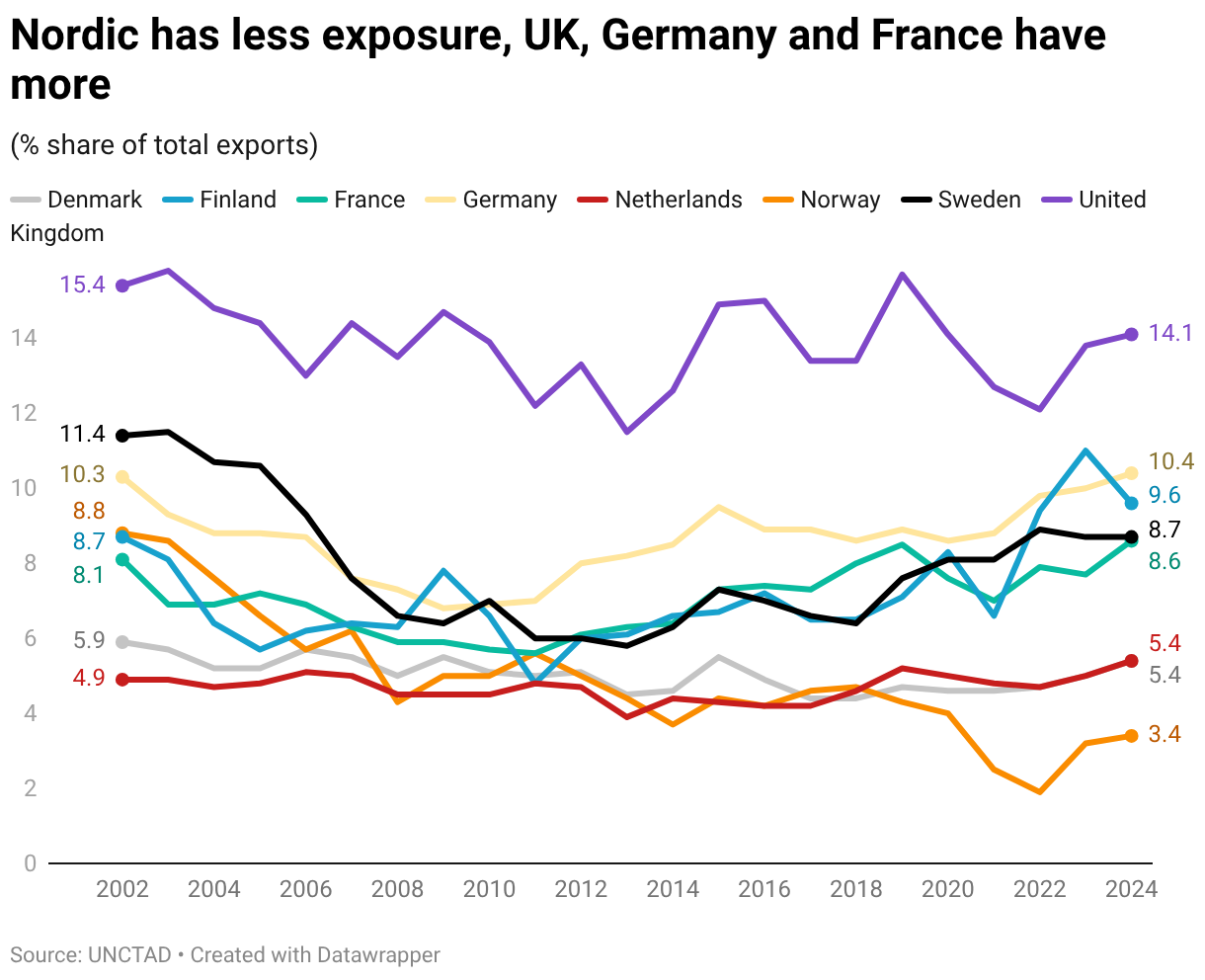
In 2024, the US absorbed 14.1 percent of total exports from the UK and 10.4 percent of exports from Germany, among the highest exposure levels in Europe. What makes this vulnerability more acute is its persistence over time. In the early 2000s, nearly 15–16 percent of British exports were already headed to the US, while Germany’s exposure hovered close to 10 percent. Two decades on, the structure of trade has changed little, leaving both economies highly sensitive to tariff-driven disruptions from Washington.
The risk has come into sharper focus after US President Donald Trump last week threatened tariffs on countries opposing America’s move to assimilate Greenland. In a post on his social media platform Truth Social, Trump warned that countries including Denmark, Norway, Sweden, France, Germany, the UK, the Netherlands and Finland would face a 10 percent tariff on all goods exported to the US starting February 1, rising to 25 percent from June 1.
“Denmark, Norway, Sweden, France, Germany, the UK, Netherlands, and Finland have journeyed to Greenland, for purposes unknown… These Countries, which are playing this very dangerous game…,” Trump said.
France faces a smaller but still notable exposure. The US accounted for 8.6 percent of French exports in 2024, placing it below the UK and Germany but still high enough for tariffs to have a meaningful impact. The Netherlands and Denmark appear relatively less vulnerable, with US exposure contained at around 5-5.5 percent of total exports, limiting the immediate spillover from any tariff escalation.
The Nordic economies stand out for having taken a different path. Sweden, Finland and Norway have actively diversified their export destinations over the long term, steadily reducing their reliance on the US market. Sweden’s share of exports going to the US has declined from over 11 percent in the early 2000s to under 9 percent in recent years. Norway’s shift has been even more pronounced, with US exposure falling from nearly 9 percent in 2002 to just 3.4 percent in 2024.
Beyond headline exposure, the composition of exports adds another layer of risk. France has a relatively large set of products where the US accounts for more than a third of global demand—together worth over $5 billion. Nearly half of France’s $4.4 billion turbine exports, for instance, were shipped to the US. The UK shows a similar concentration in select lines, with about 40 percent of its hydraulic engine exports headed to American shores. Such dependence leaves firms with limited short-term alternatives if tariffs rise abruptly.

Germany’s profile is more nuanced. While its overall export exposure to the US is large—nearly $170 billion in 2024—the value of products where the US accounts for more than a quarter of global demand is relatively small, at around $3 billion. This suggests that, over time, German exporters may find it easier than their French counterparts to redirect trade flows to other markets, softening the long-term impact of tariffs.
Discover the latest Business News, Sensex, and Nifty updates. Obtain Personal Finance insights, tax queries, and expert opinions on Moneycontrol or download the Moneycontrol App to stay updated!
Find the best of Al News in one place, specially curated for you every weekend.
Stay on top of the latest tech trends and biggest startup news.