







Kerala is no longer the state with the highest inflation, as Telangana moved to the top spot after retail inflation there rose to 4.92 percent in January, nearly double the national average of about 2.75 percent, according to data released on February 12.
The shift comes alongside the rollout of the new consumer price index (CPI) series, which has altered how inflation is measured by giving relatively higher weight to non-food items.
The revised inflation basket has significantly reshaped state-level inflation patterns. Food and beverages, which earlier accounted for over 42 percent of the CPI basket, now carry a lower weight of around 37 percent. At the same time, categories such as housing, transport, health, personal care and services have seen their weight increase. As a result, inflation readings across states appear more tightly clustered than before, reducing the extreme spikes historically driven by volatile food prices.
Telangana’s emergence as the state with the highest inflation reflects this shift. Kerala, which had recorded one of the highest inflation rates in the older series, saw inflation moderate sharply to about 3.67 percent in January from 9.49 percent in December under the previous methodology.
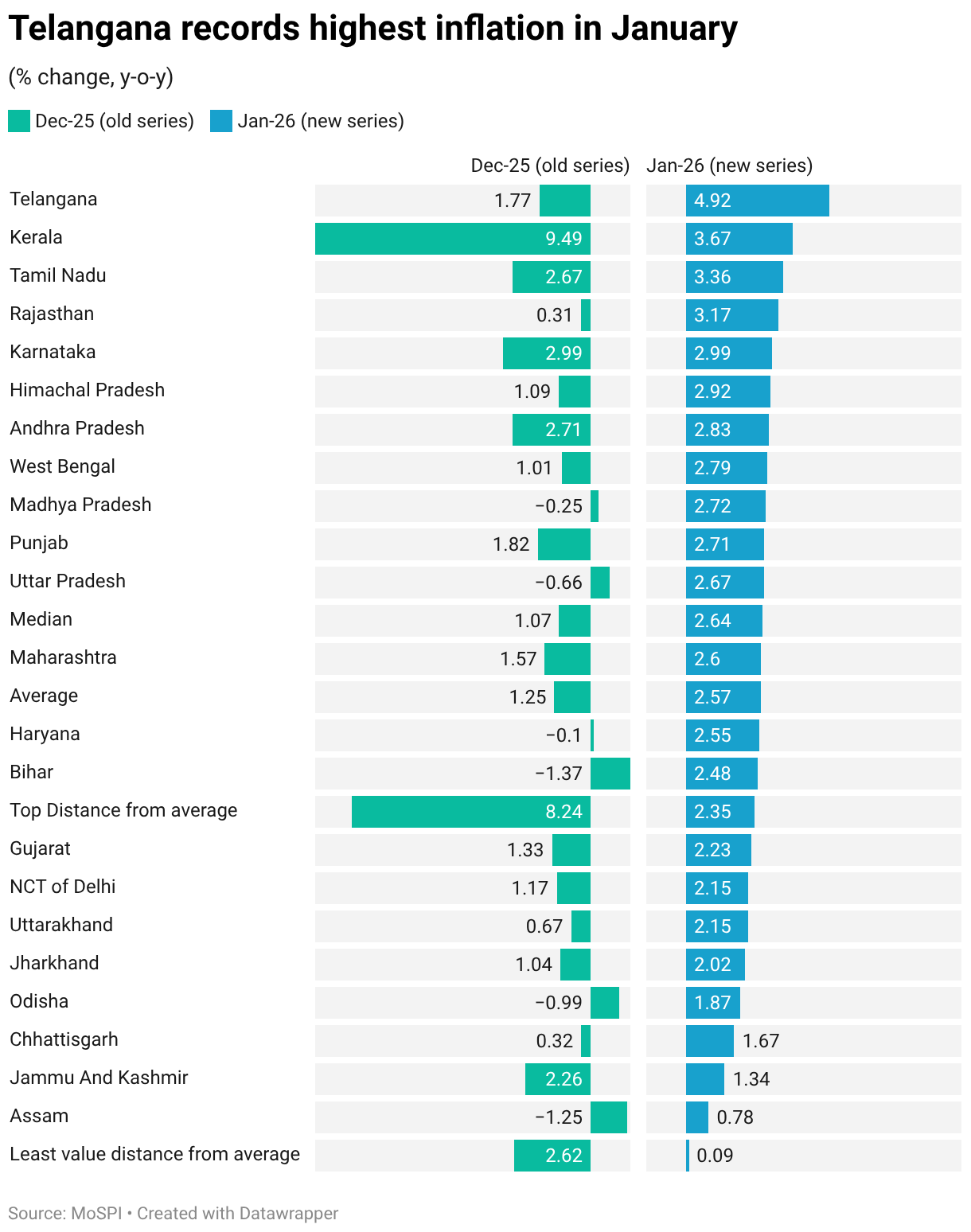
Most large states now hover close to the national average. Tamil Nadu recorded inflation of about 3.36 percent, Rajasthan around 3.17 percent, Himachal Pradesh roughly 2.92 percent and Maharashtra about 2.6 percent. Uttar Pradesh, India’s most populous state, reported inflation near 2.67 percent, broadly in line with the national trend.
The difference from the average value has also reduced. Telangana’s value (the highest inflation state) at 4.92 percent was only 2.35 percent more than the average value across large states, compared with the difference of 8.2 percent between the highest value of 9.49 percent for Kerala.
At the other end of the spectrum, Assam has emerged as the lowest-inflation state among large states, recording inflation of just 0.78 percent. This displaces Bihar, which earlier had the lowest inflation but now stands closer to the national average at about 2.48 percent. The shift reflects how reduced food weight in the CPI basket has lessened the advantage states with higher food consumption patterns previously had in keeping inflation lower.
Overall, the new CPI series suggests inflation differences across states may remain contained. With services, housing, and transport gaining prominence in household spending, inflation may increasingly reflect structural shifts in consumption rather than purely food-price cycles. That could mean fewer sharp divergences between states, even though urbanised or service-heavy economies may occasionally see slightly higher inflation readings.
Discover the latest Business News, Sensex, and Nifty updates. Obtain Personal Finance insights, tax queries, and expert opinions on Moneycontrol or download the Moneycontrol App to stay updated!
Find the best of Al News in one place, specially curated for you every weekend.
Stay on top of the latest tech trends and biggest startup news.





