






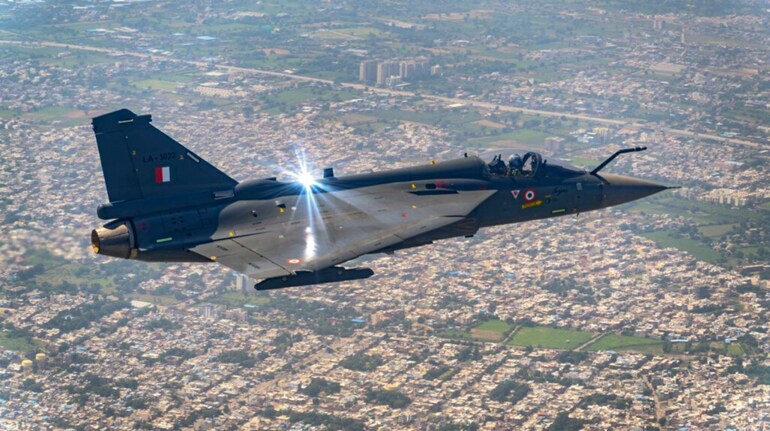

The Defence Acquisition Council’s approval of procurement proposals worth Rs 79,000 crore comes amid a structural transformation at state-run defence equipment makers. Workforce data over the past decade shows a shift from manpower-heavy production towards automation, advanced engineering, and private-sector participation.
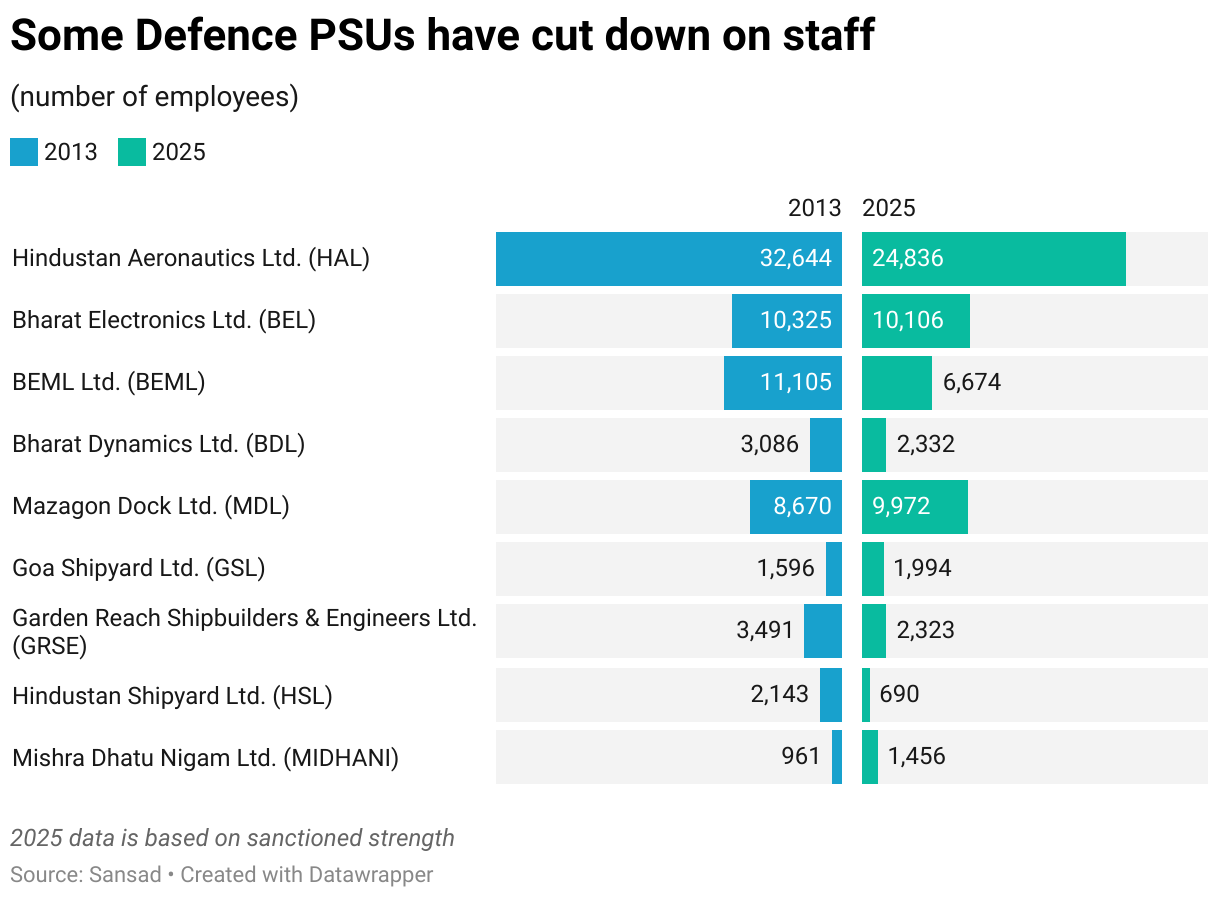
The most striking example is Hindustan Aeronautics Ltd (HAL). Once employing more than 32,600 people in 2013, HAL’s workforce has shrunk by nearly 24 percent to 24,836 employees in 2025. The contraction reflects tighter cost structures, greater automation, and a sharper focus on high-value aerospace engineering rather than on labour intensity.
A similar trend is visible at Bharat Dynamics Ltd, whose employee strength declined by 24 percent to 2,332 over the same period, and Garden Reach Shipbuilders & Engineers Ltd, which has trimmed its workforce by roughly a third.
Diverging paths within DPSUs
Not all defence PSUs are shrinking. Mishra Dhatu Nigam Ltd (MIDHANI), a key supplier of advanced alloys and strategic materials, has expanded its headcount by more than 50 percent between 2013 and 2025. The growth mirrors India’s rising emphasis on self-reliance in high-technology materials used in missiles, aircraft, space programmes and other strategic platforms.
Shipyards such as Mazagon Dock Shipbuilders Ltd and Goa Shipyard Ltd have also added workers, signalling strong order books and sustained momentum in indigenous shipbuilding.
In contrast, companies like BEML Ltd and Hindustan Shipyard Ltd have seen steep workforce declines of 39.9 percent and 67.8 percent, respectively, pointing to restructuring, efficiency drives and a move away from legacy operational models.
Order books surge even as headcounts shift
These workforce changes coincide with a sharp expansion in future business. HAL’s current FY25 order book of Rs 1.25 lakh crore is expected to give way to an average annual order pipeline of about Rs 2.6 lakh crore over the next five years, driven by fighter aircraft, helicopters and engine programmes.
Mazagon Dock shows a similar trajectory. From a current order book of Rs 39,871 crore, its average annual order inflow is projected at around Rs 1.58 lakh crore, supported by submarine, frigate and destroyer programmes.
Bharat Electronics Ltd is expected to sustain a robust pipeline of roughly Rs 60,000 crore annually, while shipyards such as Goa Shipyard and Garden Reach are also set for steady inflows.
Even smaller entities such as MIDHANI, BEML and Bharat Dynamics are projected to retain stable demand streams, underlining the depth of India’s indigenous procurement push.
Private sector’s growing footprint
Alongside DPSUs, private industry participation—including startups—is rising sharply. For the first time, private companies are expected to account for nearly a quarter of India’s defence output, at 23.5 percent in FY25, reflecting a broader shift towards public-private collaboration in defence manufacturing.
A changing defence ecosystem
Taken together, the data points to a defence ecosystem evolving on two fronts from labour-intensive production to technology-intensive manufacturing, and from near-total reliance on DPSUs to a more balanced model that increasingly integrates private players.
Discover the latest Business News, Sensex, and Nifty updates. Obtain Personal Finance insights, tax queries, and expert opinions on Moneycontrol or download the Moneycontrol App to stay updated!
Find the best of Al News in one place, specially curated for you every weekend.
Stay on top of the latest tech trends and biggest startup news.





