







The US and Israel war on Iran has revived concerns over India’s dependence on energy imports, underscoring the economic risks from global supply disruptions, industry players have said.
Amid the raging West Asia conflict, India is scouting for alternative regions for its oil and gas supplies, as the virtual closure of the Strait of Hormuz has put around 40-50 percent of its oil supplies and up to 85 percent of LPG imports at risk.
As India looks for alternative fuel supplies and routes, industry leaders say the crisis reinforces the need to boost exploration and production at home.
India, which depends on imports for around 90 percent of its oil needs and half of gas requirements, has diversified its sourcing from 27 countries in 2018 to 41 countries.
The domestic production continues to remain stagnant even after the various policy reforms, including amendment to the Oilfields (Regulation and Development) Act, 1948 and Open Acreage Licensing Policy (OALP) Programme to attract investments in the upstream sector.
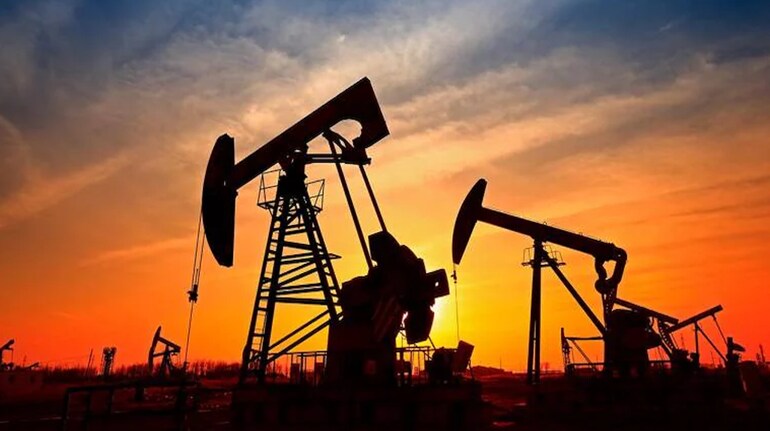
According to latest data from oil ministry’s Petroleum Planning and Analysis Cell, the country’s crude production stood at 23.5 million metric tonnes in during April-January this fiscal, down 2 percent from the year-ago period.
In FY25, the country produced 28.7 million tonnes of crude, down from 29.4 million tonnes in FY24, data shows.
On slippery slope
India's consumes around 5.6 million barrels a day.
The country’s oil imports during the period stood at 206.3 million tonnes, against 201.0 million tonnes the previous fiscal.
Similarly, natural gas production declined by 3.4 percent during Apr-Jan to 29,288 mmscm from 30,376 mmscm in the year-ago period. Gas production stood at 36,113 mmscm in FY25 against 36,438 in FY24.
Oil and gas together accounted for $131.3 billion of annual import bill in FY25 against $122 billion in FY24.
Government sources earlier told Moneycontrol that India is comfortably positioned with 25 days of crude, including oil stored in refiner’s storage tanks, pipelines, and in transit which will be replenished constantly as India continues its purchases of oil from non-Hormuz regions.
The country’s strategic petroleum reserves (SPR) hold roughly a week of cover, based on a daily consumption rate of 5.6 million barrels (bpd). It has a 25-day stock of refined oil products, including petrol, diesel, and liquefied petroleum gas, which will continue to shift as refiners continue to process crude and export these products.
Time for self-reliance
While official sources said India has begun securing liquefied petroleum gas (LPG) supplies from the international portfolios of global companies, including UAE’s Abu Dhabi National Oil Company (Adnoc), Algeria’s state-run oil and gas company Sonatrach and others, industry leaders say the latest crisis reinforces the urgency of accelerating domestic exploration and production.
“In today’s turbulent geopolitics, any conflict in a resource-rich region, like the ongoing conflict in Iran, makes India vulnerable because of its huge import dependence on natural resources from below the ground. We need to declare this sector a national priority, simplify approvals and enable a rapid increase in domestic production,” Vedanta chairman Anil Agarwal said in a note.
A key part of the strategy is to accelerate exploration across India’s vast but underdeveloped hydrocarbon landscape, Agarwal said.
India has 26 sedimentary basins covering around 3.36 million square kilometres, yet only a portion of this area has been intensively explored. “Large parts of India’s onshore and offshore basins remain underexplored compared with mature hydrocarbon provinces globally, indicating significant untapped potential,” Agarwal said.
India’s upstream companies, particularly state-run firms, are using a mix of water injection, re-perforation and advanced well stimulation to revive aging wells.
Enhanced oil recovery, which is a suite of advanced techniques used to extract crude from a reservoir that cannot be reached traditional methods, have also been initiated.
Analysts say greater use of real-time data monitoring and analytics could further optimise production.
The Vedanta chairman said with OALP Bid Round X open, under which India has put 25 exploration blocks covering nearly 1.92 lakh sq km of deep and ultra-deepwater blocks on the block, it has become essential for the country to attract investments for the high-cost deep-water well drilling.
Unlocking hydrocarbon potential
As Iran and Ukraine wars reshape global energy markets, policymakers and industry leaders says India’s next phase of economic resilience will depend on how quickly it can unlock its domestic hydrocarbon potential.
Unlocking it will require a shift in policy approach, from regulatory complexity to facilitation of exploration and investment, Agarwal said in his note, adding the oil and gas sector must move from heavy regulation to facilitation for exploration so the nation can move towards energy independence.
Discover the latest Business News, Sensex, and Nifty updates. Obtain Personal Finance insights, tax queries, and expert opinions on Moneycontrol or download the Moneycontrol App to stay updated!
Find the best of Al News in one place, specially curated for you every weekend.
Stay on top of the latest tech trends and biggest startup news.





