






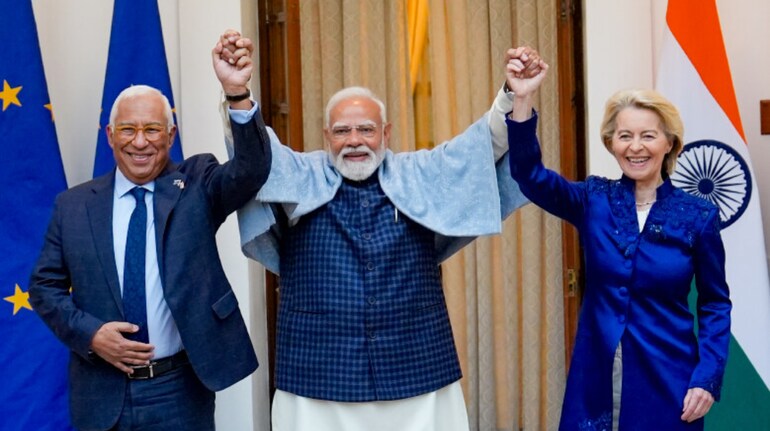

India’s proposed trade agreement with the European Union is set to intensify competition for key exporters such as Japan, the UK and US, with nearly $11 billion in trade potentially becoming contestable, according to a Moneycontrol analysis.
Prime Minister Narendra Modi announced the agreement on January 27 at India Energy Week, describing it as a landmark partnership between two major economic blocs.
"A big agreement was signed between the European Union and India. People are calling this the mother of all deals. This agreement will bring major opportunities for the public in India and Europe. This is a perfect example of a partnership between two major economies of the world. This agreement represents 25% of the global GDP and one-third of global trade,” the Prime Minister said.
The impact of the deal is expected to be uneven across trading partners but significant in scale. Of Japan’s roughly $48 billion exports to India, nearly $3.5 billion, or over 17 percent, falls into product categories where EU suppliers could become more competitive once preferential access comes into force.

The exposure is sharper for the United Kingdom, where close to 20 percent of exports to India, amounting to about $1.3 billion, lie in segments where EU firms are well placed to displace existing suppliers.
The US, despite exporting a smaller absolute value of goods to India than Japan or the UK, could still face competition in nearly $5.8 billion of trade, or around 15 percent of its exports. Russia, by contrast, appears relatively insulated, with just over 1 percent of its exports to India exposed to potential EU competition.
The pressure points vary by country. Japanese exports at risk are concentrated in high-value engineering and industrial goods, including machinery, electrical equipment, engines, precision instruments and filtering systems. These categories overlap closely with European strengths, particularly in Germany, France and Italy, where firms already have deep integration with Indian manufacturing supply chains.
For the UK, vulnerable segments are skewed towards scrap metals, aluminium and paper waste, vehicle components and aircraft parts—products that form a substantial share of Britain’s industrial exports to India and could face margin pressure once EU tariffs are lowered.
The US faces competition mainly in medical and surgical instruments, diagnostic reagents, communication equipment, polymers and petroleum-based products. Several of these categories are already witnessing rising EU participation globally, and tariff preferences could further tilt sourcing decisions in favour of European suppliers.
For Japan, the UK and US, the challenge is likely to be less about headline trade losses and more about defending market share in high-value segments, where pricing, regulatory standards and delivery timelines matter as much as tariffs.
As India deepens its trade ties with Europe, exporters from advanced economies may find themselves competing more directly than before—not only with Indian firms, but increasingly with EU suppliers operating on preferential terms.
Discover the latest Business News, Sensex, and Nifty updates. Obtain Personal Finance insights, tax queries, and expert opinions on Moneycontrol or download the Moneycontrol App to stay updated!
Find the best of Al News in one place, specially curated for you every weekend.
Stay on top of the latest tech trends and biggest startup news.





