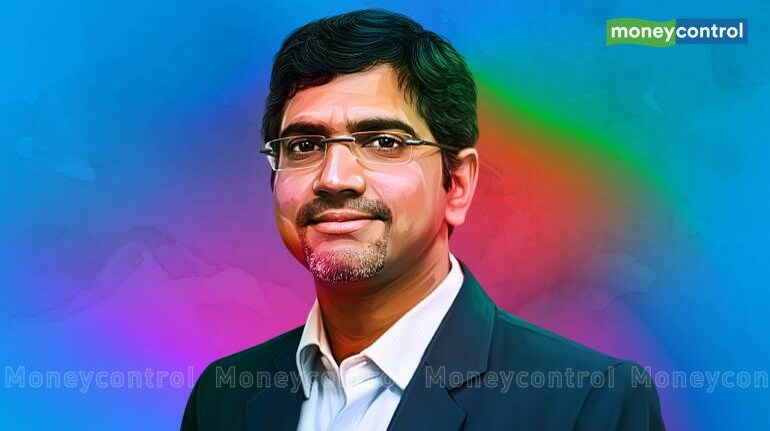
S Anjani Kumar, Partner at Deloitte India
A recent Deloitte India report says that for India to become a $5 trillion economy in the next five years, more FDI needs to reach sectors that help in capital formation. Kumar tells Moneycontrol why that's the case and what more India should be doing more for that to happen.
Kumar points out that foreign investors from various nations are seeking different things from India, as was evident from a survey of 1,200 MNC leaders by Deloitte. While those from the US and UK want to capitalise on growth and quality, those from Japan and Singapore are eyeing stability and policy predictability.
However, all of them suffer from low awareness of government policies, and, hence, marketing India’s reforms should be a key focus, he says. Edited excerpts:
The Deloitte report points out that gross capital formation in India continues to be led by domestic investments and not FDI. It says more FDI should be nudged towards capital formation if we are to become a $5 trillion economy. But by what degree can we expect FDI share of gross capital formation to go up, from the current low 3 percent?
Kumar: I think we don’t have a choice in some senses. We need to look at FDI as not just pure financial capital. There are elements of technology, leadership, governance, transparency, access to different markets and sets of investors, etc, in it. So, looking at it from a holistic perspective, it becomes really important to think about gross capital formation.
With regards to the investments that have to be made on the ground, whether it's machinery or technology, we just don't have a choice but to get the best in class from the world, and to make those investments in India. And then, we should create jobs and be able to develop world-class industries in India.
Given where we are with respect to our economy, demographic dividend, and some of the initiatives that the government has started, I think we are well poised to capitalise on that.
We have seen a record amount of FDI coming in over the last couple of years. Is this a trend that is expected to hold for the next few years, since we had a very low base? Or is it is it going to dry up, sooner than later?
Kumar: If you look at some of the survey findings, it can be clearly seen that a majority of the companies plan to invest more in India. Only 11 percent of the MNCs we spoke to in the US said they have already invested in India and do not plan to invest more.
Of the remaining, about 50 percent are saying they're either investing more, or they are first-time investors who will invest more. This is true across across each of the geographies. Last year, FDI grew about 10 percent. We do expect that trend to continue, given our findings from the survey.
While the second wave of COVID-19 is over, recovery has been weak in many sectors and GDP figures were encouraging due to a low base effect. How do you view business sentiment in India, right now?
Kumar: When we look at the three archetypes of clients we work with fairly closely -- Indian promoter-driven businesses, agencies, and government -- I think we are actually seeing a fairly secular trend across each one of them.
I think there is a lot of excitement. People want to invest more. They are also thinking about almost revenge consumption and seeing how can they, as a business in their sector, get a disproportionate share of that coming consumption.
Companies focused on exports are also seeing a fair amount of revival in the geographies of interest for them, whether they are in the US or in Europe, and they are further making some investments. The credit growth numbers are also fairly encouraging.
Does the report factor in the impact of the national infrastructure pipeline and national monetisation pipeline, in its overall estimates over the next five years?
Kumar: At the heart of the report is the survey of about 1,200 MNC leaders across the country. At the point of time this survey was done, which was a few months back, the changes in infrastructure investments were not announced. In fact, the change in legislation brought in by the government to cancel retrospective taxation wasn't even there.
We didn't have the benefit of the respondents looking at that. But I do think if we had done the survey after that, some respondent scores would have been better.
In the survey, 44 percent business leaders in the US, the UK, Japan and Singapore said they plan to invest in India. Had they known about the retrospective tax legislation, do you feel the numbers could have been higher?
Kumar: I don't want to get into hypotheticals. But when we spoke to the respondents on their willingness to invest in India, we showed them details of some of the policies the government has implemented over the last several months, whether it's Sagarmala, Aatmanirbhar Bharat, etc.
When they read those, their responses and positivity towards investing in India became stronger, which, then, brings us to the belief that we need to do a lot more in terms of marketing ourselves well. In terms of increasing people’s knowledge about the various schemes the government has launched, we need to do a much better job in getting that message across. There is a clear segmentation we've seen.
When we spoke to people in the US and the UK, which have been traditionally more aligned with larger investments in India, they had a higher knowledge of some of these schemes and some of the measures the government has launched, and their willingness to invest in India was higher.
When I look at Japan and Singapore, the understanding and exposure were lower. Also, there was a lower propensity to invest. In that sense, it makes me believe that, as a nation, all of us as stakeholders need to do a lot more in getting out there.
So, investors from which nation are the most interested ?
Kumar: In countries like the UK and the US, we found that the growth that India, as an economy, provides, and the workforce and quality are really critical parameters. For countries like Japan, stability, infrastructure and predictability of regulations become important. All these countries do feel that India is fairly strong, when it comes to growth and quality.
I think there are perception issues when it comes to stability and predictability, and those are the things we have to take back to the MNCs. We need to take war stories of successful MNCs in India to their respective countries and talk about how they have succeeded, either just using India as a domestic market, or by using India as a manufacturing hub for the rest of the world. In countries like Japan, it becomes all that more significant because when they hear from their peer group, it has a much stronger impact.