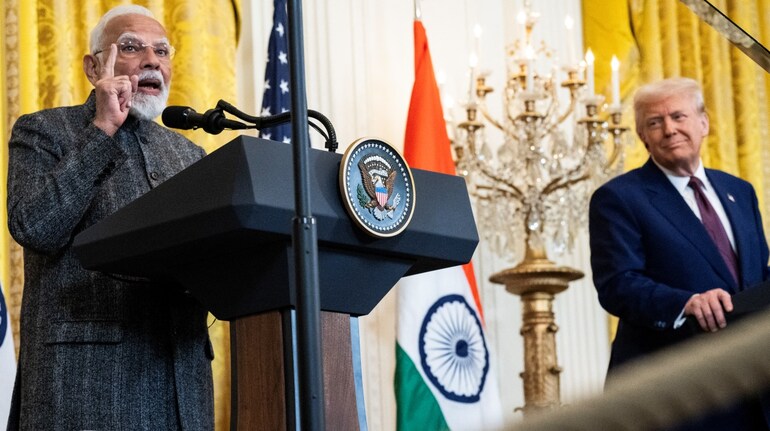

The India–US trade deal announced on February 2 is likely to reshuffle competitive dynamics in the Indian market, with the United Kingdom and Japan emerging as the most exposed among advanced economies, while China appears relatively insulated, a Moneycontrol analysis shows.
Under the agreement, tariffs on Indian exports to the United States have been sharply reduced to 18 percent from 50 percent earlier, immediately improving India’s competitiveness in the US market. In return, a set of US goods is expected to receive zero-duty or sharply reduced-duty access to India. While the immediate focus has been on the export boost for India, the more subtle impact lies in how the deal alters competition within India’s import basket.
That impact is most pronounced for countries whose export profiles to India closely overlap with those of the United States. The UK and Japan fall squarely into this category, with over 40 percent of their exports to India lying in segments where American suppliers are strong and could gain from improved market access.
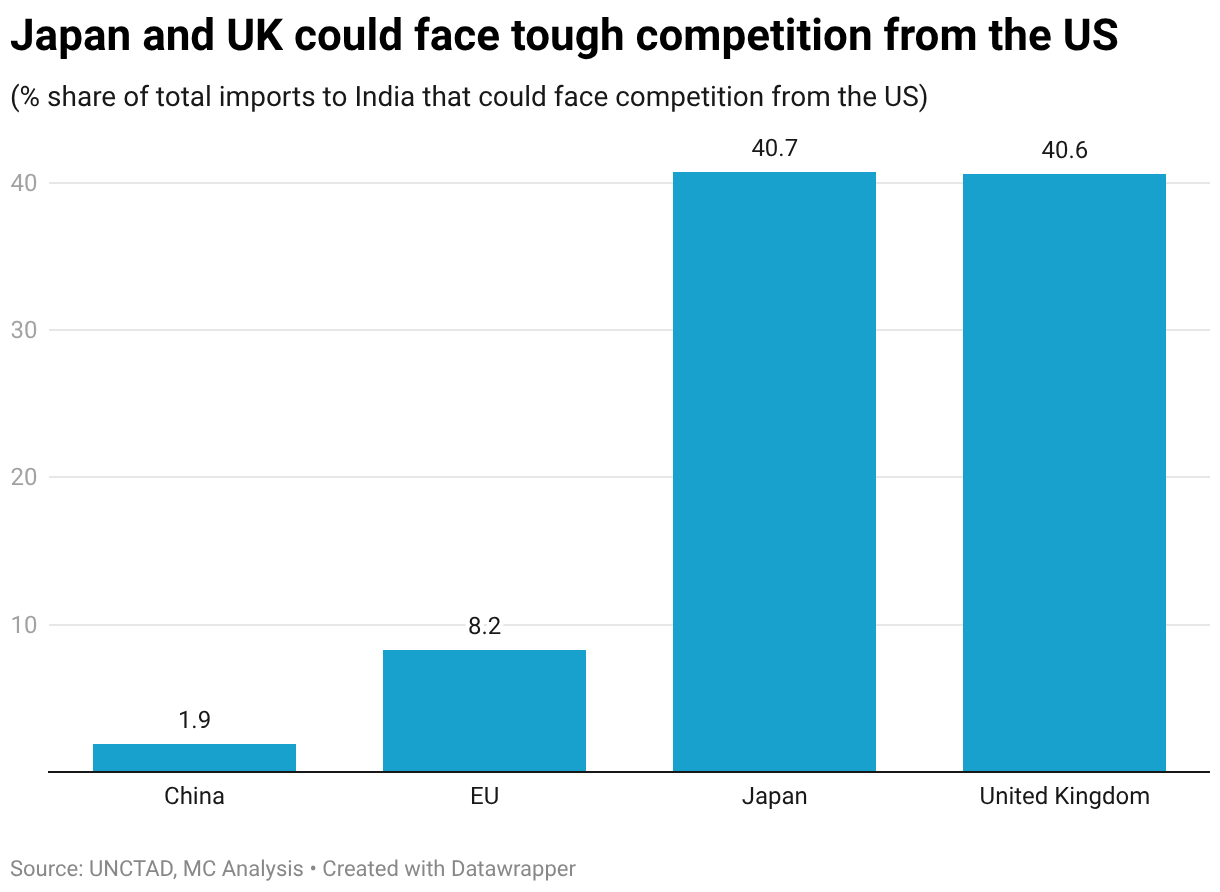
Japan’s exposure is particularly acute in capital goods, auto components, industrial machinery and electronics—sectors where tariff differentials can influence sourcing decisions. The UK faces similar risks, with overlap concentrated in industrial goods, chemicals, select engineering products and consumer categories.
Japan has had a bilateral trade agreement with India for over a decade, while UK signed a trade deal last year. EU's trade deal was announced in January.
China, by contrast, appears far more insulated despite being India’s largest goods supplier. Much of China’s export basket to India is concentrated in categories driven by scale, supply-chain depth and ecosystem advantages rather than tariff competitiveness alone. As a result, only about 2 percent of Chinese exports to India are likely to face direct competition from US producers, largely confined to medical equipment.
The European Union, which has also concluded a trade agreement with India, is expected to see competitive pressure in a narrower set of categories. About 8.2 percent of EU exports to India fall in segments where US goods could become more competitive following the tariff reset.
Discover the latest Business News, Sensex, and Nifty updates. Obtain Personal Finance insights, tax queries, and expert opinions on Moneycontrol or download the Moneycontrol App to stay updated!
Find the best of Al News in one place, specially curated for you every weekend.
Stay on top of the latest tech trends and biggest startup news.