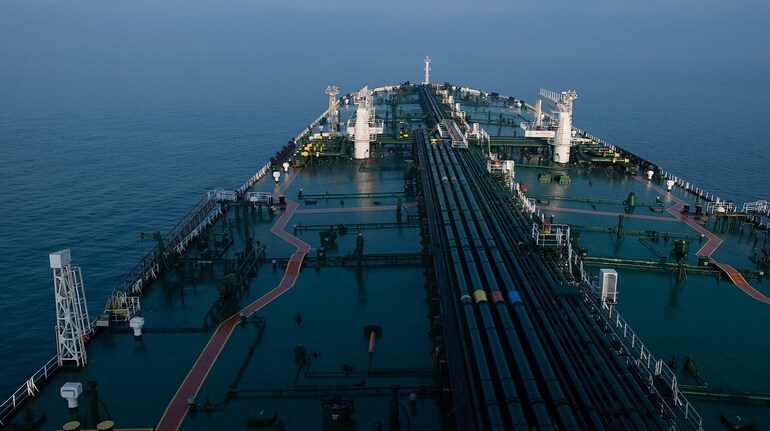

The escalating tensions between the US and Iran over Tehran’s nuclear programme has once again put the spotlight over the Strait of Hormuz, a key passage for India’s oil supplies, underscoring India’s vulnerability to any disruption of the route.
To secure its supplies, India is accelerating its purchases of crude oil from alternative suppliers, deepening its term-contracts while drawing up its strategic petroleum reserves amid rising geopolitical uncertainties, sources privy to the matter told Moneycontrol.
India’s crude purchases through the Strait of Hormuz have increased in the past two months touching 2.6 million barrels per day as of February (month till date) against 2 million bpd last year as the country stepped back from Russian oil imports and turned back to its traditional suppliers in the Middle East, data from data and analytics firm Kpler showed.
As of January-February, around 50% of India’s total monthly oil imports pass through the Strait of Hormuz, up from 40% in November-December 2025, Kpler data shows.
“A disruption at the Strait of Hormuz would have immediate and significant implications for both India and global oil markets, as roughly 2.6 million bpd of India’s crude imports transit the Strait, primarily from Iraq, Saudi Arabia, the UAE and Kuwait,” Sumit Ritolia, lead research analyst, refining and modelling at Kpler, said.
Further, sources said that India could also explore securing crude routed through bypass infrastructure such as Saudi Arabia’s East-West pipeline (to the Red Sea) and the UAE’s Abu Dhabi Crude Oil Pipeline (to Fujairah), both designed to circumvent the Strait of Hormuz.
Ritolia however cautioned that while these pipelines reduce transit risk, their capacity is finite and prioritised for producer export strategies, meaning they can mitigate but not fully offset a major Hormuz disruption. “Access would depend on producer allocation decisions and commercial negotiations,” Ritolia said.
Under such a scenario, India might have to turn back to securing Russian oil which is already facing western scrutiny. Last year, the US sanctioned major Russian oil producers Rosneft and Lukoil. US President Donald Trump while announcing the India-US deal also said that India has agreed to stop purchasing oil from Russia.
“Diversification options include increased sourcing from Russia (via eastern routes or via the oil on water around India), the United States, West Africa (Nigeria, Angola), Latin America (Brazil, Colombia, Venezuela). While these alternatives provide supply continuity, they come with higher freight costs compared to Middle Eastern barrels due to longer voyage distances, which would modestly increase landed crude costs in the short term,” Ritolia said.
Kpler data suggest India imported 1.15 million bpd of Russian oil as of February (month till date) against 1.09 million bpd in January. Imports from Iraq, however, declined to 942,000 bpd against 1.02 million bpd last month while Saudi Arabia has exported 1.11 million bpd so far compared to 774,000 bpd in January. Total imports as of February (month till date) stood at 5.47 million bpd against 5.14 million bpd last month and 4.78 million bpd in February 2025.
Further, any disruption along the route will drive oil markets higher, increasing the country’s import costs. Brent prices were hovering around $71 per barrel on February 26.
“Any blockade would likely trigger a sharp geopolitical risk premium, driving Brent prices higher even before physical shortages materialise. For India, this would translate into higher import costs, freight and insurance spikes, potential short-term supply tightness, and pressure on the rupee and fiscal balances,” Ritolia noted.
However, he added that a prolonged full blockade remains a low-probability scenario given the economic dependence of Gulf producers including Iran on uninterrupted export revenues.
“About 20% of the world's oil or petroleum liquid consumption passes through the Strait of Hormuz and that is why it will have a broader impact for entire energy markets,” said Prashant Vasisht, senior vice president and co-group head, corporate ratings, Icra Ltd.
A Strait disruption would also affect India’s refined product exports, particularly to markets in the Middle East and East Africa that rely on Hormuz-linked trade routes. While India could redirect some cargoes westward (Europe, Africa) or eastward (Asia-Pacific), shipping times and freight rates would rise, Kpler noted.
As per Kpler’s data, India exported 74,000 bpd of refined products via the Strait of Hormuz so far this year against 55,000 bpd exported in 2025.
India presently has a reserve capacity of 5.3 million tonnes and is working to establish two additional commercial-cum-strategic petroleum reserve facilities with total storage capacity of 6.5 million tonnes.
The country’s strategic petroleum reserves currently can last 74 days to meet energy demands in case of geopolitical shocks, Union Minister for Petroleum and Natural Gas Hardeep Singh Puri had informed the Rajya Sabha on February 9. The India Energy Agency however estimates that there should be about 90 days of holding as a strategic petroleum reserve.
Discover the latest Business News, Sensex, and Nifty updates. Obtain Personal Finance insights, tax queries, and expert opinions on Moneycontrol or download the Moneycontrol App to stay updated!
Find the best of Al News in one place, specially curated for you every weekend.
Stay on top of the latest tech trends and biggest startup news.