






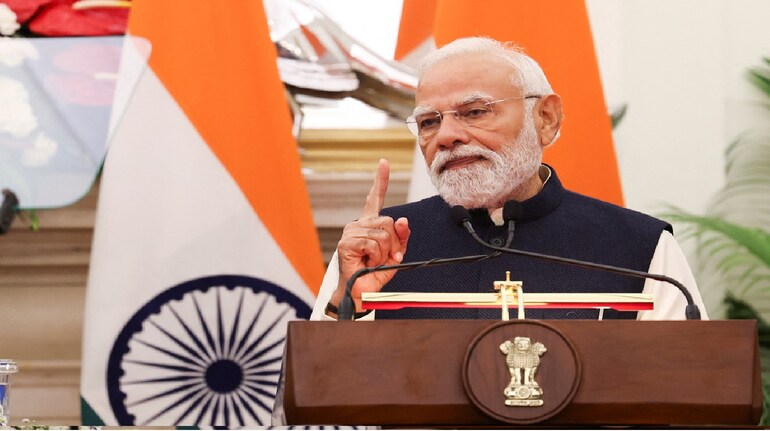

Economists attending the Prime Minister’s pre-Budget interaction have flagged growing fiscal pressures arising from rising interest obligations, weakening household savings and potential crowding-out of private investment, even as the government continues to rely on an elevated public capital expenditure push to support growth. Alongside fiscal issues, participants also focused on Atmanirbhar Bharat and the Viksit Bharat roadmap, sources said.
Prime Minister Narendra Modi at the meeting emphasised on the importance of addressing the aspirations of the nearly 25 crore people estimated to have moved out of poverty in recent years through improvements in health, education, jobs, skills and infrastructure, sources said.
Govt capex needs to be lower
Some of the senior economists, who participated in the meeting, said there was need for “…aligning fiscal policy more closely with the original Fiscal Responsibility and Budget Management (FRBM) framework, including a call to recalibrate government capital spending to around 3 percent of gross domestic product (GDP) from the current level of above 3 percent.”
“It is important to return to the spirit of the original FRBM framework. Public capital expenditure should gradually be brought closer to 3 percent so that more financial resources are available for the private sector,” a source told Moneycontrol.
In the FY26 Budget, the government budgeted around Rs 11.21 lakh crore for capital expenditure, higher than 3 per cent of GDP.
Atmanirbhar Bharat
Alongside fiscal issues, participants also discussed Atmanirbhar Bharat and the Viksit Bharat roadmap, including climate finance, digital infrastructure, high-technology education and artificial-intelligence-related skilling initiatives.
The Prime Minister, the source said, emphasised the importance of addressing the aspirations of the nearly 25 crore people estimated to have moved out of poverty in recent years through improvements in health, education, jobs, skills and infrastructure.
“The broader takeaway was that policy now has to focus on the next stage of aspiration-building for those who have moved out of poverty. That long-term development lens formed an important part of the conversation,” the person added.
Household savings decline seen as macro risk
Concerns over the sharp decline in household financial savings also figured prominently in the meeting, with participants warning that weakening domestic savings could constrain financing options for both the government and the private sector.
“Household financial savings have fallen from around 10 to 10.5 percent of GDP earlier to about 7 to 7.5 percent now. With domestic savings dwindling and foreign capital flows becoming uncertain, even financing a 2 percent current account deficit could become challenging unless savings recover,” the economists noted.
The person added that sustained high public capex, combined with falling household savings, was tightening liquidity and raising bond yields.
“Private capital expenditure is ultimately more efficient than public capex. The objective is not to cut investment, but to calibrate it so that the private sector has the financial space to expand. That is fully consistent with the philosophy of the FRBM framework,” he said.
25% of govt expenditure goes for interest payment
Participants also drew attention to the rising share of interest payments in the government’s expenditure profile, warning that the trend could weigh on fiscal flexibility over the coming years. The Eighth Pay Commission could further add to debt levels.
“The concern is not only the level of borrowing, but the fact that interest payments have been increasing steadily. Today, roughly 25 to 28 percent of total government expenditure is going towards servicing interest. That means nearly 25 paise out of every rupee spent is absorbed by interest payments alone,” the person said, adding that pressures such as the Eighth Pay Commission could further add to debt levels.
“Citing Japan as an example of an economy with very low or negative interest rates, the economists said India’s comparatively higher cost of government borrowing makes its debt dynamics far more vulnerable to fiscal slippages,” he said.
Deficit framework needed
A key theme in the discussion was the need for a fiscal framework that integrates both debt and deficit targets, rather than relying on a debt-only anchor.
“A debt framework on its own is not sufficient – we also need a proper deficit framework with clearly defined instruments,” the source said. “Earlier recommendations under the FRBM review laid out a calibrated path for both the fiscal deficit and the revenue deficit – including a revenue deficit target of zero over time — alongside a public-debt target. In the last Budget, the government said it would anchor policy only to public debt, but if you remove the deficit targets, then the framework becomes inconsistent,” he said.
No concern raised on US tariff risk
Participants also discussed India’s ongoing trade engagements, with some economists expressing optimism that recent and upcoming free trade agreements could support export prospects over the medium term.
“There was a broadly positive view on the trade agreements that India has been pursuing, and the expectation is that they should yield constructive outcomes for exports over time,” the person said.
No specific concern was raised on the risk of potential tariff actions by the United States, and the conversation remained focussed largely on wider macroeconomic and structural themes rather than country-specific trade frictions, he said.

Discover the latest Business News, Sensex, and Nifty updates. Obtain Personal Finance insights, tax queries, and expert opinions on Moneycontrol or download the Moneycontrol App to stay updated!
Find the best of Al News in one place, specially curated for you every weekend.
Stay on top of the latest tech trends and biggest startup news.





