







Nearly a decade after its launch, India’s flagship Smart Cities Mission is running behind schedule, with repeated deadline extensions, the latest being end of December, highlighting persistent execution bottlenecks.
What was conceived as a time-bound urban transformation programme has seen its completion date pushed back multiple times—first due to the covid pandemic and later because of unfinished projects across several cities.
The original deadline was extended to June 2023 following Covid-related disruptions. This was later revised to 2024, then March 2025, and most recently to June and December, as a significant number of projects remained incomplete.
Even as the urban renewal programme enters its final phase, visible gaps in execution persist across cities and sectors.
Overall, the Smart Cities Mission has achieved a completion rate of about 96 percent but the aggregate figure masks wide disparities at the city level.
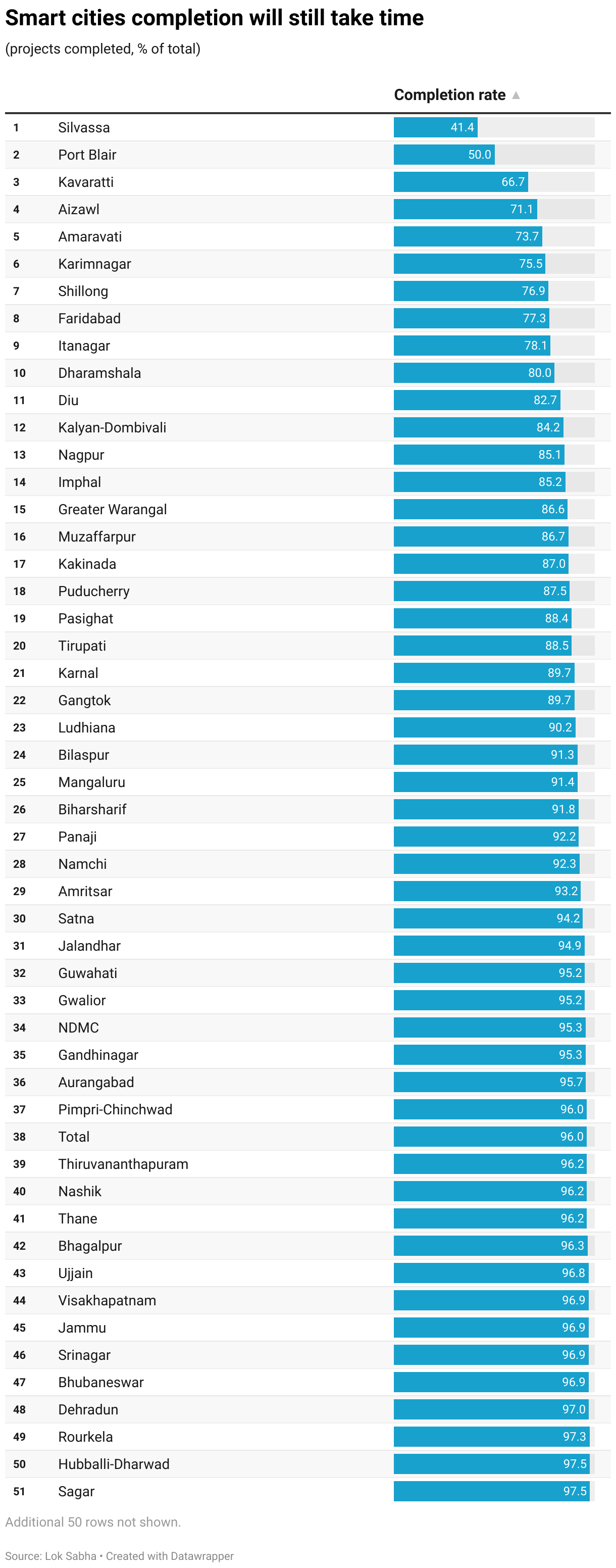
Several large cities, including Patna, Pune, Surat, Indore and Chennai, have completed all their approved projects. Others, however, continue to lag.
Port Blair has completed only about half of its projects, while Silvassa and Kavaratti also remain well below the national average.
In the Northeast, cities such as Aizawl, Shillong and Itanagar continue to record lower completion ratios.
Costs rise as large projects linger
Cost patterns point to mounting strain as projects drag on. The average cost of completed projects is lower than that of ongoing projects, suggesting that larger and more complex works are still in the pipeline.
In some cities, the cost of unfinished projects is several times higher than the mission-wide average.
Cities such as Kalyan-Dombivli, Thane and Dehradun stand out.
In Maharashtra’s Kalyan-Dombivli, for instance, ongoing projects are valued at Rs 174.7 crore, compared with Rs 45 crore worth of completed projects.
At the national level, the average cost of a completed project is Rs 20.1 crore, well below the Rs 29 crore average for projects still under execution.
Uneven progress across sectors
Sector-wise performance also varies. Integrated Command and Control Centres have been fully completed, reflecting their prioritisation during the pandemic. Components such as smart energy, environmental projects and governance reforms have also achieved high completion rates.
In contrast, smart mobility, economic infrastructure and social infrastructure have progressed more slowly, with ongoing projects accounting for a significant share of remaining expenditure.
Discover the latest Business News, Sensex, and Nifty updates. Obtain Personal Finance insights, tax queries, and expert opinions on Moneycontrol or download the Moneycontrol App to stay updated!
Find the best of Al News in one place, specially curated for you every weekend.
Stay on top of the latest tech trends and biggest startup news.




