
Even by the roller-coaster standards of the global oil market, Monday’s swings were extreme enough to test traders’ limits.
“I’m enjoying the volatility but it’s exhausting,” said Toby Copson, a China-based portfolio manager at Davenport Energy, which trades oil and gas. “It’s been all hands on deck. Not many us are getting much sleep. Fundamentally, we know the drivers, but we’re being stress-tested by headlines and tweets.”
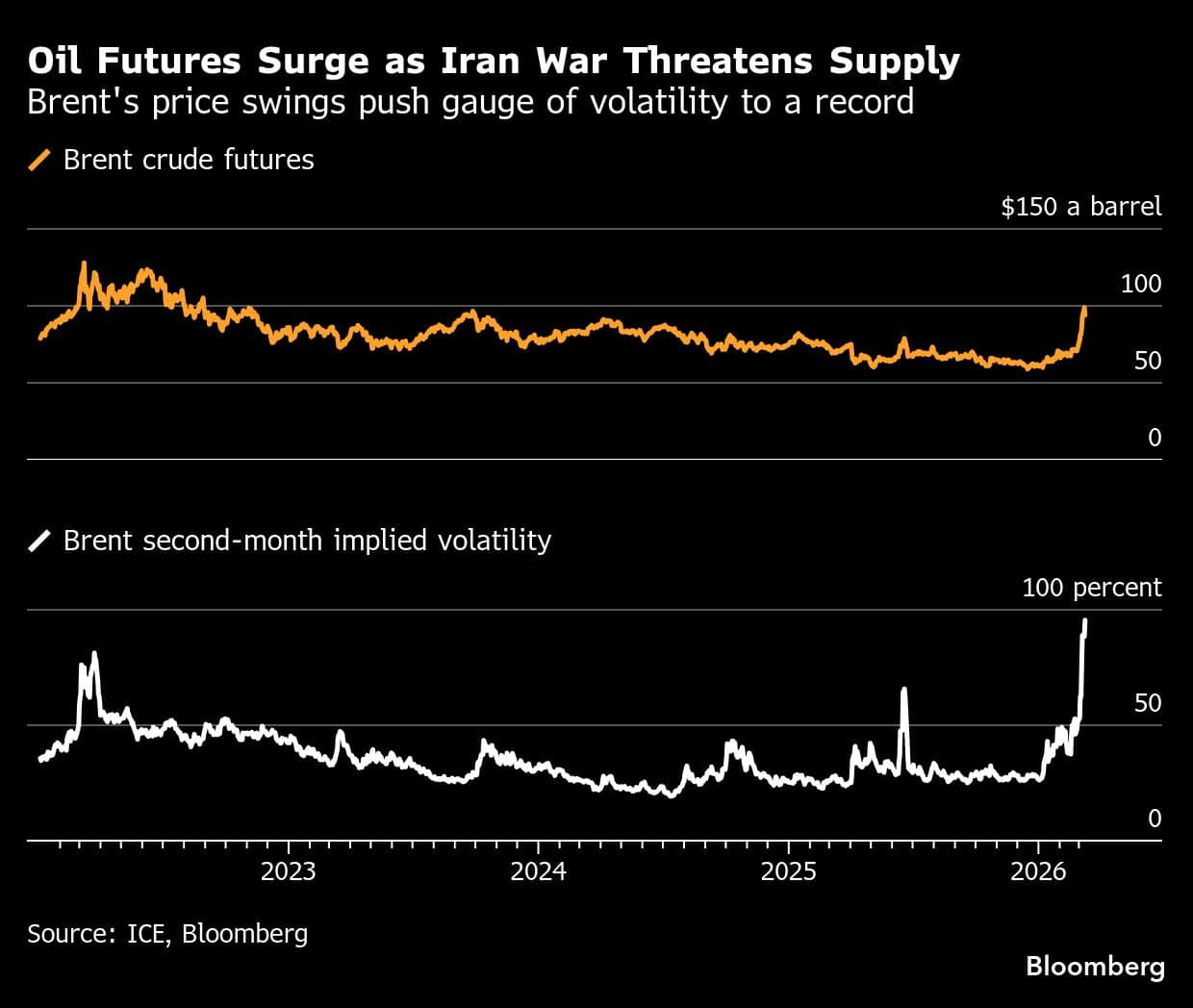
Benchmark contracts for oil — the world’s most traded commodity — surged as much as 29% on Monday following a weekend of unrelentingly negative news from the deepening crisis in the Middle East. With Persian Gulf drillers locking in oil output, maritime traffic through the Strait of Hormuz at a near standstill and no sign of a resolution, Brent contracts soared in heavy volumes to a peak of almost $120 a barrel in the first few hours of trading, to highs last seen in the middle of 2022.
Then the mood abruptly shifted — forcing traders to make a dramatic turn.
Moves by the Group-of-Seven nations to pave the way for a coordinated release of crude from strategic reserves cooled early gains, followed by comments from President Donald Trump that the conflict could end soon. Even with scant detail, it was a change of tone that rippled through the market. For Brent, it was the largest-ever drop from an intraday maximum to a closing price, the sort of swings seen during the Covid pandemic.
Traders typically thrive on volatility, but oscillations as intense as Monday’s are relatively infrequent. This week’s dramatically changing headlines and huge moves in prices have left even veterans rattled — recalling the upsurge in commodities triggered by Russia’s invasion of Ukraine in 2022 and, before that, the historic day in 2020 when West Texas Intermediate briefly traded below zero.
“It was downright panic trading,” said Nick Twidale from AT Global Markets, who — with 27 years of market experience behind him — was at his desk in Sydney at 6:00 a.m. on Monday. “My phone was going off every 10 seconds — bing, bing, bing — from traders to clients to industry guys who all had one question: ‘What the hell is going on with oil?’”
The crisis in the Middle East kicked off at the end of last month, when US and Israeli forces began strikes on Iran. Tehran responded with defiance, targeting bases and infrastructure across the region, spreading disruption across the Persian Gulf. Heading into Monday’s session, concern was growing about the duration of a war that is already hitting the global economy.
“When geopolitical decisions drive price action, investors feel they have less control,” said Stefano Grasso, a former oil and LNG trader who’s currently senior portfolio manager for 8VantEdge Pte’s flagship Enhanced Value Fund in Singapore. “What markets are experiencing right now is not just volatility but a sense of helplessness.”
Beyond oil, Monday’s swings engulfed other commodities from base and precious metals to food products, as traders attempted to price in the dislocations that were already apparent, and the trouble that may yet be in store. Among them, aluminum spiked to the highest level since 2022, silver tanked almost 6%, and gold was dragged lower by a rising US dollar.
Gas markets were also in turmoil. As oil surged, Asia’s liquefied natural gas buyers — particularly those in the emerging world — began to panic, fearing there would be a global rush for supply. An outage at the world’s largest LNG export plant in Qatar caused by the war continued with no end in sight.
GAIL India Ltd. failed to award an LNG purchase tender on Monday to secure a March shipment, according to traders, who noted that there just weren’t any spare gas cargoes available for the month. Buyers in Thailand were trying to secure near-term shipments from Malaysia and other regional suppliers, traders added.
“The best response is discipline: keep positions sized appropriately and stay focused on risk management rather than prediction,” said 8VantEdge’s Grasso. “The market is trying to price political decisions that can change overnight. That naturally creates sharp swings.”
Crude’s wild ride extended into Tuesday, as the Nymex-listed price hit a circuit-breaker halt in the first two minutes of the session. When trading got going, West Texas Intermediate lost as much as 11%, although it still remains above the levels seen before the war began.
“Is the worst behind us? Maybe,” Twidale said. “This is headline-by-headline trading, and it’s very hard.”
Discover the latest Business News, Sensex, and Nifty updates. Obtain Personal Finance insights, tax queries, and expert opinions on Moneycontrol or download the Moneycontrol App to stay updated!
Find the best of Al News in one place, specially curated for you every weekend.
Stay on top of the latest tech trends and biggest startup news.