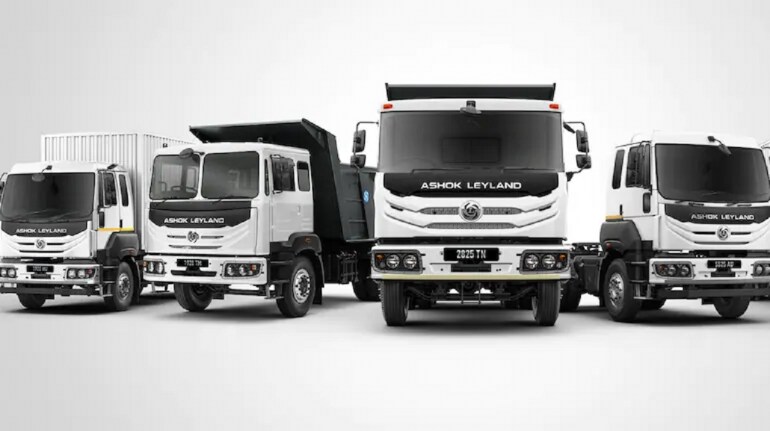
Anticipating all-time high sales volumes in FY 2024, Commercial Vehicle (CV) makers including Ashok Leyland, Tata Motors and VECV are looking to step up investments to strengthen their lineups, develop green products and improve production.
Ashok Leyland Limited has charted out a capital expenditure plan of up to Rs 750 crore for the current financial year, led by new product development, capacity debottlenecking and electric Light Commercial Vehicle (e-Dost) rollout.
The flagship company of Hinduja Group, which had spent Rs 500 crore during the last FY, is increasing investment because it is optimistic about industry prospects.
ALSO READ: Ashok Leyland net profit skids 17% in Q4, but brokerages retain the 'buy' tag
Shenu Agarwal, Managing Director of Ashok Leyland, expects 10 percent growth in industry volumes over last year.
“The steel, cement, and mining industries are also expected to bolster the medium and heavy commercial vehicle (M&HCV) sales segment for this year,” Agarwal said.
Citing a research report, he stated that demand for higher load carrying capacity vehicle segment products such as multi-axle vehicles tippers and tractor trailers are set to grow as well in FY24.
When asked about the ramp-up in production, Agarwal maintained that the company has sufficient capacity visibility for the next two to three years, so a significant portion of capex would be spent on debottlenecking engine plants.
Recovery underway
Tata Motors revealed that it has drawn up a blueprint for spending Rs 8,000 crore across the Passenger Vehicle, Electric Vehicle and CV segments this fiscal. The company didn’t share its capex specific to the CV vertical.
ALSO READ: Tata Motors stock price rises on move to hike commercial vehicle prices
“We are clearly starting to see sequential improvement in our market shares since October and by March it's been increasing in all the categories barring intermediate and light commercial vehicles, where we still have work to do to increase portfolio,” said P.B. Balaji, Chief Financial Officer of Tata Motors, in a post Q4 earnings call.
He added, “The underlying demand in terms of infrastructure investments, (operators) wanting to renew their fleet, ensuring the e-com business continues to move, etc., point to pretty much everything (to) CV ecosystem is likely to come back sooner.”
VE Commercial Vehicles Limited (VECV) , a joint venture between the Volvo Group and Eicher Motors Limited, is planning to invest Rs 750 crore this year for business growth and aims to increase truck and bus volumes to meet the growing demand.
“We continue to spend on our future initiatives and in the current year our investments would be for (development of) new products as well as (for establishing) additional paint shop at Bhopal plant. And, of course, further capacity expansion towards our engine unit and a components plant. So, therefore, we are continuing to invest heavily on our future,” Vinod Aggarwal, Chief Executive Officer of VECV, said at a recent media briefing.
As per data shared by ICRA, the total investments made by the CV industry were estimated at nearly Rs 3,200 to Rs 3,500 crore during last fiscal, and a similar amount is expected for FY 2024 as well. The research agency claims that the amount will primarily be deployed towards development of new products and alternative fuel powertrains and regulatory compliance such as meeting emission and safety norms.
However, since adequate capacity is available for manufacturing, investments for enhanced output are expected to be limited.
Brighter prospects ahead
ICRA also revealed that the Total Industry Volumes (TIV) in the domestic CV industry stood at 960,000 units and is poised to grow by 7-10 percent to 1.03-1.06 million units in FY 2024. The growth is expected to be broad-based, but to be led by the truck segment largely in terms of volumes, as per ICRA.
According to ICRA, the M&HCV segment is expected to drive the volumes with 8-10 percent Year-on-Year growth expected in FY 2024, supported by a pickup in construction, mining and infrastructure activities as well as healthy replacement demand.
The growth in the LCV truck segment at 4-6 percent while it will continue to be supported by last-mile transportation requirements, would be lower given the high base effect, as per ICRA.
“The growth is expected to be led by various factors such as government infrastructure spending, replacement demand, resumption of schools and offices, and e-commerce expansion,” Sruthi Thomas, Assistant Vice President & Sector Head - Corporate Ratings, ICRA Limited, told Moneycontrol.
She also said: “Additionally, the implementation of the scrappage policy from April 1, 2023, with government vehicles older than 15 years to be mandatorily scrapped, may provide an additional fillip to replacement demand.”
Discover the latest Business News, Sensex, and Nifty updates. Obtain Personal Finance insights, tax queries, and expert opinions on Moneycontrol or download the Moneycontrol App to stay updated!
Find the best of Al News in one place, specially curated for you every weekend.
Stay on top of the latest tech trends and biggest startup news.