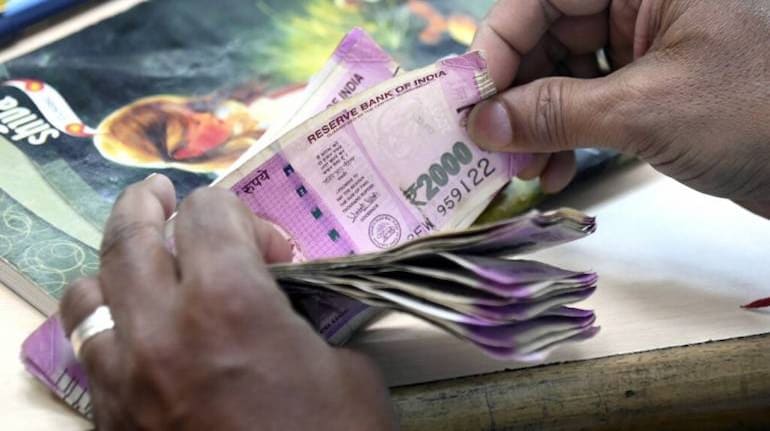
Fretful over future enquiries by investigating agencies and the regulator, most banks are insisting on customers filling out separate forms for exchanging Rs 2,000 notes. Many banks have made such forms mandatory, Moneycontrol has found.
On May 19, the Reserve Bank of India (RBI) announced the withdrawal of Rs 2,000 notes from circulation and gave citizens time until September 30 to exchange or deposit the notes.
The RBI said customers can make deposits into accounts without restrictions.
"The Rs 2,000 banknotes can be deposited into bank accounts and cash requirements can be drawn thereafter, against these deposits," RBI said in an official statement.
Members of the public can exchange Rs2,000 banknotes up to a limit of Rs 20,000 at a time, the central bank had said.
Playing safeBanks are insisting on customers filling separate forms as a precautionary measure so that data on every such transaction is accounted for with customer details to share with RBI or other agencies if enquiries arise in future, bankers said.
"We have introduced forms because we want to keep data on who has exchanged money from our bank,” a senior banker in Mumbai/Delhi with a state-run bank told Moneycontrol on condition of anonymity.
“This is to ensure we don't fall in trouble (in case of future enquiries)," the banker added.
Another banker said many people tried to come to branches to exchange Rs 2,000 notes multiple times.
"Only motive to come up with this separate form at the time of exchange is to keep track of how many people are coming to the branch to exchange the Rs 2,000 notes,” said the second banker.
To ascertain the progress of Rs2000 note deposits/ exchange, Moneycontrol reporters visited several bank branches in New Delhi and Mumbai.
Banks insisting on forms being filled include Punjab National Bank (PNB), Bank of Baroda (BOB), Canara Bank, Axis Bank, IDFC First Bank, RBL Bank and HDFC Bank.
"As directed by the Reserve Bank of India (RBI), we are facilitating Rs 2,000 denomination notes deposited in customer accounts without the requirement of any document submission. This has been ensured at all our branches across the country. Besides, the exchange of Rs 2,000 denomination bank notes is being facilitated, up to the limit of Rs 20,000 at a time, for our customers based on customer ID and for all non-HDFC Bank customers a copy of any of the officially valid document (OVD) or pan card is required. This is as per the RBI’s master direction on Know Your Customer and in line with the extant process of the bank. HDFC Bank stands committed to serving its customers," an official from HDFC Bank said.
Except for HDFC Bank, emails sent to other banks seeking responses for this story remained unanswered till the time of filing this copy.
A few banks such as ICICI Bank are using the deposit slip instead of separate forms for the exchange of Rs 2,000 notes.
"We are only allowing customers to exchange Rs 2,000 notes once in a day; also we are not facing any kind of liquidity crises so far and have enough cash for exchange," a Delhi-based banker said.
State Bank of India (SBI) on May 22 informed all its branches that no form or identity proof would be needed to exchange Rs 2,000 currency notes and reiterated the one-time limit of Rs 20,000 for depositing or exchanging banknotes.
"The facility of exchanging Rs 2,000 notes to all members of the public up to a limit of Rs 20,000 at a time will be allowed without obtaining any requisition slip," the country's largest lender said in a press release on May 20. "No identity proof is required to be submitted by the tenderer at the time of exchange."
Officials at SBI said there are no restrictions on customers coming in multiple times to exchange notes.
"This is true that many people are coming to exchange multiple times to exchange Rs 2,000 notes and exchanging more than 10 notes. However, we try to keep an eye on this too, "said a senior SBI official.
Rs 2,000 note so far in the marketThe latest release on May 19 by the RBI showed the total value of Rs 2,000 banknotes was Rs 3.62 lakh crore constituting only 10.8 percent of notes in circulation on March 31, 2023.
About 89 percent of the Rs 2,000 denomination banknotes were issued prior to March 2017 and are at the end of their estimated lifespan of 4-5 years.
“It has also been observed that this (Rs 2,000 banknote) denomination is not commonly used for transactions. Further, the stock of banknotes in other denominations continues to be adequate to meet the currency requirement of the public,” the RBI said in the release.

Discover the latest Business News, Sensex, and Nifty updates. Obtain Personal Finance insights, tax queries, and expert opinions on Moneycontrol or download the Moneycontrol App to stay updated!
Find the best of Al News in one place, specially curated for you every weekend.
Stay on top of the latest tech trends and biggest startup news.