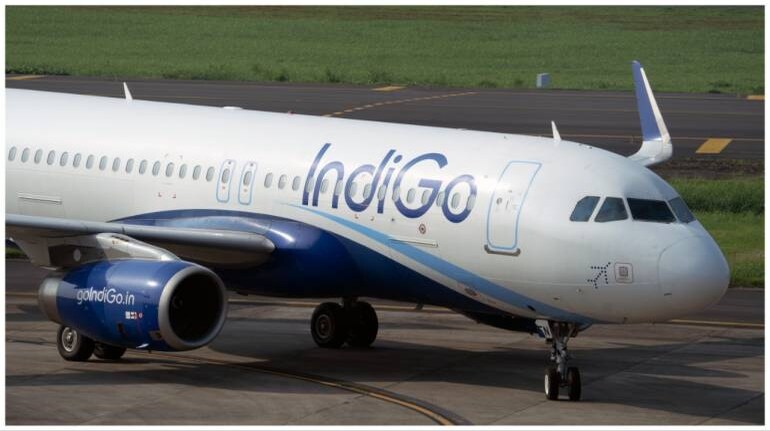
IndiGo, the country’s largest carrier by fleet and market share, has long been rumoured to be looking for widebody aircraft to expand its footprint beyond India. It has been on an expansion spree pre-COVID and has continued in the recent past as well. To this effect, it has deployed two wet-leased B777s on routes to Istanbul. While a wet or damp lease is a common practice, rarely are the planes painted in the livery of the operator which has been the case with IndiGo.
As it sets sight on international expansion, IndiGo has one disadvantage as compared to Air India and another example of it will be in full display starting September 12th. . The split terminal operations in India threaten to derail the international growth ambitions of IndiGo.
Indian airport terminalsInternational traffic from and to India has largely been via the hubs of Delhi and Mumbai. A look at the footfalls at Indian airports shows how Delhi is way ahead of every other airport. The footfalls at Delhi were 1.5 times that of Mumbai, three times of Chennai and almost 15 times of Ahmedabad which is 10th in the list of international footfalls for July.
The airports at Delhi and Mumbai, from where the majority of the international traffic flows, are divided into three terminals in the case of Delhi and two at Mumbai. With the plans for these terminals being laid out when the full-service carriers ruled the roost in India, things have changed drastically since then with low-cost carriers (LCCs) capturing an 80 percent share. This has meant that airports have one international terminal which is co-occupied with full-service domestic carriers while LCCs operate from the older terminals.
Over the years, the growth of LCCs has meant that IndiGo now carries more passengers from and to India than Air India, but IndiGo’s international and domestic operations are split unlike that of Air India. With Bengaluru shifting international operations to T2 very soon along with all full-service domestic carriers, the problem of Delhi and Mumbai will be replicated at Bengaluru for IndiGo. Ironically, IndiGo has more seats to offer on international flights from Bengaluru than Air India, even when Air India has its flagship non-stop to San Francisco.
Why does it matter?The fall of Jet Airways further complicated the capacity and usage of terminals across airports which had multiple terminals in operations. IndiGo operates from all three terminals in Delhi and both terminals in Mumbai.
A connection is attractive for a passenger when it fulfils multiple criteria – cost, comfort, connecting time and total duration to reach the destination. While IndiGo has its standardised product which will not match with a full-service carrier but duly compensated with lower cost, the connecting time and total duration becomes not so competitive when a passenger has to change terminals, mostly on their own by exiting the terminal fully.
Globally, airlines operate across terminals, and people movers — air side transfers via buses — have been the norm for quick connections, which is totally missing in India. This increases the Minimum Connection Time (MCT).
IndiGo had seen 6.28 million transfer passengers at Delhi in FY19-20, higher than Air India – which has a hub at Delhi and a single terminal advantage but saw transfer passengers at 3.56 million in the same duration. The potential is much more for IndiGo – due to its scale.
Is the order stuck for this?With the new flights to former USSR states, Turkey and the Gulf towards the west and Hong Kong and ASEAN in the east, IndiGo is building an effective hub. The passengers are not always international to international connections and a multi-terminal approach is impacting domestic to international connections and vice versa. A solution is to have IndiGo flights in the same terminal but since the idea was mooted in 2011 (when Delhi Airport had to abandon the project midway to have international services from T1), it hasn't gained a lot of traction.
Kolkata and Chennai, both airports operated by the Airports Authority of India have better transfer times due to the international and domestic terminals operating under the same roof. Yet, one of the other issues has meant that airlines have opted for limited expansion from these airports. Kolkata has seen IndiGo expand to China, Vietnam and Myanmar in the past but some of this has been curtailed due to political situation as well as COVID-centric rules.
To fill up widebody aircraft, the airline will have to primarily rely on Delhi, followed by Mumbai. With long connecting times, it will be a disadvantage. To make it work, airports will have to convert all terminals to service both domestic and international operations allowing every carrier to be based at a single terminal. While it will help the airlines beyond IndiGo which have smaller fleets, it will also help the airport operators. If it feels so hunky dory then why is it stuck? The security, immigration and customs are neither part of the airlines nor the airport but a part of the central government workforce. Adequate manpower apart from security audits is a must and until that happens multi-terminal operations will continue. Will IndiGo place an order without an assurance? Probably not and if India has to become a hub, a holistic overview of policies is much needed now.
Discover the latest Business News, Sensex, and Nifty updates. Obtain Personal Finance insights, tax queries, and expert opinions on Moneycontrol or download the Moneycontrol App to stay updated!
Find the best of Al News in one place, specially curated for you every weekend.
Stay on top of the latest tech trends and biggest startup news.