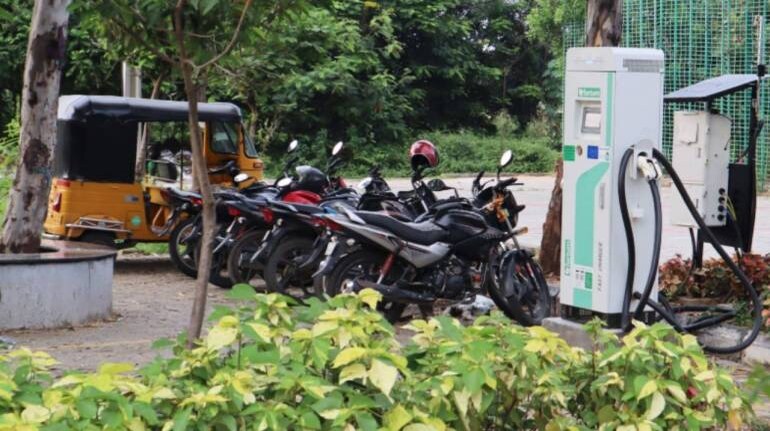
In a first, the Bureau of Indian Standards (BIS) along with the National Standard Body of India has approved the country’s first ever indigenously developed AC (Alternating Current) and DC (Direct Current) combined charging connector standard for light electric vehicles (LEVs) like two-wheelers and three-wheelers and micro cars.
The move is seen to aid electric vehicle manufacturers and OEMs in moving away from relying solely on international standards and protocols and instead implement a charging system that is developed in-house.
AC and DC are two types of electric currents. All home EV chargers and the majority of public charging stations use AC, while DC is used for fast charging.
NITI Aayog, The Department of Science and Technology, ARAI, EV makers like Ather, Hero, Ola Electric and the Bureau of Indian Standards came together to develop the national standard. The proposal and discussion have been going on for around four years.
“A strong need was felt for a combined charging system for light EVs in India and since such an option has not been provided in the international standards, it was necessary to develop it indigenously to give light EV customers the option of charging both from an AC or a DC outlet, whichever is available conveniently for them,” said BVR Subrahmanyam, CEO, NITI Aayog in a statement on October 18.
A charging standard like this for four-wheelers is available only in countries like China, Japan and Europe. So far, the Indian OEMs have been following either international standards or developing on their own, however, there will be a benefit of interoperability.
“Having a central standard makes it easier for every OEM to now follow uniformity in making charging infra. Until now every OEM had their own standard…Now customers can enjoy interoperability where Ather bikes can be charged with any other charging facility and more,” Ather’s cofounder and chief technology officer Swapnil Jain told Moneycontrol.
According to experts, this standard addresses a large gap that existed in the market for a standardised connector for AC & DC combined charging systems for light electric vehicles.
“A combined AC and DC charging connector ensures that a hybrid, cost-efficient infrastructure emerges for all forms of charging whether fast or slow for light electric vehicles,” BIS said in its statement.
The move will also benefit the end user by having an interoperable network for both fast and slow charging without having to carry a bulky charger with them.
Ather’s Jain also said that this will help the government in pushing and promoting EV charging stations and even help in providing subsidies.
“Earlier the government could not push aggressively for EV charging infra as it was very OEM-specific, now with a central standard it becomes easier for the government to push for this and even offer subsidies for manufacturing and operating chargers,” Jain said.


Discover the latest Business News, Sensex, and Nifty updates. Obtain Personal Finance insights, tax queries, and expert opinions on Moneycontrol or download the Moneycontrol App to stay updated!
Find the best of Al News in one place, specially curated for you every weekend.
Stay on top of the latest tech trends and biggest startup news.