






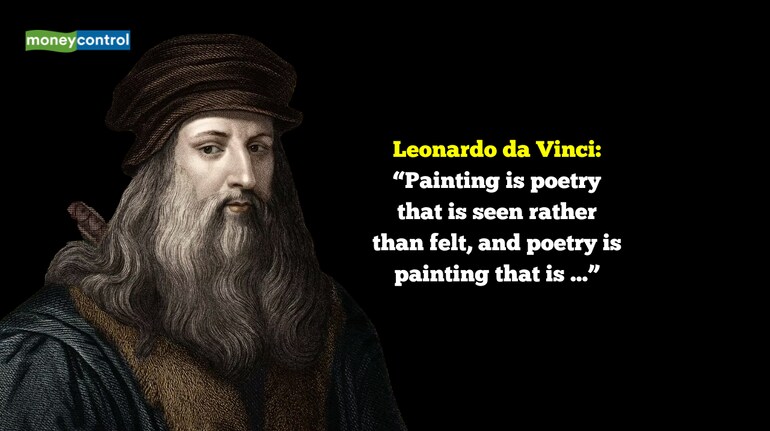

Long before the concept of "multidisciplinary" became a modern ideal, Leonardo da Vinci embodied it completely. A master painter, scientist, inventor, and thinker, he understood that the arts and sciences were not separate languages but different dialects of the same human urge to create and understand. His observation on the relationship between painting and poetry reveals this beautifully:
"Painting is poetry that is seen rather than felt, and poetry is painting that is felt rather than seen."
With this elegant symmetry, Leonardo dissolves the boundary between visual and literary art, revealing them as two expressions of a single, shared soul.
Painting: The Silent Poem
When Leonardo calls painting "poetry that is seen," he elevates the visual artist beyond mere imitation. A great painting does not simply record what the eye observes; it speaks. The arrangement of colour, the weight of a shadow, the curve of a gesture—these are words in a silent vocabulary. A portrait by Leonardo, such as the Mona Lisa, does not tell a story we can write down, yet it communicates mood, mystery, and inner life directly to our perception. It is poetry rendered in pigment, composed not for the ear but for the eye, bypassing language to touch the understanding directly.
Poetry: The Invisible Canvas
Conversely, poetry is "painting that is felt rather than seen." The poet works not with brush and pigment, but with rhythm, sound, and suggestion. The images a poem creates exist nowhere on the page; they bloom inside the mind of the reader. A line about a sunset does not show us the sunset, but through feeling and association, it allows us to experience it more intimately than any photograph might. The poet paints with invisible ink, and the canvas is the human heart. This is why poetry can express grief, joy, or longing with an immediacy that transcends literal description.
Two Paths to the Same Truth
Leonardo's genius lies in his refusal to rank one art above the other. He does not say painting is superior to poetry, or vice versa. Instead, he identifies their distinct strengths while affirming their shared purpose. Both are acts of translation—the painter translates feeling into form, the poet translates sight into sound. Both are engaged in the same essential human project: to capture the fleeting, to give shape to the intangible, and to communicate the depths of experience across the distances of time and space.
This insight extends beyond the arts into how we perceive the world itself. Leonardo reminds us that truth wears many garments. An equation can be as elegant as a sonnet; a scientific diagram can hold the quiet beauty of a sketch. When we limit ourselves to a single mode of expression, we impoverish our own understanding. The painter can learn from the poet's economy of language; the poet can learn from the painter's attention to light and form. Creativity is not a competition between disciplines, but a conversation.
Leonardo da Vinci, who filled countless pages with both anatomical studies and drafts of fantastical inventions, who painted some of the most beloved images in human history and wrote extensively in notebooks, lived this unified vision. His words invite us to see that whether we work with words or images, with formulas or forms, we are all, in our own way, trying to paint the invisible and give voice to the silent. The eye and the heart are not rivals; they are partners in the great work of making sense of being alive.
Discover the latest Business News, Sensex, and Nifty updates. Obtain Personal Finance insights, tax queries, and expert opinions on Moneycontrol or download the Moneycontrol App to stay updated!
Find the best of Al News in one place, specially curated for you every weekend.
Stay on top of the latest tech trends and biggest startup news.





