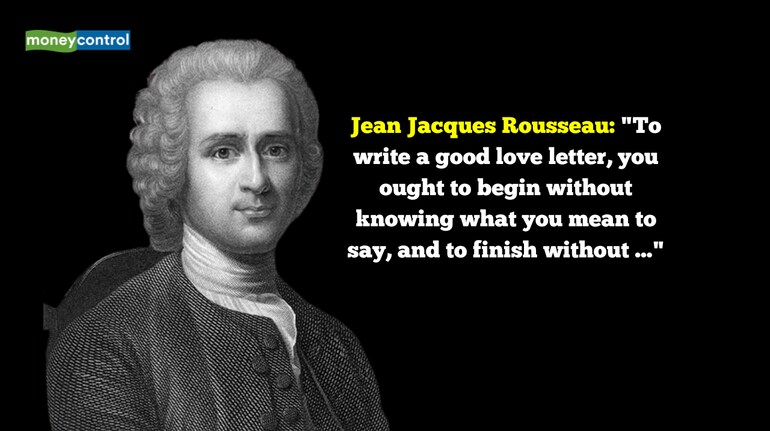

There is something deeply intimidating about a blank page, especially when the subject is love. We want our words to be perfect, our sentiments clear, our expression memorable. Yet the 18th-century philosopher Jean-Jacques Rousseau offered a curiously liberating piece of advice that turns this pressure on its head. He said:
"To write a good love letter, you ought to begin without knowing what you mean to say, and to finish without knowing what you have written."
This is not a call to carelessness, but a profound insight into the nature of genuine emotion and the limitations of the controlled, calculating mind when it comes to matters of the heart.
When we sit down to craft a love letter with careful intention, we often produce something that feels stiff, rehearsed, or borrowed from greeting cards. We edit our spontaneity, filter our rawness, and polish until the original feeling is lost beneath the shine. Rousseau suggests that true feeling cannot be scheduled or outlined. Love, by its nature, is a little disorienting. If you know exactly what you mean to say before you begin, you are probably not speaking from the heart, but from the head. You are describing love, not expressing it.
Beginning in Uncertainty
"To begin without knowing what you mean to say" is an act of trust. It requires setting aside the inner critic, the editor, the voice that worries about grammar and coherence. It means picking up the pen while the feeling is still fresh and letting the emotion guide the hand. This vulnerability is precisely what makes a love letter powerful. The reader senses the genuine searching, the honest attempt to articulate something that resists easy capture. Uncertainty, in this context, is not weakness but authenticity.
Ending in Surprise
The second half of Rousseau's insight is perhaps the more magical: "to finish without knowing what you have written." This describes a state of flow, where the writer becomes a channel for feeling rather than its master. When we write from this place, we often surprise ourselves. We discover feelings we did not know we had, or find words that seem to come from somewhere beyond our conscious mind. The letter becomes a record of discovery, not a report of settled conclusions. Reading it back, we meet ourselves anew.
The Letter as Living Thing
A love letter written in this spirit is not a product but an event. It captures not just the feeling, but the movement of the feeling—its starts and stops, its hesitations and rushes. It is alive in a way that a polished composition cannot be. The recipient is not merely informed of love, but invited into its unfolding. They witness the writer in the act of feeling, which is far more intimate than reading a summary of feelings already processed and packaged.
Rousseau's insight extends beyond the love letter to any creative or vulnerable expression. It reminds us that the most powerful communication often comes when we release the need to control and allow ourselves to be genuinely present. Whether speaking to a lover, a friend, or even to ourselves in a journal, the words that matter most are often those we did not plan.
In the end, Rousseau gives us permission to trust the heart's own language, even when it arrives uninvited and departs without our full understanding. The best love letters are not written by the clever mind, but by the feeling hand, moving across the page in search of a truth it cannot name but desperately wants to share.
Discover the latest Business News, Sensex, and Nifty updates. Obtain Personal Finance insights, tax queries, and expert opinions on Moneycontrol or download the Moneycontrol App to stay updated!
Find the best of Al News in one place, specially curated for you every weekend.
Stay on top of the latest tech trends and biggest startup news.