






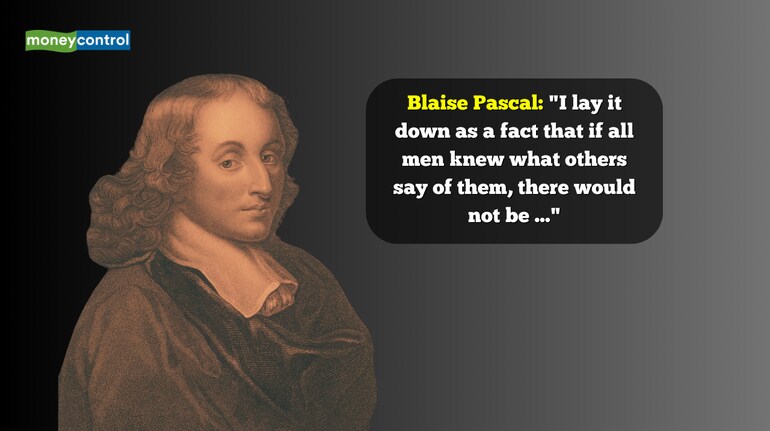

We often wonder what others truly think of us. The 17th-century philosopher and mathematician Blaise Pascal offered a stark perspective on this curiosity. He stated:
"I lay it down as a fact that if all men knew what others say of them, there would not be four friends in the world."
This sharp observation is not a celebration of gossip, but a profound commentary on human nature, the fragility of social bonds, and the private self we protect.
The Space Between Public and Private
Pascal points to a necessary gap between our public interactions and private thoughts. In the daily dance of society, we often soften our opinions, bite our tongues, and offer polite encouragement to maintain harmony. The unvarnished judgments, petty criticisms, or fleeting jealousies that we might express in confidence form a hidden layer beneath our social surface. Pascal suggests that if this layer were suddenly made visible, the foundations of most relationships would crack under the weight of bruised egos and wounded pride.
A Defense of Social Peace, Not Deceit
Rather than condemning this gap as simple hypocrisy, we can see it as a necessary social mechanism. Complete, brutal transparency in all moments would be paralyzing. The private venting of minor frustrations or the sharing of critical observations with a trusted few can be a release valve, allowing us to return to our friendships and duties with greater patience. Pascal’s “fact” is less about universal betrayal and more about acknowledging that human imperfection makes absolute, unfiltered honesty between all people an impossible standard that would destroy social cohesion.
The Call for Grace and Self-Awareness
This quote serves as a powerful mirror. It asks for two forms of humility. First, it encourages us to be more graceful and forgiving, recognizing that we, too, have likely been the subject of someone’s private, less-than-flattering commentary. Second, it invites self-awareness: if we fear hearing others' candid opinions of us, perhaps we should examine the gap between the person we present and the person we truly are. The healthiest friendships are often those that can navigate this terrain, offering charitable interpretations and communicating grievances directly rather than in secret.
The True Test of Friendship
Ultimately, Pascal’s line helps define real friendship. A true friend is not someone who never speaks of you in your absence, but someone whose private assessments are tempered by loyalty, kindness, and a fundamental desire for your good. They are also the ones brave enough to offer difficult truths to your face, with care. In a world where we cannot know all that is said, the goal is not to live in paranoid suspicion, but to strive to be the kind of person whose private character aligns closely with their public one, and to cherish those rare friends who offer both honesty and unwavering support.
Discover the latest Business News, Sensex, and Nifty updates. Obtain Personal Finance insights, tax queries, and expert opinions on Moneycontrol or download the Moneycontrol App to stay updated!
Find the best of Al News in one place, specially curated for you every weekend.
Stay on top of the latest tech trends and biggest startup news.





