






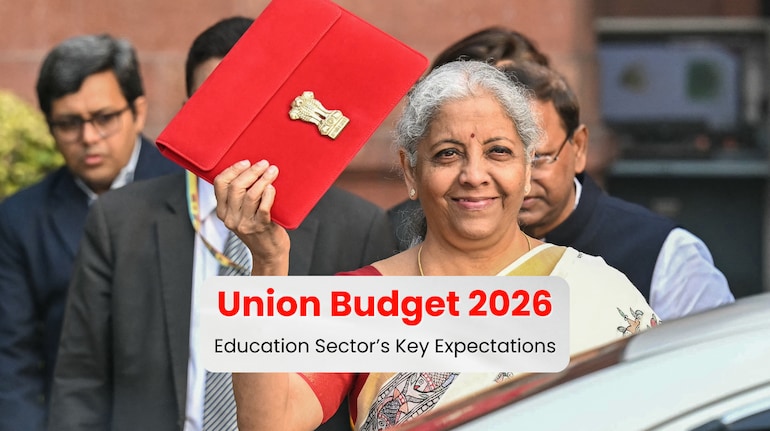

Union Finance Minister Nirmala Sitharaman is scheduled to present the Union Budget 2026-27 in Parliament on February 1, 2026, at 11 am. This will be the government’s eighth consecutive Budget and a crucial policy document for India’s growth story.
In the Union Budget 2025, the government continued its focus on education and skilling with allocations aimed at strengthening school education, digital learning platforms, higher education infrastructure, and skill development programmes. Emphasis was placed on technology-driven learning, teacher training, and improving access to education, especially in underserved regions.
What the Education Sector Is Expecting from Union Budget 2026
As expectations build ahead of Budget 2026, the education sector is calling for a shift from incremental funding to outcome-driven reforms. Stakeholders are seeking higher allocations for school and higher education, faster and more effective implementation of NEP 2020, and increased investment in teacher training and institutional capacity building.
There is also a growing demand for student-centric financing mechanisms that make higher education more affordable for middle-income families through transparent scholarships, affordable credit, and income-linked repayment models. Institutions are pushing for stronger alignment between education funding and employability outcomes, with greater focus on skilling, career guidance, industry exposure, and emerging technologies such as AI, clean energy, and advanced manufacturing. Enhanced support for research, innovation, and digital infrastructure—across both public and private institutions—is seen as critical to building a future-ready education ecosystem.
What Education Leaders Are Saying
Prof. Indranil Manna, Vice Chancellor, BIT Mesra: “Funding for higher education—especially in emerging domains such as artificial intelligence, clean energy, and advanced manufacturing—will be crucial. Continued support for start-up incubation, industry-academia collaboration, scholarships, and skill development can ensure equitable access and help students translate ideas into real-world solutions.”
Praneet Mungali, Trustee, Sanskriti Group of Schools, Pune: “Rapid changes in technology and assessment aligned with NEP 2020 require significant investment in digital infrastructure, STEM labs, and competency-based teacher training. Budgetary support is essential for holistic student development, mental well-being, and building a future-ready generation.”
Vinu Warrier, Managing Partner & Founder, eduVelocity: “The education sector needs a shift from incremental funding to structural reform. A student-centric financing model combining affordable credit, transparent scholarships, and income-linked repayment is essential. Public spending must prioritise not just enrolment, but retention, completion, and workforce readiness.”
Dr. Ramya Chatterjee, CEO, Solitaire Brand Business: “The challenge ahead is not access to information, but ensuring knowledge is absorbed, applied, and retained. Intelligent, integrated learning ecosystems can deliver measurable outcomes while keeping budgets efficient, benefiting both educators and enterprises.”
D L Prachotan, Co-Founder and Head of Business Development at Bhanzu: “India is transitioning from job seekers to job creators. The upcoming Budget should strengthen ecosystems that support entrepreneurship, attract global talent, and enable innovation aligned with the country’s skilling and education goals.”
Sonica Aron, Founder & Managing Partner, Marching Sheep: "The 2026 Budget is a pivotal moment to build a future-ready workforce. Organisations are grappling with rapidly changing skill needs and a shortage of qualified talent. At the same time, the representation of women and persons with disabilities in the workforce remains alarmingly low-women at 23% and PwDs at less than 0.6%, as highlighted in the Marching Sheep Inclusion Index. The Budget must incentivise inclusive hiring, especially for women and PwDs, and drive investment in upskilling, leadership development, and mental well-being. The budget must also extent BRSR from the top thousand companies to a wider set. These measures will not only boost productivity and retention but also position Indian businesses to compete globally with a diverse, resilient workforce."
Pankaj Priya, Deputy Director and Dean Academics, Birla Institute of Management Technology (BIMTECH) Greater Noida: “In education, addressing cognitive skill gaps alone is not sufficient, and this responsibility cannot be left solely to State governments when the Centre is driving the national skilling agenda. At the higher education level, there is an urgent need to align curricula with Industry 4.0 and emerging technologies such as Generative AI and machine learning. The National Education Policy 2020 recognises this shift and targets that by 2025, at least 50 per cent of students across school and higher education will be exposed to skill-based learning. While the Economic Survey 2024–25 shows that the number of colleges has increased by 13.8% over the past eight years and the Gross Enrolment Ratio has risen from 23.7% to 28.4%, the next phase of reform must clearly pivot towards quality, deep research capacity, and strong employability outcomes—not just expanding access. This Budget is a critical opportunity to transform India’s education system into a globally competitive engine for innovation and future-ready talent. Our aim is to instill a mindset for innovation and entrepreneurship to derive maximum benefits from government initiatives focused on cutting-edge technologies.”
Dr. P. R. Sodani President, IIHMR University: “The healthcare sector needs a significant boost, requiring investments in talent, digital transformation, and infrastructure. To further reduce out-of-pocket spending, public health spending needs to increase substantially. The government should effectively utilise the increased public health spending to enhance the capability and capacity of human resources, attract talent, and support training and capacity building, thereby improving the management of healthcare services and facilitating the digital transformation of healthcare, research, and development”.
Kunal Vasudeva, Managing Director and Co-founder of Indian School of Hospitality: History offers no example of a nation achieving sustained prosperity without deep investment in education. Developed economies progressed by building functional capability at scale, not by improving literacy metrics alone. India's real challenge lies in execution, not policy intent. Budget 2026 must place education in the everyday vocabulary of the country and give it a seat at the highest decision making table. This requires absolute priority over the next two decades, starting with a fundamental reset of primary education, particularly in rural India where outcomes remain uneven. One practical lever is the development of indigenous AI tools that strengthen teachers' everyday effectiveness and enable rural classrooms to meet the same functional standards as private schools. If India is serious about Viksit Bharat, this is the only credible path forward.

Discover the latest Business News, Sensex, and Nifty updates. Obtain Personal Finance insights, tax queries, and expert opinions on Moneycontrol or download the Moneycontrol App to stay updated!
Find the best of Al News in one place, specially curated for you every weekend.
Stay on top of the latest tech trends and biggest startup news.





