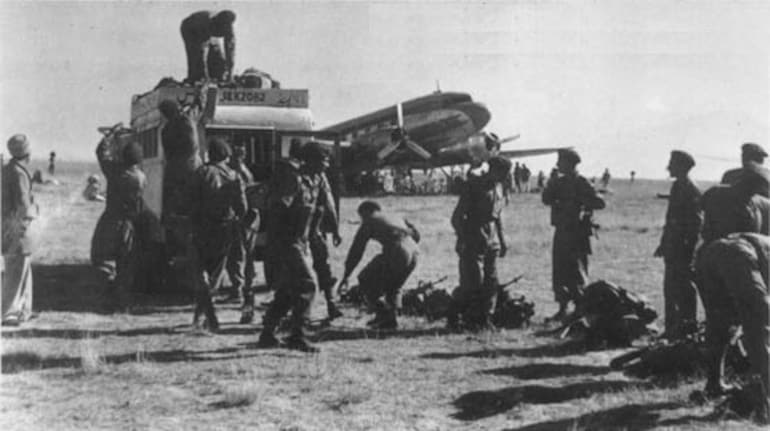
In the winter of 1947, as tribal lashkars backed by Pakistan advanced across Jammu and Kashmir, the newly independent Indian state faced a logistical and tactical crisis. Road links were blocked, mountain passes were snowed in, and vital garrisons were on the verge of starvation. What followed remains one of the least-celebrated, yet most decisive, episodes of the first India-Pakistan war: the creation of two wartime airbridges into Srinagar and Poonch, kept alive by the Royal Indian Air Force’s Dakota crews who flew day after day into hostile skies, often with minimal navigation aids, little military infrastructure and a clear understanding that failure would mean the loss of the Valley.
The airlift into Srinagar is widely remembered for the symbolic landing of the first troop-carrying Dakota on 27 October 1947, bringing 1st Sikh under Lt Col Dewan Ranjit Rai. But the full scale, tempo and risks of the operation have rarely been given the attention they deserve. By the end of 1948, the Dakota pilots had carried out thousands of sorties, delivered men, ammunition and food, evacuated civilians, transported artillery, and performed casualty evacuations under fire. They held the line where land routes could not.
The crisis after accession
When Maharaja Hari Singh signed the Instrument of Accession, Indian forces were nowhere near the state. Pakistan-supported tribal forces had already entered Kashmir, overrunning Muzaffarabad and pushing rapidly towards Srinagar. With the Uri-Baramulla road cut and reinforcements unable to arrive overland in time, Delhi ordered an airlift to secure the capital.
The Royal Indian Air Force’s World War II-vintage Dakotas (C-47 Skytrains) were the only transport aircraft available in meaningful numbers. Many had flown supply missions in Burma and Southeast Asia during the war, but independent India had no substantial air transport infrastructure, limited radar and almost no wartime air experience at the organisational level. What it did have was a core of highly trained pilots, navigators and engineers whose instinct for improvisation proved indispensable.
Timed loading, rapid turnarounds and ad hoc maintenance became the norm. Srinagar airfield itself was little more than a strip carved out of open ground, with no hardened runway and minimal facilities. Yet from the first day, Dakotas began landing every few minutes—each carrying troops who would fight at Shalateng, defend the airfield and halt the advance towards the capital.
Faces behind the controls
Among the first pilots was Wing Commander KL Bhatia, who flew one of the initial sorties on 27 October. The first aircraft to touch down that morning was flown by Wing Commander LRD Blunt, carrying the vanguard of 1 Sikh. Squadron Leaders Mehar Singh (“Mehar Baba”) and KK “Jumbo” Majumdar soon emerged as among the most daring commanders of the airlift.
Mehar Singh, a wartime veteran and one of the RIAF’s most decorated officers, quickly took charge of high-risk operations. His reputation for flying in poor weather and mountainous terrain without hesitation became central to the Kashmir operations. Majumdar, another remarkable
pilot whose wartime record had already earned him international respect, flew reconnaissance and support missions that shaped the understanding of the frontlines in those chaotic early weeks.
These pilots flew at extremely low altitudes through mountain valleys, often hugging terrain to avoid both weather and the possibility of hostile ground fire. Navigation aids were limited to visual references, compasses and rudimentary radio assistance. Many flights departed before dawn and landed after dusk, relying on burning torches or improvised lighting rigs along the runway.
Securing Poonch: The other airbridge
If Srinagar was essential to holding the Valley, Poonch became the symbol of endurance. A heavily populated border district loyal to the Maharaja, Poonch had been surrounded by tribal forces by late 1947. Thousands of refugees had fled into the town. Supplies ran dangerously low. Roads remained cut for months.
India’s only option was to sustain Poonch entirely by air until a land link could be re-established. The task fell again to the Dakota crews, who soon began a relentless schedule of sorties into an airstrip described in accounts as a narrow, improvised ground marked out between hill features and exposed to hostile fire.
Here too, Mehar Singh’s name stands out. In December 1947, he undertook a hazardous landing to assess whether Dakotas could operate safely into the makeshift strip. After circling the valley, he found a small clearing—too short by most standards—and brought his aircraft down. His successful landing convinced commanders that the airbridge was feasible.
For nearly a year, Dakotas delivered grain, medicines, mail, weapons and ammunition, and evacuated the wounded. They carried out upwards of two thousand sorties into Poonch alone. Records note that some days saw as many as 20 to 30 landings despite unpredictable winds, narrow approaches and shelling in nearby areas. Pilots often had seconds to commit to a landing; turning back was not always possible.
Flying into history: The Poonch evacuation and the Poonch brigade airlift
One of the largest operations the Dakota crews executed was the evacuation of Poonch’s civilians during intense shelling. Pilots loaded aircraft far beyond ordinary limits. Accounts describe people seated on the floor, between equipment racks, or standing due to lack of space. In another remarkable chapter, Indian forces used Dakotas to airlift elements of the Poonch Brigade out of the beleaguered town and redeploy them for offensive operations—a logistical manoeuvre unprecedented in South Asian military history at the time.
When the land corridor to Poonch was finally opened in November 1948 by the 268th Infantry Brigade after fierce fighting, the airbridge was closed. It had lasted nearly a year and kept tens of thousands alive.
Risks, losses and the cost of the operations
The Dakota crews flew in uncertain weather, without modern de-icing systems, terrain warning, pressurised cabins or advanced radio navigation. Engine failure over high mountains was often fatal. Aircraft had to climb rapidly out of narrow valleys, and downdrafts could push them dangerously close to ridgelines.
Several aircraft were lost, many damaged, and crews worked around the clock to keep the fleet flying. Ground engineers improvised spare parts. Pilots frequently rotated between frontline missions and maintenance duties.
Yet morale remained extraordinarily high, driven by the knowledge that failure meant the loss of territory and people who had no alternative line of survival.
Transforming air power in independent India
The Srinagar and Poonch airbridges established the strategic value of airlift capability in a manner that shaped Indian defence thinking for decades. The operations demonstrated that India—still forming its institutions—could coordinate multi-theatre air, land and logistical efforts under wartime pressure. Many officers involved would go on to shape the future Indian Air Force’s transport and strategic airlift doctrines.
These missions also set a template for later operations, including the 1962 Ladakh resupply effort, the air maintenance of Siachen, relief missions across the Northeast and Andaman Islands, and the massive humanitarian and military airlifts in later decades.
Why the Dakota crews deserve remembrance
The men who flew the Dakotas into Poonch and Srinagar did so with no certainty that they would return. Their aircraft were slow and vulnerable. They operated without the safety nets of modern aviation. Yet they sustained entire towns, turned the tide of the war and saved Kashmir from falling in those first critical weeks.
Despite this, their contribution rarely receives the public recognition it deserves. Ground battles dominate public memory; the men who kept those battles supplied are often forgotten.
Their work stands as one of the most consequential logistical missions in Indian military history—achieved not with advanced technology, but with professionalism, courage and the improvised genius of individual pilots and engineers.
A legacy in need of retelling
As India documents and declassifies more of its early military history, the story of the Dakota pilots of 1947-48 continues to emerge as a defining chapter. It reveals the sheer fragility of the moment, the scale of improvisation and the quiet heroism of aircrew who flew unarmed transports into war zones to keep a newly independent nation from losing ground.
Srinagar and Poonch remained in Indian hands not just because soldiers fought on the frontlines, but because the Dakota crews ensured they had the men, ammunition and supplies to do so. Their contribution, understated yet decisive, continues to resonate through the history of Jammu and Kashmir and the evolution of Indian air power.
Discover the latest Business News, Sensex, and Nifty updates. Obtain Personal Finance insights, tax queries, and expert opinions on Moneycontrol or download the Moneycontrol App to stay updated!
Find the best of Al News in one place, specially curated for you every weekend.
Stay on top of the latest tech trends and biggest startup news.