






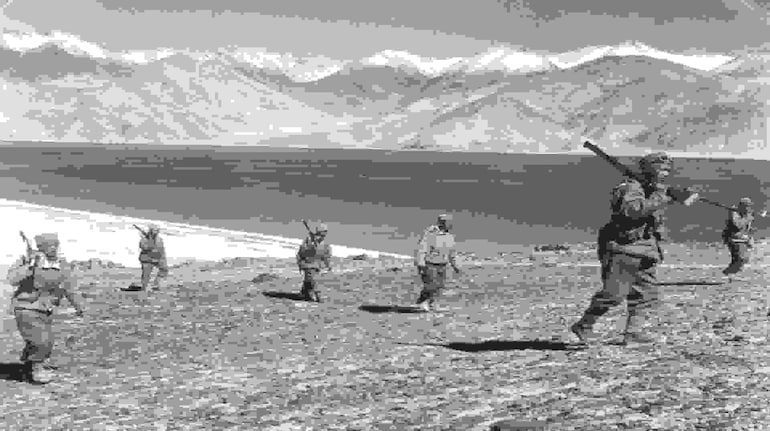

Tawang did not “fall” in 1962 the way people imagine a fortress falling, after a dramatic last stand at the town gates. What happened was messier and, in some ways, more unsettling. The Indian position in the Tawang tract was hollowed out first, then the town was evacuated, and only then did the People’s Liberation Army move in. The real break in the eastern sector was not a single battle at Tawang, but a sequence that began north of it, at Namka Chu and the approaches to Thag La, and then snowballed into panic down the axis of Se La, Dirang, Bomdila and toward the Assam plains.
To understand why Tawang was abandoned so quickly, you have to start with the impossible geometry of that front in 1962. Tawang sits deep in the mountains, dependent on a narrow road line to the south through Se La. The high passes to the north and east, including the approaches around Bum La, are punishing even in peacetime. In October 1962, India’s local posture was a mix of scattered posts, thin logistics, and formations pushed forward under political pressure but without the kind of reserves and artillery depth that mountain defence needs.
The setup: Forward policy meets hard terrain
Through 1961 and 1962, India’s “forward policy” sought to establish and hold small posts to assert claims and prevent Chinese consolidation. In the Tawang area, that logic translated into positions north of the McMahon Line and around the Namka Chu river. The problem, as later accounts and analyses keep returning to, was that the posts were often tactically exposed and logistically fragile. When pressure came, they could not support each other, and higher formations struggled to coordinate defence across ridges and valleys that look close on a map but are brutal on foot.
Brigadier J P Dalvi’s 7 Infantry Brigade became central to this story. It was ordered into the Namka Chu sector, where the brigade was expected to maintain a presence under conditions that Dalvi and others believed were militarily untenable. The Indian Express has described the Namka Chu episode as a moment that revealed how unprepared the system was for a serious fight in those mountains.
Namka Chu: The shock that left Tawang exposed
When the Chinese attack came in October 1962, it hit the forward positions hard. The destruction and dispersal of 7 Infantry Brigade in the Namka Chu area mattered not only as a battlefield defeat, but because it effectively removed the nearest coherent shield for Tawang. A United Service Institution of India journal paper on the campaign notes bluntly that after the brigade’s destruction, “there was no effective formation responsible for defence of Tawang,” and that the morale and cohesion of ad hoc troops in the area were already low.
That is the key point people miss. Tawang’s fate was tied to what happened north of it. Once the forward brigade was broken, the town’s defence became less about holding a line and more about deciding how not to be cut off.
Bum La and the northern approaches
Around the same period, Chinese pressure also built along approaches such as Bum La, one of the traditional routes down toward Tawang. The fighting at Bum La on 23 October 1962 is often
remembered through individual acts of bravery and small-unit resistance, but at the operational level, it reinforced the wider sense that the northern approaches could not be sealed with the forces available.
The consequence was psychological as much as tactical. With forward posts collapsing and multiple axes threatened, commanders had to consider the nightmare scenario in that terrain: being enveloped and losing the only viable withdrawal route south toward Se La.
The evacuation: Why Tawang was given up
By 24 October 1962, accounts widely note that Tawang was abandoned without a pitched battle at the town itself. The USI paper describes troops being ordered to withdraw, and Tawang “fell without a fight” by 24 October, setting the stage for further operations toward Se La and Bomdila.
This is where the phrase “fall of Tawang” can be misleading. The town was not surrendered by a mayor waving a white flag. It was vacated because the defending posture had already cracked, and staying risked losing the force altogether. In mountain warfare, that calculation is brutally common: you trade ground to save units, but if the retreat is disorganised, you lose both.
The line moves to Se La
Once Tawang was gone, the obvious defensive hinge became Se La, the high pass on the road south. In theory, Se La could be held as a choke point. In practice, holding it required a coherent division-level defence, reliable communications, and troops who believed they would not be abandoned if the enemy manoeuvred around them.
By November, the fight in the eastern theatre turned decisively toward Se La and the Bomdila axis. One reason Se La became so vulnerable was the ability of attacking forces to use mountain trails to outflank road-bound assumptions, cutting lines of communication and isolating large bodies of troops.
ThePrint, in a later analysis, argued that in the Se La–Dirang–Bomdila area, 4 Infantry Division “psychologically collapsed” and disintegrated with startling speed, suggesting that the defeat was not only about firepower but also about command cohesion and morale under pressure.
Bomdila, panic, and the sense of unraveling
As the Chinese pushed past Se La and down toward Bomdila, the sense of a military retreat turned into something closer to a civil flight. Contemporary recollections and later reporting from the region describe fear and confusion spreading quickly, with civilians and local administrations looking south toward Assam for safety. A Times of India report on Bomdila’s war memories notes that Tawang fell within days and that Bomdila, then a key administrative headquarters, saw “sheer panic,” even as local support for soldiers remained strong.
This was the moment when the eastern sector stopped feeling like a front line and started feeling like an exposed corridor. The symbolic centre of gravity also shifted. Tawang is spiritually significant and politically sensitive, but the fear in November 1962 was about whether the PLA would reach the plains, with Tezpur often appearing in accounts as the looming reference point for how far the retreat might go.
Why it unravelled so fast
There is no single neat explanation that covers everything, and anyone promising you one is usually selling a pet theory. Still, the broad shape is consistent across serious accounts.
First, the Indian posture was too far forward, too thin, and too poorly supported for the terrain, and the Namka Chu defeat shattered the nearest formation that could have anchored a defence of the Tawang tract.
Second, command and control broke down under stress. Once withdrawals began, it became difficult to draw a clean line again, because units were moving through narrow mountain roads, often with unreliable communications, and with growing fear of being cut off.
Third, the Chinese operational approach in the eastern theatre combined frontal pressure with manoeuvre, including moving along trails to bypass expected road-based defences. That kind of move does not just win ground, it cracks confidence.
And finally, there was the morale factor, which ThePrint and other commentators have highlighted. When soldiers feel that plans are confused, resupply is fragile, and higher direction is either absent or contradictory, the will to hold a pass to the last man becomes very hard to sustain.
The aftershock: Tawang as a lasting scar
Indian Express writing on the border has pointed out how 1962, and Tawang in particular, left deep psychological scars on the Army’s institutional memory. That is not just rhetoric. It shows up in how the region is discussed even today, as a place where geography, logistics, and political symbolism collide.
If you zoom out, the fall of Tawang was less a standalone defeat and more the first visible sign that the eastern sector’s defensive system had already been compromised. Once that happened, the rest became a race between retreat and encirclement.
In that sense, 1962 in the east is a warning that still feels current: in the high Himalayas, a frontline is only as strong as the roads behind it, the reserves behind those roads, and the clarity of command holding it all together.
Discover the latest Business News, Sensex, and Nifty updates. Obtain Personal Finance insights, tax queries, and expert opinions on Moneycontrol or download the Moneycontrol App to stay updated!
Find the best of Al News in one place, specially curated for you every weekend.
Stay on top of the latest tech trends and biggest startup news.





