






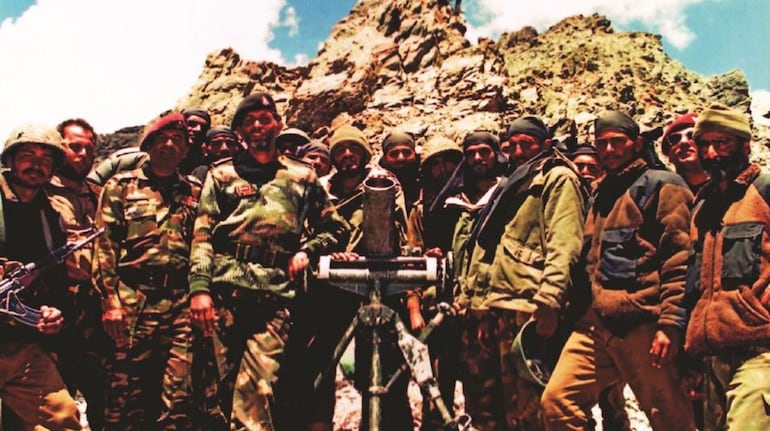
When people talk about the Kargil War, they often mention Tololing and Tiger Hill. But veterans and military historians will tell you that Point 4875 in the Dras sector was just as decisive. Its capture in July 1999 did not merely add another height to India’s tally. It helped end the fight for Dras and secured a critical stretch of the National Highway 1A, the lifeline linking Srinagar to Leh.
Why Point 4875 mattered
Point 4875 was not just another number on a map. Rising to roughly 16,000 feet, it dominated the Mushkoh Valley and overlooked Indian supply routes. According to reporting in The Hindu and Indian Express during and after the conflict, Pakistani intruders had occupied commanding ridgelines in the Dras–Kargil belt, enabling them to observe and direct fire on Indian positions and the highway below. Control of these heights meant control of movement.
By mid-June 1999, Indian forces had begun clawing back peak after peak in the Dras sector. Tololing fell first, then other features. But Point 4875 remained a stubborn, heavily defended objective. Its steep rock faces, narrow approach routes, and well-sited enemy bunkers made a frontal assault costly. Military accounts note that the enemy had the advantage of altitude and prepared defences, forcing Indian troops to attack uphill in exposed conditions.
The units and the climb
The assault on Point 4875 was led primarily by the 13th Battalion of the Jammu and Kashmir Rifles. The operation unfolded in early July, with multiple companies tasked to approach from different directions to dislocate Pakistani defences.
The terrain was brutal. Accounts published in The Print and later regimental histories describe how soldiers had to climb rock faces that were almost vertical. The climbing commenced mostly at night, silently and freezing temperatures, using fixed ropes, ice axes, and sheer muscle power. If they were discovered, there would be heavy machine-gun fire from above.
Among the officers leading from the front was Captain Vikram Batra, who had already played a key role in earlier operations in the sector. On Point 4875, his company was tasked with clearing one of the most strongly held features. According to official citations and widely reported narratives in Indian Express and The Hindu, Batra personally led assaults on enemy sangars and encouraged his men under intense fire. He was killed in action during the battle and was posthumously awarded the Param Vir Chakra.
Another young officer, Lieutenant Anuj Nayyar of 17 Jat, also played a crucial role in operations linked to the feature. He led his men in clearing multiple bunkers and was killed while neutralising enemy positions. He too was awarded the Maha Vir Chakra posthumously.
The fight on the feature
The battle for Point 4875 was not a single charge but a series of close-quarters engagements. Once Indian troops reached the top, the fighting often devolved into bunker-to-bunker combat. At that altitude, artillery support was limited by angles and proximity. Infantrymen had to rely on grenades, small arms, and sheer aggression to clear fortified positions.
Indian Express reports from the period describe how troops pressed forward despite casualties, often dragging wounded comrades to cover while continuing the assault. The capture of key sub-features on the ridgeline gradually broke the coherence of Pakistani resistance. Each cleared bunker reduced the enemy’s ability to dominate the approaches.
By July 7-8, Indian forces had secured the feature after intense fighting. The cost was high, but the tactical payoff was immediate. With Point 4875 in Indian hands, Pakistani positions in the Mushkoh Valley became increasingly untenable.
Why it “sealed” Dras
The phrase is not dramatic exaggeration. Military analyses in The Print and subsequent commemorative pieces in The Hindu argue that once the dominating heights in Dras, including Tololing, Tiger Hill, and Point 4875, were retaken, the Pakistani hold over the sector effectively collapsed.
Point 4875 in particular had provided observation over wide swathes of terrain. Its loss meant that Pakistani forces could no longer effectively threaten the highway in that sector. Combined with diplomatic pressure and sustained Indian offensives across Kargil, Dras, and Batalik, the capture accelerated Pakistan’s decision to pull back.
The broader Kargil context
The Kargil War, fought between May and July 1999, began when Pakistani regulars and irregulars occupied high-altitude positions on the Indian side of the Line of Control. India responded with Operation Vijay, mobilising tens of thousands of troops and extensive artillery support.
The recapture of successive peaks followed a pattern. Identify the intrusion. Establish artillery dominance. Launch infantry assaults at night up near-impossible slopes. Accept casualties. Hold the crest. Repeat. Point 4875 fits squarely into that pattern, but its scale and symbolism elevated it.
The final Pakistani withdrawal, announced later in July after international pressure and battlefield reverses, did not hinge on one peak alone. But without the fall of Point 4875 and similar objectives, the cumulative pressure that forced withdrawal would have been weaker.
Legacy and memory
Today, Point 4875 is sometimes referred to as “Batra Top” in honour of Captain Vikram Batra. Memorials in Dras commemorate those who fell in the Kargil War, and each year tributes recall the cliff assaults that defined the campaign.
What makes Point 4875 endure in public memory is not just the strategic value, but the image it represents: young officers and soldiers climbing into darkness against a prepared enemy, with no guarantee of survival. The story has been revisited in documentaries, regimental accounts, and mainstream reporting in outlets such as Indian Express and The Hindu on Kargil Vijay Diwas anniversaries.
In military terms, the capture of Point 4875 demonstrated that altitude advantage, though formidable, is not invincible when faced with coordinated artillery, determined infantry, and relentless operational tempo. In strategic terms, it reinforced a core lesson of Kargil: high-altitude warfare demands preparation, intelligence vigilance, and political clarity.
In human terms, it remains a reminder of how wars in the Himalayas are often decided not by sweeping manoeuvre, but by men inching up a cliff under fire, determined to take back a single, wind-lashed crest.
Discover the latest Business News, Sensex, and Nifty updates. Obtain Personal Finance insights, tax queries, and expert opinions on Moneycontrol or download the Moneycontrol App to stay updated!
Find the best of Al News in one place, specially curated for you every weekend.
Stay on top of the latest tech trends and biggest startup news.




