






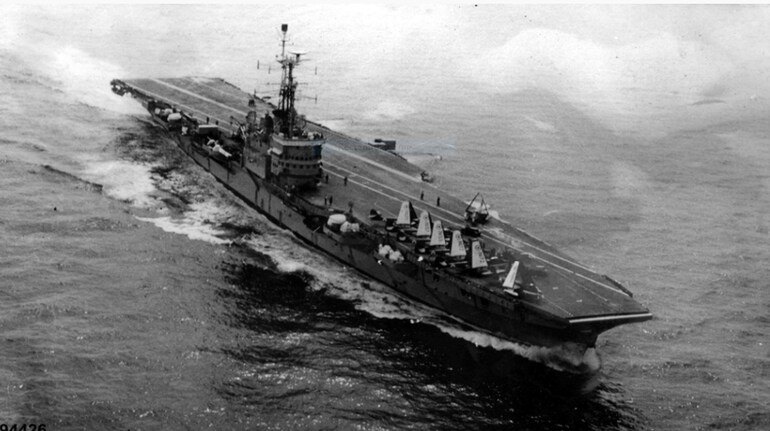
When the 1971 war began, the Indian Navy faced a stark reality. It had only one aircraft carrier in service — INS Vikrant. The ship was not new. She had propulsion limitations and was considered vulnerable. Yet in the eastern theatre, Vikrant became one of the most decisive instruments of the campaign.
Her objective was unambiguous: seize control of the Bay of Bengal and prevent East Pakistan from receiving reinforcements or being evacuated by water.
A calculated risk before war
Tensions with Pakistan were already high by the end of 1971. Naval strategists were aware that Vikrant would be a top target in the event of conflict. The apparent goal of the deployment of Pakistan's submarine PNS Ghazi was to pursue the carrier.
India used dispersal and deception strategies in anticipation. To make Pakistani monitoring more difficult, Vikrant was stationed in the eastern theatre while false signals were produced elsewhere. Although the exact cause of Ghazi's eventual sinking off Visakhapatnam is still up for question, its loss eliminated a significant danger to the carrier at the beginning of the war.
With that danger reduced, Vikrant was free to operate more assertively in the Bay of Bengal.
The logic of a naval blockade
East Pakistan was geographically separated from West Pakistan by more than a thousand miles of Indian territory. Reinforcement by land was impossible. Sea and air routes were therefore critical.
Indian naval strategy focused on cutting those links. If ports were neutralised and shipping deterred, Pakistani forces in the east would be isolated. That isolation would amplify pressure from Indian Army advances on land.
Vikrant was central to this design.
Carrier air strikes on Chittagong and Cox’s Bazar
Once hostilities formally began on December 3, 1971, Vikrant’s Sea Hawk fighter aircraft and Alizé anti-submarine aircraft began operations against targets along the East Pakistani coast.
Air strikes hit port facilities at Chittagong, Cox’s Bazar, Khulna and Mongla. Fuel dumps, warehouses and vessels were attacked. According to contemporary reporting in The Hindu and later military accounts cited by The Indian Express, these strikes disrupted shipping activity and damaged infrastructure critical for sustaining Pakistani forces.
The attacks were not symbolic. They were systematic. Repeated sorties ensured that ports could not function normally, effectively paralysing maritime movement.
Establishing sea control in the Bay of Bengal
Beyond direct strikes, Vikrant’s presence signalled control. Merchant vessels avoided the area. Pakistani naval units in the east were unable to mount a serious challenge.
The blockade meant that Pakistani forces in East Pakistan had no viable maritime escape route. Supplies could not flow in. Reinforcements could not arrive. Evacuation by sea became unrealistic.
Defence commentators writing in The Print have noted that in modern warfare, isolation is often more decisive than destruction. By sealing the coastline, Vikrant contributed to a situation in which the Eastern Command was cut off not just physically but psychologically.
Coordination with land operations
The eastern campaign in 1971 was notable for joint planning. While the Army advanced rapidly toward Dhaka and the Air Force established air superiority, the Navy’s role ensured that the theatre remained closed.
The naval blockade complemented ground manoeuvres. As Indian forces bypassed strongpoints and converged on the capital, there was no risk of significant seaborne reinforcement altering the balance.
This integration stands in contrast to earlier conflicts where services operated more independently. In 1971, at least in the eastern theatre, the strategic objective was shared: compress time and deny the enemy options.
The vulnerability question
INS Vikrant was not without weaknesses. Mechanical constraints limited her top speed. In another scenario, she might have been exposed to concentrated attack.
But in the eastern theatre, the absence of a substantial Pakistani naval presence and the neutralisation of submarine threats allowed her to operate with relative freedom.
Her effectiveness in 1971 later shaped Indian naval thinking. The experience reinforced the value of carrier-based air power in projecting force and controlling sea lanes, especially in enclosed or semi-enclosed maritime theatres.
Strategic impact on the war’s outcome
By mid-December, as Indian forces closed in on Dhaka, East Pakistan was effectively cut off from external support. The surrender on December 16 was shaped by rapid ground advances, air dominance and maritime isolation working in tandem.
It would be simplistic to say Vikrant alone forced the outcome. But without the eastern naval blockade, the strategic picture would have been different. Even limited reinforcement or evacuation efforts could have complicated India’s timeline.
Instead, the carrier’s operations ensured that the Bay of Bengal became, for the duration of the conflict, an Indian-controlled space.
A legacy that endures
INS Vikrant’s role in 1971 remains one of the defining chapters in Indian naval history. It demonstrated that sea control can decisively influence land campaigns. It showed how air power launched from the sea can shape events hundreds of kilometres inland by cutting supply lines.
More than five decades later, as India commissions new carriers and debates maritime doctrine, the 1971 experience continues to serve as reference.
In that war, the carrier did not simply strike targets. It enforced isolation. And in doing so, it helped ensure that the eastern theatre had no exit for the adversary — by land, by air or by sea.
Discover the latest Business News, Sensex, and Nifty updates. Obtain Personal Finance insights, tax queries, and expert opinions on Moneycontrol or download the Moneycontrol App to stay updated!
Find the best of Al News in one place, specially curated for you every weekend.
Stay on top of the latest tech trends and biggest startup news.




