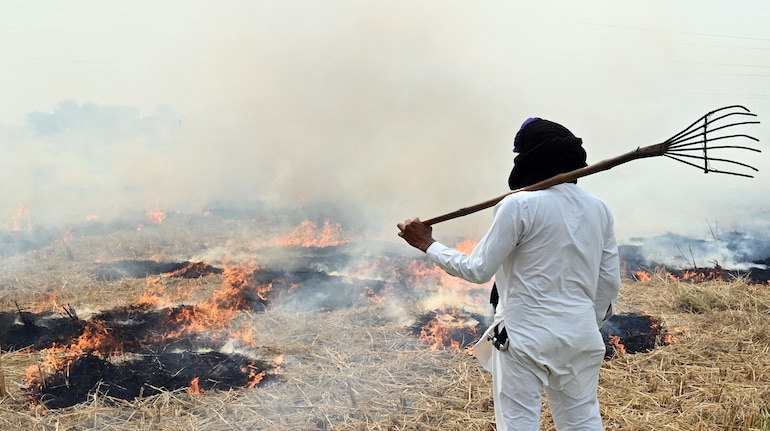
A new environmental study has revealed a major blind spot in India’s stubble-burning monitoring system, raising concerns about the accuracy of the data used to frame air-pollution policies.
According to the International Forum for Environment, Sustainability and Technology (iFOREST), more than 90% of large farm fires in Punjab and Haryana are now occurring in the late afternoon and evening, long after the government’s monitoring satellites have passed over the region.
As a result, official numbers capture only a fraction of the actual farm fires, weakening efforts to assess and control air pollution in northern India.
Fires now burning after 3 pm
The iFOREST report, based on a first-of-its-kind multi-satellite analysis, shows that farmers have shifted the timing of stubble burning significantly in recent years. In Punjab, more than 90% of large fires in 2024 and 2025 took place after 3 pm.
This is a steep rise compared with 2021, when only 3% of such fires occurred late in the day. Haryana, too, has shown a similar pattern since 2019, with most large fires being set in the second half of the day.
However, the monitoring satellites used in India's official CREAMS system, such as NASA’s MODIS and VIIRS, only pass over North India between 10.30 am and 1.30 pm. Fire incidents that take place after this window go undetected. The report warns that this timing mismatch has led to “large-scale undercounting” of farm fires and their emissions. Because policymakers rely heavily on this data for pollution forecasts and enforcement action, the gaps make it difficult to accurately understand the true scale of the problem.
Official decline in fire counts misleading, study says
Government data in recent years has suggested that stubble burning has reduced dramatically. Official satellite-based active fire counts have shown declines of up to 90%, and these figures are often used in policy discussions, court submissions and Delhi’s pollution forecasts. But the new iFOREST study argues that this apparent improvement is misleading because many fires now happen outside the detection window.
A recent RTI reply to the Commission for Air Quality Management (CAQM) shows a similar pattern. Punjab recorded 5,114 farm fires in 2024, down sharply from 10,909 the previous year. Haryana recorded just 662 incidents this year, compared to 1,406 last year. The number of FIRs filed also fell from 6,469 to 2,193, and fines issued by both states dropped significantly.
But experts say these large drops reflect missed detections rather than real progress. The study warns that relying on such incomplete data gives a false sense of improvement and weakens the scientific basis of pollution-control measures.
Burnt-area mapping
While active fire counts are missing most incidents, burnt-area mapping offers a clearer picture of how much land is actually being burned. This method, which is considered more reliable, uses a combination of data from MODIS, VIIRS, Sentinel-2 and Meteosat’s SEVIRI sensor. The iFOREST analysis shows that Punjab has reduced its burnt area from a peak of 31,447 sq km in 2022 to around 20,000 sq km this year, roughly a 35% improvement.
Haryana has also brought its burnt area down from 11,633 sq km in 2019 to 8,812 sq km in 2025. Although this indicates progress, it is far less than the 80-90% decline suggested by official active fire counts.
The report calls on the central government to immediately modernise the monitoring system for stubble burning. It recommends integrating burnt-area mapping into the official reporting process, using geostationary satellites that capture images every 10–15 minutes, and publishing burnt-area data regularly to ensure transparency. The study also highlights the need to track emerging hotspots in states like Uttar Pradesh and Madhya Pradesh.
Discover the latest Business News, Sensex, and Nifty updates. Obtain Personal Finance insights, tax queries, and expert opinions on Moneycontrol or download the Moneycontrol App to stay updated!
Find the best of Al News in one place, specially curated for you every weekend.
Stay on top of the latest tech trends and biggest startup news.