






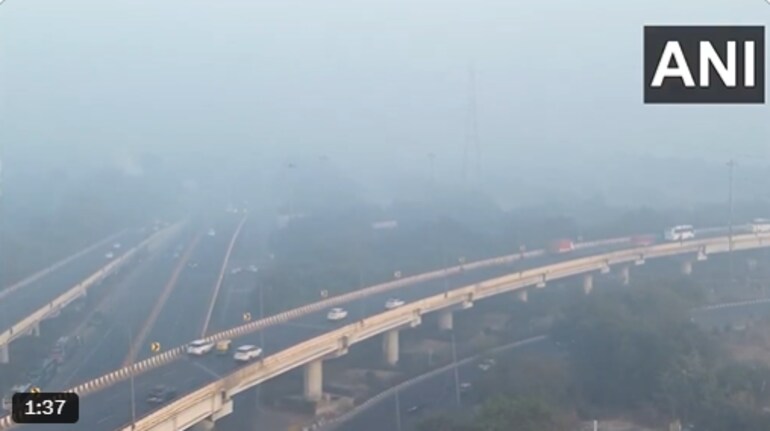
Delhi has been trapped under a thick haze, with the city’s AQI staying in the “very poor” or “Severe category” for weeks now., making the air virtually unsafe for everyone outdoors.
Delhi’s air has slipped into the worst band, with today’s AQI at 374, driven largely by extremely high PM2.5 levels above 350 micrograms per cubic metre.
But the crisis is no longer limited to the capital’s borders, the wider NCR, parts of Uttar Pradesh, Haryana, Punjab and even Dehradun are now mirroring Delhi’s toxic winter air.
NCR towns: No clean escape
For residents of Noida, Ghaziabad, Greater Noida, Gurugram and Faridabad, escaping Delhi’s smog by crossing a border has become a myth.
The 24-hour average AQI in Delhi settled at 334 on Wednesday. In Noida, Greater Noida and Gurugram, all in NCR, the AQI was recorded at 331, 310 and 279, respectively. Gurugram has been keeping relatively better but still unhealthy.
This means the entire core NCR is breathing the same toxic air. The daily commute across city lines adds to vehicular emissions, and dust from expressways, construction corridors and industrial clusters in Ghaziabad and Faridabad feeds back into Delhi’s air.
UP, Haryana and Punjab in the mix
Beyond NCR, several urban centres in Uttar Pradesh and Haryana have also reported “poor to severe” air this season. CPCB’s nationwide bulletin listed many UP cities, including Ghaziabad, Noida in the ‘very poor’ zone while Bulandshahr recorded ‘poor’ air and Bareilly ‘moderate’ on Wednesday.
Notably, the fourth T20I between India and South Africa on Wednesday was cancelled due to poor visibility caused by dense smog at the Ekana Stadium, Lucknow even as the city’s official AQI stood at 174, categorised as moderate.
In Haryana, towns such as Panipat and Hisar have fluctuated between “moderate” and “poor” categories, reflecting the influence of both local industry and regional transport of pollutants.
Punjab, often in the spotlight for stubble burning, contributes significantly during October–November, when thousands of farm fires release plumes that ride north westerly winds into Delhi NCR.
The capital city of Punjab and Haryana, Chandigarh also recorded ‘poor’ air with AQI hitting 275 on Wednesday.
Dehradun and the hills not spared
Perhaps most worrying is that even traditional getaways like Dehradun are no longer guaranteed clean air in winter. The capital of Uttarakhand, over the past two days, has recorded AQI in the "poor" category. Dehradun's real-time AQI on Wednesday hovered between 260 and 300, deteriorating sharply after sunset.
Overall, Delhi may be the face of India’s winter smog crisis, but the problem now stretches across surrounding areas, while other metro cities like Mumbai and Bengaluru have also recorded poor air in recent times.
Discover the latest Business News, Sensex, and Nifty updates. Obtain Personal Finance insights, tax queries, and expert opinions on Moneycontrol or download the Moneycontrol App to stay updated!
Find the best of Al News in one place, specially curated for you every weekend.
Stay on top of the latest tech trends and biggest startup news.




