






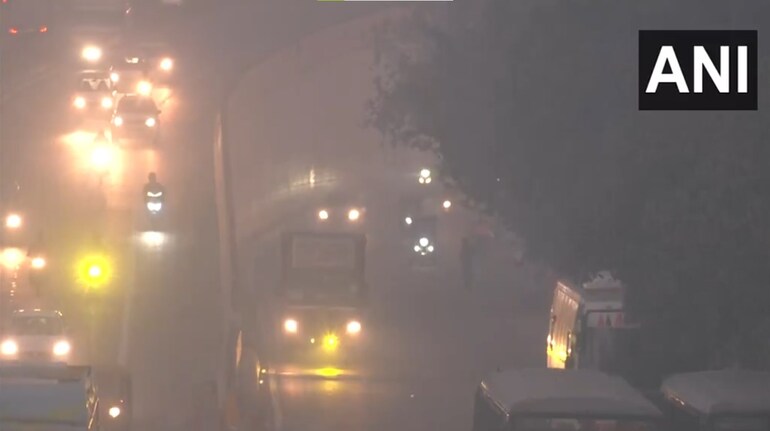
The national capital woke up to a blanket of toxic smog on Friday morning, with the average Air Quality Index (AQI) hitting 329 at 7 am, marking it in the "very poor" category, according to the Central Pollution Control Board (CPCB).
Despite marginal improvements in recent weeks, large parts of the capital remained engulfed in dense and toxic smog. A thick haze was reported in areas such as Ghazipur and Anand Vihar, where visibility remained severely low. According to the CPCB, several localities across the city continued to register "very poor" air quality.
The area around Anand Vihar and Ghazipur was blanketed in a dense layer of toxic smog, with an AQI of 386.
According to CPCB data, Sonia Vihar recorded an AQI of 338, while Wazirpur recorded 382.
Bawana recorded the highest AQI of 365 at 7 am, placing it in the 'very poor' category. In contrast, NSIT Dwarka recorded an AQI of 269, which falls under the 'poor' category, according to data from the Central Pollution Control Board (CPCB).
The Dhaula Kuan area this morning was blanketed by a layer of toxic smog, with an air quality index of 337, categorised as 'Very Poor'.
Additionally, a thick layer of dense fog blanketed several parts of Haryana this morning, reducing visibility and disrupting early travel. According to the India Meteorological Department (IMD), Karnal recorded a minimum temperature of 7°C, marking a notably cold start to the day.
According to AQI categorisation, 0-50 is 'good', 51-100 'satisfactory', 101-200 'moderate', 201-300 'poor', 301-400 'very poor', and 401-500 'severe'. According to CPCB, the AQI, which ranges from 0 to 500, is divided into six categories, each reflecting the level of pollution and associated health risks.
An AQI between 0 and 50 is classified as "Good", indicating minimal or no health impact. AQI levels from 51 to 100 fall into the "Satisfactory" category, where air quality remains acceptable, though sensitive groups such as children, the elderly, and those with respiratory issues may experience slight discomfort.
The "Moderate" category, ranging from 101 to 200, indicates rising pollution levels that can trigger breathing difficulties in people with asthma, lung conditions, or heart disease.
Dangerous levels of AQI have become increasingly common in several parts of the capital during winter. "Very poor" air quality poses a risk of respiratory illnesses, even for healthy individuals, when exposure continues for prolonged periods.
Discover the latest Business News, Sensex, and Nifty updates. Obtain Personal Finance insights, tax queries, and expert opinions on Moneycontrol or download the Moneycontrol App to stay updated!
Find the best of Al News in one place, specially curated for you every weekend.
Stay on top of the latest tech trends and biggest startup news.




