






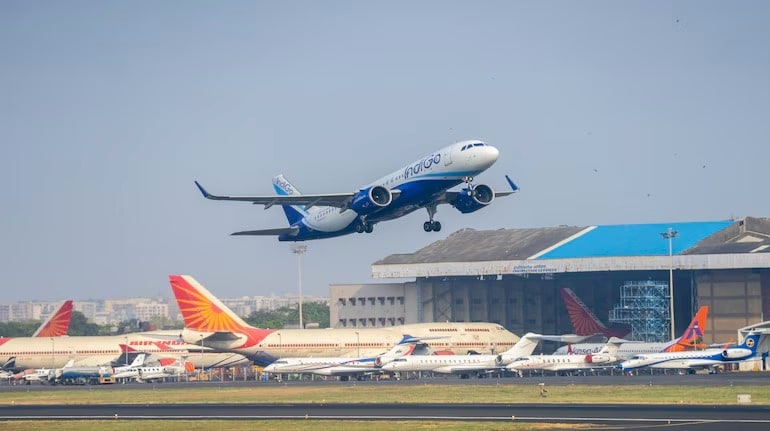
In a bid to dramatically boost efficiency and safety within its saturated airspace, Mumbai’s Chhatrapati Shivaji Maharaj International Airport (CSMIA) is poised for a fundamental technological shift.
Rather than relying on physical expansion, the airport plans to overhaul how aircraft are guided to land using an advanced, time-based precision system, an exclusive report by CNN-News18 reveals.
The Airports Authority of India (AAI) has initiated a global tender process to procure, install and implement an “Intelligent Approach” system, targeting an operational launch before the end of 2028. The upgrade, centred on Time-Based Separation (TBS) technology, aims to replace estimation-heavy methods with machine-enabled decision support for air traffic controllers.
“Less guesswork, more precision,” a senior official was cited by CNN-News18 as saying, encapsulating the goal of the project.
Currently operating as the world’s busiest single-runway airport for mixed-mode traffic, CSMIA handled over 55 million passengers and 330,000 aircraft movements in the 2024-25 financial year. Its capacity is capped at approximately 44-46 movements per hour, with congestion, aircraft bunching and peak-hour spillovers frequently forcing traffic restrictions and heightening controller workload.
The proposed system is designed to unlock new flight slots by enabling tighter, yet safer, sequencing of aircraft on final approach. It will provide controllers with real-time tools to calculate optimal arrival times, factoring in variables like aircraft performance, wake turbulence and weather conditions. This precision is expected to allow operations to run closer to the runway’s true maximum theoretical capacity.
Beyond easing congestion, the initiative promises significant ancillary benefits. By optimising approach paths and reducing unnecessary track miles, airlines could achieve substantial fuel savings and lower carbon emissions. Controllers, meanwhile, would gain enhanced situational awareness and the ability to plan proactively rather than reactively.
The plan represents a critical piece of future-proofing for India’s second-busiest airport. With national air travel demand projected to grow at an average of 5.6% annually for the next twenty years, pressure on Mumbai’s infrastructure is set to intensify.
While the upcoming Navi Mumbai International Airport will absorb future growth, CSMIA itself is not at a hard stop — its Terminal 2 is already undergoing expansion to add capacity for five million more passengers a year.
Crucially, the new Intelligent Approach system will be integrated into the existing air traffic management (ATM) automation platform. It will also be designed to manage approaches for both CSMIA and the forthcoming Navi Mumbai airport through a common control framework, ensuring coordinated use of the region’s congested airspace.
The foundation for this upgrade is already in place. Mumbai’s air traffic control has reportedly strengthened surveillance via Automatic Dependent Surveillance (ADS) systems, is nearing full integration of Advanced Arrival and Departure Manager tools and has begun implementing digital controller-pilot data link communications for equipped aircraft.
Discover the latest Business News, Sensex, and Nifty updates. Obtain Personal Finance insights, tax queries, and expert opinions on Moneycontrol or download the Moneycontrol App to stay updated!
Find the best of Al News in one place, specially curated for you every weekend.
Stay on top of the latest tech trends and biggest startup news.




