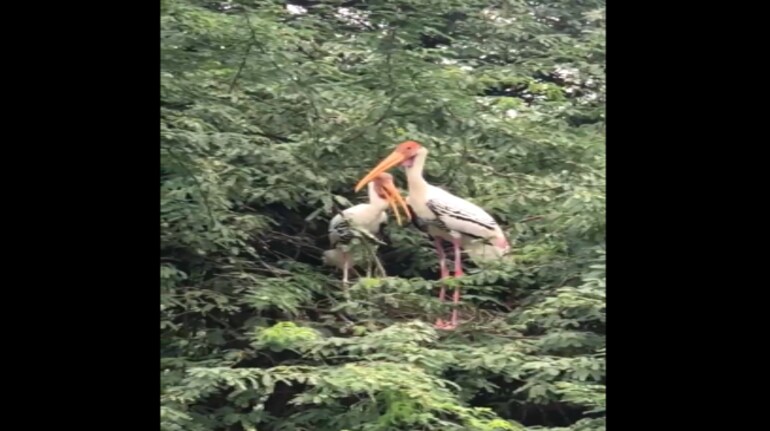
The Delhi zoo has been closed for visitors until further order after two painted storks were found infected with the H5N1 bird flu virus.
In an official statement, the National Zoological Park in Delhi confirmed an outbreak of the H5N1 avian influenza virus after two painted storks in the waterbird aviary died and tested positive. The zoo was temporarily closed to visitors as a precautionary measure to prevent the disease from spreading.
Citing sources, the Times of India reported that another captive bird, an ibis, died too, and its sample was also being sent to Bhopal. National Institute for High Security Animal Diseases, Bhopal, reported both samples of the dead painted storks positive for the virus on Thursday evening, the zoo stated.
It added that "immediate action has been initiated in accordance with Chapter VI of Guidelines for Zoological Park of Action Plan for Preparedness, Control and Containment of Avian Influenza (revised-2021) issued by the ministry of fisheries, animal husbandry and dairying, Govt of India, to prevent its spread to other animals, birds, and safeguarding staff of the zoo".
Officials were quoted by TOI as saying that intensive surveillance and strict bio-security measures had been put in place to prevent the spread of the disease.
"Further, in the interest of public health, safety and to strengthen bio-safety protocol, the zoo will be temporarily closed for visitors from Aug 30, 2025, until further order," the zoo stated in its statement.
Considered highly pathogenic, avian influenza is a virus that primarily affects birds, but can also impact human beings and other mammals, and can be deadly.
As per the report, the virus had forced the zoo to shut its door for visitors in 2021 and 2016 too. According to official sources, the zoo will be shut for at least three to four weeks before they screen and ensure that it's completely free of the virus.
TOI reported that currently, prevention was the prime concern, which began with curtailing the infected area and treating the birds showing signs of influenza.
"In the case of poultry or livestock setup, the prevention includes culling of the entire flock/stock. However, this is not possible in the case of wild birds or captive zoo birds. So preventive measures are taken," an official was quoted by TOI as saying.
"There is a large SOP for the same, starting from no vehicles being allowed to exit without a tyre bath, staff wearing protective gear before entering animal cages, all animals being observed twice a day, regular disinfection, etc.," he added, clarifying that the linkage must be broken to end the infection.
Officials explained that random samples would be sent every 15 days for at least three times, and if all three turned out to be negative, the authorities might take a call to reopen the zoo. Speaking on the diet of the predators like tigers, officials were quoted by TOI as saying that the chicken given to these animals was already treated, and since there was no outbreak outside the zoo, they didn't see any reason to stop sourcing chicken.
"Had there been a case in Delhi or elsewhere as well, we would have avoided such food completely. But since there is no outbreak or any case reported, we will continue giving chicken. Still, we are treating it with chlorine water," people familiar with the matter told TOI.
Discover the latest Business News, Sensex, and Nifty updates. Obtain Personal Finance insights, tax queries, and expert opinions on Moneycontrol or download the Moneycontrol App to stay updated!
Find the best of Al News in one place, specially curated for you every weekend.
Stay on top of the latest tech trends and biggest startup news.